
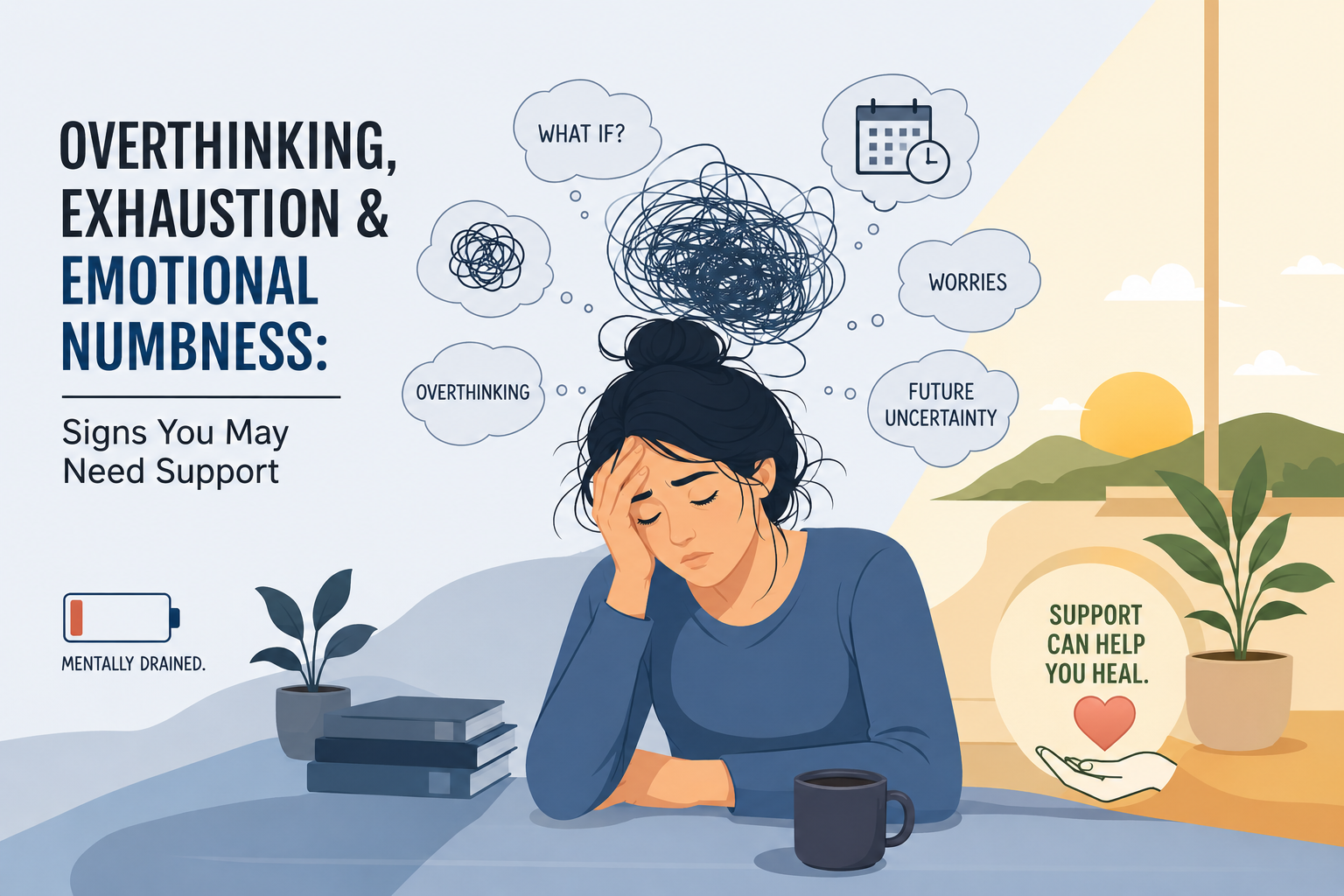
Have you ever ended the day feeling completely drained despite not doing anything physically demanding?
Your mind has been busy all day; replaying conversations, worrying about future outcomes, analysing decisions, anticipating problems, and trying to stay on top of endless responsibilities. By the time evening arrives, you're exhausted. Yet when someone asks what's wrong, you struggle to explain it.
This is the reality for many people living with chronic overthinking, emotional exhaustion, and anxiety. Because these experiences develop gradually, they often become normalised. People assume they're simply stressed, busy, or going through a difficult phase.
What they don't realise is that persistent mental fatigue and emotional numbness can sometimes signal deeper emotional struggles.
When Your Mind Never Gets a Day Off
According to the World Health Organization, anxiety and depression affect hundreds of millions of people worldwide. For many, the first signs aren't obvious; they show up as mental exhaustion, overthinking, and feeling emotionally checked out.
Overthinking is often mistaken for problem-solving. It feels productive because the brain is constantly searching for answers. In reality, many people find themselves trapped in repetitive thought loops that generate more anxiety than clarity.
Common signs include:
- Replaying conversations long after they've ended
- Constantly questioning decisions
- Imagining worst-case scenarios
- Struggling to switch off, even during downtime
- Feeling mentally busy but emotionally stuck
The challenge is that overthinking consumes enormous amounts of emotional energy. Eventually, the mind becomes so focused on analysing life that it forgets how to experience it. For some, this can gradually develop into struggles that may require treatment for depression and anxiety in Mumbai.
Emotional Numbness Isn't the Same as Feeling Fine
One of the most misunderstood signs of emotional distress is numbness. People expect mental health struggles to feel intense, but many experience the opposite.
Life starts feeling muted.
Achievements don't bring the satisfaction they once did. Exciting events feel strangely flat. Relationships continue, but the emotional connection feels weaker. Instead of sadness, there's often a sense of disconnection.
Many people describe it as "going through the motions." They're functioning, but not fully present.
Emotional numbness can make life feel distant, even when everything appears fine on the surface. For many individuals, working with an experienced therapist like Aanchal Narang helps them reconnect with their emotions and rediscover a sense of meaning, joy, and presence in their daily lives.
The Exhaustion of Always Being "On"
Modern life rewards constant availability. We're expected to respond quickly, stay productive, remain emotionally composed, and manage multiple responsibilities simultaneously.
Over time, this creates a hidden form of burnout.
You may notice:
- Small tasks feel unusually overwhelming
- Rest doesn't feel restorative
- Motivation fluctuates dramatically
- Social interactions feel draining
- You feel tired even after a quiet day
These signs are often dismissed because they don't seem serious enough. However, emotional exhaustion rarely appears overnight; it builds gradually until functioning starts requiring far more effort than it should, leading many people to explore treatment for depression and anxiety in Mumbai.
Why People Wait Too Long to Seek Help
One of the biggest barriers to support is the belief that things aren't "bad enough."
People often tell themselves:
- "Others have it worse."
- "I'm still managing."
- "I should be able to handle this."
- "It's probably just stress."
The problem is that emotional wellbeing isn't measured by how much you're struggling compared to someone else. If overthinking, exhaustion, or numbness are affecting your quality of life, they deserve attention.
Seeking support isn't about waiting for a crisis. It's about recognising when you're carrying more than you were meant to carry alone.
What Professional Support Can Offer
Therapy provides a space to understand the patterns beneath the symptoms. Through therapy for depression and anxiety, individuals can learn why certain thought patterns persist, how emotional exhaustion develops, and what healthier coping strategies look like.
Support can help with:
- Managing anxiety and overthinking
- Processing difficult emotions
- Building emotional resilience
- Improving self-awareness
- Reconnecting with personal wellbeing
Mental health professionals such as Aanchal Narang often work with individuals who appear highly functional on the outside but feel emotionally depleted on the inside. The goal isn't to "fix" a person; it's to help them understand themselves with greater clarity and compassion.
Remember:
Overthinking, exhaustion, and emotional numbness are often dismissed as unavoidable parts of modern life. Yet when they become constant, they may be signalling that something deeper needs attention.
You don't have to wait until you're overwhelmed to seek support. If your mind feels permanently switched on, your energy feels depleted, or life feels increasingly disconnected, it may be worth exploring treatment for depression and anxiety in Mumbai. Sometimes the most important step isn't pushing harder; it's pausing long enough to ask what your mind has been trying to tell you all along.
For many individuals, working with professionals like Aanchal Narang becomes the beginning of a healthier relationship with themselves, one where surviving gradually gives way to living.