
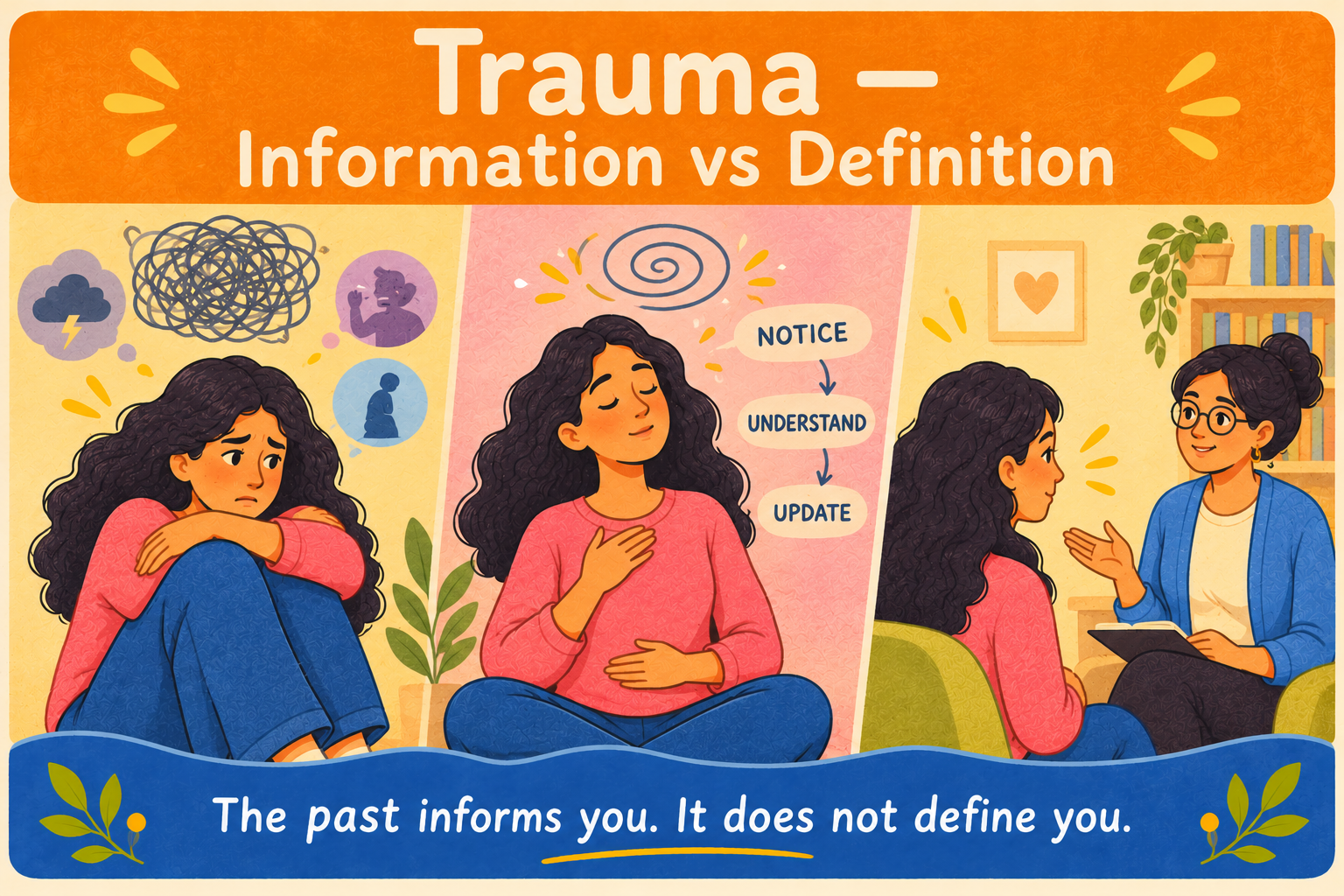
Trauma — Information vs Definition
There is a peculiar way in which we tend to understand trauma.
“Something happened”.
It was frightening, overwhelming, violating, humiliating, painful, unexpected, or simply too much for a person to process at the time. Then, quite naturally, we give the experience a name: Trauma.
Naming something is not the same as understanding it, and speaking about something is not the same as processing it. This distinction becomes extremely important in therapy because trauma work can easily become reduced to a deceptively simple instruction: Tell me what happened. What happened? Who was there? What did they say? What did you do? What happened next? These questions are necessary, and sometimes they are profoundly important, but the story of the event is only one layer of trauma. The more complicated question is what the event came to mean inside the person. What did the nervous system learn? What did the body begin to expect? What became dangerous? What became necessary for survival? What did the person stop asking for? What did they begin believing about themselves, other people, relationships, safety, conflict, intimacy, authority, rejection, or even their own emotions? This is where trauma begins to move from definition to information.
The Event Is Not the Entire Trauma
Consider someone who grew up in a household where anger was unpredictable. Perhaps nothing happened every day. Perhaps there were periods of affection, ordinary conversations, even moments of genuine warmth. But there was always a possibility: a door closing too loudly, a particular tone of voice, footsteps becoming heavier, a change in facial expression, silence lasting slightly longer than usual. The child learns to notice. Not because they are naturally hyper-observant, but because observation becomes useful. The body begins scanning before the conscious mind has even formulated a thought: Is something wrong? Do I need to leave? Should I stay quiet? Should I make myself useful? Should I make them happy? Should I apologise?
Years later, that person may describe themselves as someone who "overthinks." They may say, "I don't know why I constantly analyse people's moods," or "I can't relax when someone is upset with me," or "I know logically that they're not angry, but my body doesn't believe me." If therapy focuses exclusively on the original event, something important can be missed. The trauma is not only the memory of an angry parent. The trauma may also be the information encoded through repeated experiences: anger means danger; someone else's discomfort means I have done something wrong; safety depends on anticipating other people's needs; my needs can wait; conflict must be prevented; relaxation is possible only when everyone else is okay.
Now the therapeutic question becomes different. It is no longer merely, What happened to you? It becomes, What did you learn to do because of what happened to you? And perhaps even more importantly, do you still need to do it now?
Trauma becomes a Way of Organising Experience
Trauma does not simply sit inside memory like an old photograph stored in a drawer. It can become a way of organising attention, interpreting situations, anticipating the future, relating to the body, relating to other people, and relating to oneself. This is why two people can experience apparently similar events and carry very different psychological consequences. The important information is not simply what occurred. It is also how the person experienced it, what resources were available, what meaning was constructed, whether there was escape, whether there was support, whether the experience was repeated, and what the person subsequently learned about themselves and their environment.
Trauma processing therefore cannot simply mean remembering. Memory is already present. The therapeutic task is often to help the person develop a different relationship with what the memory currently communicates. A traumatic experience may continue to communicate messages such as, You are unsafe. You have no control. You cannot trust anyone. Your body will betray you. You have to stay alert. You must not say no. If someone leaves, it is because you were not enough. If someone is angry, you are responsible. These conclusions may once have made psychological sense. They may even have helped the person survive. But survival strategies can outlive the environments that created them. This is where trauma therapy becomes less about deleting the past and more about updating the present.
Processing Is Not “Simply Talking”
There is something deeply valuable about telling one's story: being believed, being heard, putting language to what previously existed only as fragments, connecting events that once felt unrelated, and recognising that something was not "just in your head." There can be enormous therapeutic value in this. But talking about trauma can also become another form of avoidance. A person can become extraordinarily articulate about their trauma while remaining disconnected from what happens inside them. They can explain the event beautifully, analyse the perpetrator, understand the family system, read every book about trauma, know every diagnostic term, and still have no idea what happens in their chest when somebody raises their voice. They may still struggle to identify anger before it becomes resentment, experience guilt whenever they say no, freeze when someone expresses disappointment, confuse emotional intensity with intimacy, or have difficulty recognising what they actually want.
Information about trauma is not automatically the processing of trauma. Knowing why something happens does not necessarily mean the nervous system has learned something different. This is one of the reasons trauma processing needs to be systematic. Not mechanical, not rigid, and certainly not something that can be reduced to a universal sequence of questions, but intentional. There needs to be a movement between remembering, observing, experiencing, understanding, regulating, integrating, and eventually responding differently.
Trauma Processing as a Systematic Procedure
Trauma processing often begins long before the traumatic memory is directly explored. There needs to be enough stability for the person to approach difficult material without becoming completely overwhelmed by it, enough awareness to recognise activation, enough capacity to return to the present, enough trust to say I don't want to go there today, enough therapeutic safety for uncertainty, and enough body awareness to notice when something is changing.
This matters because trauma processing is not simply an exercise in emotional intensity. More emotion does not automatically mean more healing. Sometimes the most therapeutically important moment is not a dramatic emotional release but a person noticing, "My shoulders became tense when you asked me that," or "I stopped breathing when I started talking about my father," or "I noticed I was smiling while describing something that was actually frightening." These observations create information, and information creates choice.
The therapist's role is not necessarily to force the client further into the memory but to help the client become increasingly capable of observing what happens when they approach it. What changes in the body? What emotion appears first? What thought arrives automatically? What impulse follows? What does the person want to do? Run, hide, fight, please, freeze, explain, apologise, become invisible, take control? These responses are not simply behaviours to eliminate. They are clues about what the person has learned to expect.
From the Story to the Experience
The traumatic event can initially be approached as a story, but trauma processing eventually needs to move toward the experience of that story. What happens while the person talks about it? What happens in the body? What emotion appears first? What happens immediately before that emotion? What does the person predict will happen next? What do they want to do when the feeling arrives?
A clenched jaw may not "mean" one particular thing. A racing heart may not automatically indicate trauma. A stomach sensation is not a magical diagnostic instrument. The body provides information, not unquestionable truth. The therapeutic task is therefore curiosity: What happens here? What does your mind predict? What does your body prepare you for? What do you want to do? What do you actually need?
That final distinction can be enormous because trauma can make survival needs and authentic needs difficult to distinguish. A person may have become exceptionally good at preventing rejection but have very little understanding of what they actually want from a relationship. They may know how to keep someone happy but not how to experience mutuality. They may know how to avoid conflict but not how to tolerate healthy disagreement. They may know how to protect themselves from abandonment but not how to allow themselves to become emotionally close to another person.
What Did You Need Then? One of the most powerful questions in trauma work can be deceptively simple: What did you need that you did not receive?
Protection? Permission? Comfort? Choice? Someone to believe you? Someone to intervene? Freedom to say no? A safe adult? Recognition? Affection? Space? Predictability? Boundaries?
Sometimes the answer is obvious. Sometimes it takes considerable therapeutic work before a person can even formulate the question. A client may initially say, "I don't know." That I don't know can itself become information. Perhaps nobody ever asked. Perhaps wanting something felt dangerous. Perhaps their role was to accommodate rather than to need. Perhaps they learned very early that identifying a need did not guarantee that someone would meet it.
And then comes another question: Do you still need that now?
Not necessarily from the person who failed to provide it. Not necessarily in exactly the same form. But as an adult, what does that unmet need look like today? A need for safety might now require boundaries. A need for recognition might involve learning to acknowledge one's own achievements. A need for autonomy might require practising disagreement. A need for protection might involve learning to leave situations that repeatedly cause harm. A need for connection might require risking appropriate vulnerability.
Trauma processing can therefore become a movement from what happened toward what is needed now. The past provides information about the origin of the need, while the present provides an opportunity to understand how that need can be met differently.
The Body Has to Become Part of the Conversation
Trauma is often discussed through language, but much of traumatic experience is encountered through the body: tension, numbness, agitation, collapse, restlessness, shallow breathing, a racing heart, a heavy chest, a sudden urge to leave, difficulty making eye contact, feeling disconnected, feeling unreal, or feeling suddenly very small.
These experiences deserve attention without being turned into rigid interpretations. Body awareness is not about becoming obsessed with every sensation. It is about developing enough familiarity with one's internal landscape to recognise change. This is what anxiety feels like in me. This is what anger feels like before I become reactive. This is what happens when I feel trapped. This is what happens when someone respects my boundary. This is what safety feels like.
That last one matters. Trauma work should not become an endless excavation of suffering. The body also needs opportunities to experience stability, choice, orientation, grounding, connection, agency, rest, pleasure, movement, and safety. Otherwise, therapy can inadvertently teach a person to become exceptionally good at finding what is wrong while remaining unfamiliar with what is okay.
Stability is therefore not separate from trauma processing. It is part of it. A person who can recognise activation, regulate enough to remain present, orient themselves to the current environment, and notice the difference between past and present has more room to approach traumatic material without becoming consumed by it.
Reprocessing Is About Updating Information
Perhaps this is the most important distinction. Trauma processing is not an attempt to convince someone that the past was not painful. It was. It is not an attempt to manufacture a positive interpretation, and it is certainly not about telling someone to "let go." It is about creating enough psychological and physiological capacity for previously overwhelming information to be encountered differently.
The past can remain true and yet its meaning can change. I was powerless then does not have to become I was never powerless. It can become: I was powerless in that situation, and I have more choices now. I had to stay alert then can become: My vigilance protected me then. I don't need it at the same intensity everywhere now. I learned that saying no was dangerous can become, saying no once carried consequences. Today I can learn what happens when I set appropriate boundaries.
This is not positive thinking. It is psychological differentiation. Then is not now. Memory is not current reality. Activation is not always danger. A feeling is not always an instruction. A bodily response is not necessarily a prediction. A survival strategy is not necessarily an identity.
Trauma as Information
Perhaps we need to become more careful about the language we use. I am traumatised may sometimes become an identity rather than a description. I have trauma may describe history but tell us little about the person's current experience. What if we became curious about what the trauma is communicating instead?
What does it tell you about what you learned? What does it tell you about what you fear? What does it tell you about what you need? What does it tell you about what you protect? What does it tell you about what you avoid? What does it tell you about how your body responds to threat? What does it tell you about the relationships you repeatedly create or tolerate?
And perhaps the most uncomfortable question is this: What information from the past are you still using to make decisions about the present?
That question changes the therapeutic conversation because the goal is not simply to remember differently. It is to perceive differently, notice differently, respond differently, inhabit the body differently, recognise needs earlier, distinguish triggers from present circumstances, and develop the capacity to remain present when the past suddenly becomes psychologically loud.
Trauma processing, then, is not merely speaking about what happened. It is a gradual and intentional process of allowing a person to approach what happened with increasing stability, observe what it continues to do to their body and mind, understand the needs and protective strategies that developed around it, and begin separating old information from present reality.
Perhaps trauma is not something we simply "get over." Perhaps it is something we learn to read differently.
The event remains part of the story. The body remembers that it happened. The mind remembers what it meant.
Therapy can create enough space for the person to ask a different question: What does this information mean about my life now? Somewhere within that question lies the possibility of something more important than forgetting.
The possibility of making it yours, to own, to keep, to live with. The Trauma does not define you, it informs you and allows you to regain clarity, control, and curiosity