
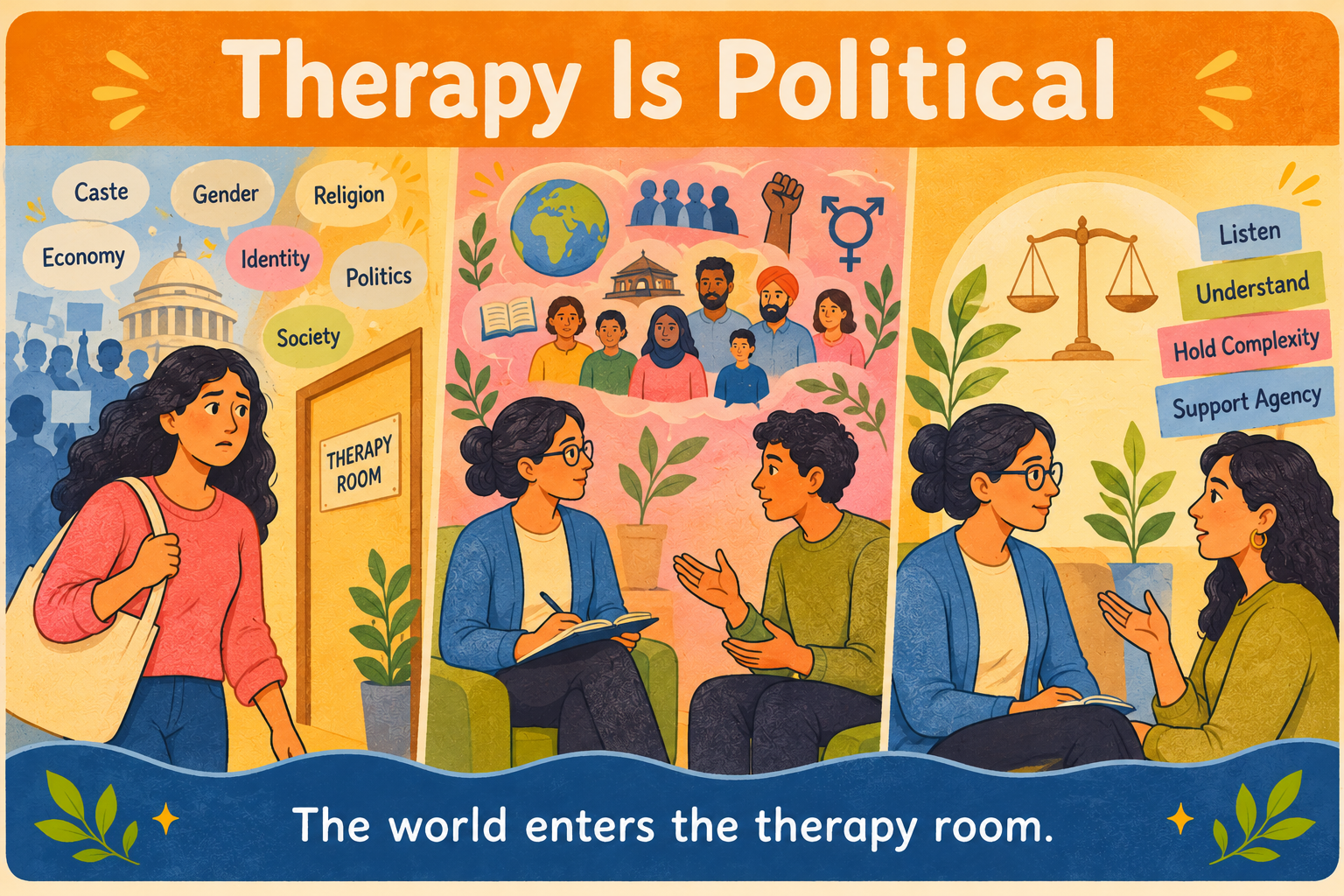
Therapy is Political
There are seasons in a nation's life when politics refuses to stay where we would like it to. It escapes parliamentary debates and election rallies. It leaves television studios and enters kitchens, classrooms, cafés, WhatsApp groups and dinner tables. Eventually, it enters therapy rooms.
The recent protests at Jantar Mantar are one such reminder. Regardless of where we stand politically, or whether we choose to stand anywhere at all, moments like these reveal something uncomfortable. Politics is never just about governments. It is about people. It is about whose voices are amplified, whose fears are dismissed, whose grief is recognised and whose existence becomes negotiable.
For therapists, these moments raise an unavoidable question.
Can therapy ever truly be apolitical? Many would like the answer to be yes.
The consulting room, they argue, should be a sanctuary from politics. Therapy should concern itself with thoughts, emotions, relationships and healing. Politics should remain outside.
The appeal of that position is understandable. But it is impossible.
Not because therapists become political commentators or ideological campaigners. Not because every session involves discussions of elections or legislation. Rather because human beings do not arrive in therapy as isolated minds. We arrive as people whose identities have already been shaped by countless systems of meaning, power, history and culture.
There is perhaps no such thing as an apolitical life.
Only lives whose politics remain invisible to those privileged enough not to notice them.
Therapy begins with a deceptively simple observation. Human beings are thrown into a world they did not choose.
None of us chose where we were born. None of us chose our family. Our language. Our religion. Our caste. Our skin colour. Our gender. Our nationality. Our economic circumstances. Our bodies.
Before we ever developed a personality, the world had already begun making decisions about us. Some of those decisions opened doors. Others quietly closed them. This is not merely sociology. It is psychology.
Psychology often asks, "How do I live?" Politics asks, "Who gets to live freely?"
These questions cannot be separated. When clients enter therapy, they rarely say, "Politics is making me anxious." Instead they say… "I don't feel safe." "I never feel good enough." "I feel guilty for wanting something different." "I don't know where I belong." "I'm exhausted." "I feel invisible." "I don't know who I am anymore." These sound like deeply personal struggles.
Often they are. They are also profoundly political.
Frantz Fanon observed that oppression eventually becomes psychological. Paulo Freire argued that systems of domination reshape consciousness itself. bell hooks repeatedly reminded us that love cannot exist without justice. Judith Butler questioned how societies decide whose lives are considered grievable and whose are rendered invisible.
Psychology has never existed outside these conversations. Neither have therapists. The difficulty is that politics is often misunderstood. Politics is not simply voting. Politics is the distribution of power. It determines which stories become history. Which languages survive. Which identities require explanation. Which bodies are welcomed. Which bodies are feared. Which families are considered "normal." Which grief receives public mourning. Even language is political.
There are experiences that some cultures possess words for while others do not. There are emotions that become impossible to express because no socially acceptable vocabulary exists. There are identities people spend decades discovering simply because nobody ever gave them language to describe what they already felt. Language does not simply describe reality. Language creates reality. The same can be said of ideas. What we call common sense is often inherited ideology.
Take independence. Many Indian children grow up hearing that obedience is respect. Questioning elders is disrespect. Sacrifice is virtue. Family comes first. Duty precedes desire. None of these beliefs are inherently wrong. Neither are they universally true. Yet many adults spend years believing that saying "no" makes them selfish. Not because they independently reached that conclusion. But because the social world reached it first.
Therapy frequently becomes the first place where inherited truths are examined rather than simply obeyed. This is why therapy inevitably brushes against politics. Not because therapists introduce ideology. Because clients eventually begin questioning it. Perhaps nowhere does this become clearer than when working with people whose existence has itself become politicised. A woman who refuses prescribed gender roles. A queer adolescent wondering whether authenticity is worth rejection. A transgender adult navigating healthcare systems that repeatedly ask them to justify their existence. A Dalit student carrying generations of exclusion into elite educational spaces. A tribal elder watching forests become commodities while being told that displacement is development. A Muslim family living with uncertainty after another episode of communal tension. A person with disability repeatedly asked to adapt to environments that were never built with them in mind.
None of these people require therapy because they are political. They require therapy because politics has already entered their lives. The consulting room cannot pretend otherwise. Therapists often speak about neutrality. Neutrality deserves closer examination. Neutrality sounds ethical. Sometimes it is. Sometimes it becomes avoidance.
If a client describes experiencing caste discrimination and the therapist responds only with cognitive restructuring, something essential has been missed. If a queer client fears rejection and the therapist frames the problem purely as anxiety, reality has quietly disappeared from the room. If a woman describes systemic sexism and the conversation immediately becomes about communication skills, suffering has been individualised while power remains invisible. Neutrality can unintentionally protect existing structures because it mistakes unequal realities for equal perspectives.
The therapist's responsibility is therefore neither agreement nor disagreement. It is witness. To witness is radically different from taking sides. Witnessing requires acknowledging reality without rushing to simplify it.
It asks difficult questions. What happened to you? Who benefited? Who was silenced? What meanings have you inherited? Which of those meanings still belong to you?
Therapy has always understood that freedom is complicated. Freedom is never limitless. We choose within conditions we did not choose. Every decision involves loss. Every authentic life disappoints someone. This becomes painfully clear inside therapy. Clients often ask whether they should prioritise themselves or their families. Safety or authenticity. Belonging or truth. Tradition or individuality. The therapist cannot answer these questions. Nor should they. Instead, therapy creates space for a deeper inquiry.
What is socially acceptable? What is legally permissible? What is morally defensible? What is psychologically necessary?
These categories overlap less often than we would like. History repeatedly demonstrates that legality is not always justice. Culture is not always compassion. Tradition is not always wisdom. Equally, rebellion is not always liberation. The therapist's work lies in helping clients tolerate this ambiguity without collapsing into certainty. This is perhaps one of the greatest challenges facing therapists today. We are living through an era increasingly uncomfortable with complexity. Public conversations reward certainty. Algorithms reward outrage. Political identities become moral identities. Disagreement becomes betrayal. Curiosity becomes weakness. The pressure to immediately know where everyone stands has become immense. Therapy offers something radically different. It slows time. It refuses premature conclusions. It invites contradiction.
A person can love their family while recognising the harm they endured within it. A client can appreciate aspects of tradition while questioning others. Someone can deeply love their country while grieving its failures. Hope and disappointment can coexist. Love and anger can coexist.
Fear and courage can coexist. Human beings have always been larger than ideological categories. Good therapy remembers this. But remembering it requires preparation. Curiosity alone is insufficient. Therapists must continually educate themselves. Not to become experts on every marginalised experience, which is impossible. But to recognise the limits of their own understanding. Reading feminist scholarship matters. Reading Dalit writers matters. Listening to queer voices matters. Understanding disability justice matters. Learning from tribal communities matters. Studying history matters. Not because therapy should become political education. Because therapists cannot meaningfully understand human suffering while remaining ignorant of the worlds producing it. Perhaps most importantly, therapists must become comfortable having difficult conversations. Not performatively. Not to demonstrate social awareness. But because difficult conversations are where relationships either deepen or collapse.
When a therapist can remain emotionally available while discussing caste, religion, gender, sexuality, privilege or prejudice without becoming defensive, dismissive or fragile, something remarkable happens.
The client discovers that honesty does not necessarily destroy connection. This is profoundly healing. Healing has always been relational. The opposite of trauma is not merely calm. It is connection. Connection capable of surviving truth. If you are considering therapy and wonder how politics should appear in the consulting room, you need not search for a therapist who shares every one of your beliefs. Agreement is comforting. It is not the same as safety. Instead, ask different questions.
Can this therapist remain curious when we disagree? Can they acknowledge structural injustice without reducing me to victimhood? Can they recognise my agency without denying the realities constraining it? Can they tolerate complexity? Can they admit when they do not know? Do they ask questions that help me think rather than questions designed to make me agree? Do I leave sessions feeling more capable of engaging with the world, or merely more certain of my therapist's opinions?
Therapists do not recruit followers. They cultivate thinkers. They do not hand clients ready-made answers. They accompany them as they search for their own. Because therapy was never meant to tell people what to believe. It was meant to help people discover how to live. And learning how to live honestly, responsibly and courageously inside a world shaped by power, history and inequality will always be political. Not because therapy chooses politics, but because politics has always shaped the lives of the people who come seeking healing.
The therapy room is not an escape from the world. It is one of the few places where the world can be encountered slowly enough that we begin to understand not only what has happened to us, but also who we wish to become in response.