
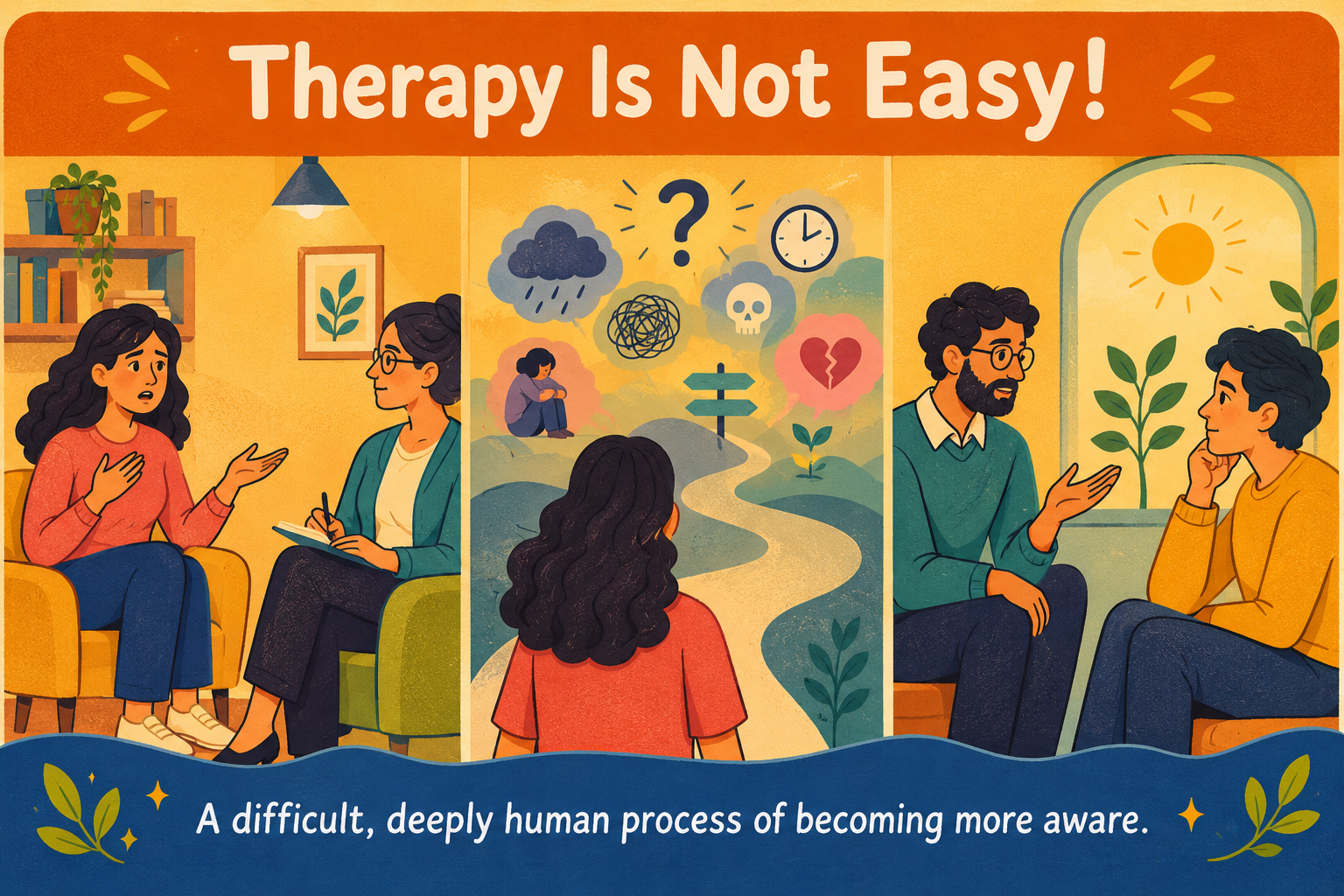
Therapy is not easy!
Therapy is often spoken about in extremes. For some, it is a miracle cure, a soft room where healing arrives through insight and reassurance. For many, it is an unnecessary indulgence, a replacement for friendship, spirituality, resilience, or “real life.” Somewhere between these poles lies a quieter, more complicated truth: therapy is difficult work.
Not because it is inherently harmful, but because genuine self-examination rarely comes without discomfort. Existential therapy, in particular, does not promise escape from the realities of being human. Instead, it asks people to encounter them more honestly: freedom, loneliness, mortality, responsibility, uncertainty, desire, regret, meaning. These are not small subjects.
In a cultural moment where therapy is simultaneously romanticized, commodified, dismissed, and misunderstood, it becomes important to ask a simple but unsettling question
What actually happens in therapy?
The answer may genuinely surprise you.
Misconceptions About Therapy
Recently, public comments made by Bollywood Actress Mrs. Neetu Singh sparked conversation online when she expressed skepticism about therapy and psychologists, suggesting she did not understand what psychologists “do,” and that friends are enough to talk to. Reactions ranged from agreement to criticism, but the statement reflects a broader and longstanding cultural uncertainty around therapy itself.
The confusion is completely understandable. Therapy can appear deceptively easy from the outside. Two people sit in a room and talk. “Advice” may or may not be offered. Emotions emerge. Sometimes there are silences. Sometimes there are tears, externally it may seem indistinguishable from a deep conversation with a trusted friend.
But therapy is not merely conversation. It is structured relational work.
Friendship and therapy serve profoundly different functions. Friends participate in our lives alongside us. They bring their own needs, histories, loyalties, expectations, and emotional investments into the relationship. Therapy, by contrast, is intentionally asymmetrical. The therapeutic relationship is designed to prioritize the client’s internal world with consistency, ethical boundaries, emotional attunement, and psychological intentionality.
A friend may reassure us quickly when we are distressed. A therapist may instead slow the moment down and ask why reassurance feels urgently necessary. A friend may encourage avoidance to protect us from pain. A therapist may carefully help us approach the pain because avoiding it has become destructive. A friend may unknowingly reinforce our patterns. A therapist is trained to notice them.
This distinction matters. Insight is not always comforting.
There is also a misconception that therapy exists only for crisis. In many societies, psychological help is viewed as something one seeks only when one is “unable to cope.” Yet existential therapy understands suffering not merely as pathology, but as part of the human condition. Questions such as “What gives my life meaning?” or “Why do I feel disconnected despite succeeding?” are not signs of dysfunction. They are deeply human inquiries.
Another misconception frames therapy as passive consumption. People often imagine therapy as something “done” to a person by an expert. But therapy is participatory. It requires willingness, honesty, emotional risk, and sustained engagement. One cannot outsource self-awareness.
This is partly why therapy can feel frustrating for those entering it with expectations of immediate clarity or solutions. Therapy rarely offers neat conclusions because human beings themselves are not neat. The mind does not unfold in straight lines. People contradict themselves. They want intimacy while fearing vulnerability. They seek freedom while fearing responsibility. They crave change while clinging to familiarity. Therapy does not try to eliminate these contradictions entirely. Instead, it asks whether one can live more consciously within them.
Therapy as a Microcosm of Society
One of the more difficult truths about therapy is that people do not enter the therapy room as isolated individuals. They bring entire worlds with them.
Family structures, cultural expectations, gender roles, economic pressures, caste realities, religion, social conditioning, trauma histories, political anxieties, and interpersonal wounds all enter the therapeutic space, whether acknowledged directly or not. Therapy therefore becomes, in many ways, a microcosm of society itself.
A person who has learned that vulnerability is weakness may struggle to speak honestly in therapy. Someone raised in emotionally unpredictable environments may interpret silence as rejection. A person conditioned to prioritize others may apologize constantly for taking up space. Someone accustomed to criticism may experience even gentle therapeutic challenges as an attack. The therapy room becomes a place where these patterns reveal themselves in real time.
This is one reason existential therapists pay close attention not only to what clients say, but to how they exist within relationships. Therapy often mirrors broader relational patterns. A client who fears abandonment may worry that the therapist secretly dislikes them. A client uncomfortable with authority may resist therapeutic structure. Someone terrified of disappointing others may try to become the “perfect client.” These moments are not failures of therapy. They are the work itself.
Importantly, therapy does not exist outside social realities. Therapists themselves are human beings shaped by culture, bias, training, limitations, and perspective. Ethical therapeutic work requires awareness of this complexity. Existential therapy, particularly, recognizes that suffering cannot always be reduced to individual pathology when people are navigating systems of inequality, instability, or alienation. In that sense, therapy reflects life itself: imperfect, relational, uncomfortable, and deeply meaningful.
Why Therapy Can Actually Be Difficult
There is a common assumption that emotional expression automatically leads to relief. Sometimes it does. But therapy often asks for something more demanding than expression alone. It asks for sustained confrontation with oneself.
To sit with difficult emotions without immediately escaping them is a learned skill. Many people enter therapy having spent years surviving through distraction, overworking, caretaking, emotional numbing, intellectualization, humor, anger, or avoidance. These strategies are not signs of weakness; often, they once served an important protective function. But what once protected a person can eventually imprison them.
Therapy gently interrupts these automatic escapes.
A person grieving a relationship may discover that beneath sadness lies shame. Beneath shame may lie fear of unworthiness. Beneath that fear may exist years of unmet emotional needs. Therapy often moves layer by layer, not because therapists enjoy analysis for its own sake, but because human pain is rarely singular.
Consider someone who repeatedly enters emotionally unavailable relationships. On the surface, the problem may appear obvious: “I keep choosing the wrong people.” Yet deeper exploration may reveal a lifelong association between love and inconsistency, intimacy and unpredictability, longing and emotional deprivation. The pattern begins to make psychological sense, even if it continues to cause suffering. Recognition, however, is only the beginning.
Insight does not instantly transform behavior. This is another difficult reality many people encounter in therapy. A person may intellectually understand their patterns while emotionally remaining pulled toward familiarity. Therapy can therefore feel repetitive or slow. The same fears return. The same conflicts emerge. The same defenses reappear.
Existential therapy views this not as evidence of failure, but as evidence of being human.
There is also the challenge of responsibility. Existential thinkers often emphasize freedom, but freedom is inseparable from responsibility. To realize one has choices can initially feel liberating. It can also feel terrifying.
What if one’s unhappiness is not solely caused by circumstances, but also by avoided decisions? What if staying emotionally disconnected has become safer than risking intimacy? What if the life one is living no longer feels authentic? These recognitions can destabilize identities built over years.
Therapy also resets expectations around healing itself. Healing is not linear. People often expect emotional progress to resemble productivity: measurable, efficient, consistently upward. Human growth rarely behaves that way. Some sessions feel transformative; others feel stagnant. Some periods bring clarity; others bring confusion. Sometimes people leave therapy feeling lighter. Sometimes they leave emotionally exhausted because they have touched something long buried.
There is a subtle but profound difference between pain that destroys and pain that reveals.
Therapy attempts to help distinguish between the two.
The Reality of Therapy
Despite its challenges, therapy is not emotional chaos without structure. Ethical therapy contains protections, boundaries, and psychological safeguards designed to support stability while difficult material is explored. This aspect is often overlooked in public discussions.
Therapists are trained not merely to “listen,” but to regulate the pace and depth of exploration. There are protocols for risk assessment, confidentiality, crisis intervention, trauma-informed practice, and ethical boundaries. Effective therapy is intentional, not improvisational emotional exposure.
Existential therapy particularly values presence. Not performance, not diagnosis alone, but genuine human encounter. The therapist is not positioned as an all-knowing authority dispensing perfect answers. Instead, therapy becomes a collaborative exploration of existence itself: how one lives, avoids, chooses, fears, desires, connects, and suffers.
Many people imagine therapy as endlessly affirming. While empathy is foundational, therapy is not simply validation without examination. Existential therapists may engage in empathic confrontation — gently naming contradictions, avoidances, or patterns while maintaining respect and compassion.
For example, a therapist might notice that a client repeatedly describes wanting intimacy while withdrawing emotionally from others. Rather than accusing or criticizing, the therapist may invite reflection: What feels dangerous about being fully known?
Such moments can feel uncomfortable precisely because they move beyond surface-level reassurance.
Importantly, good therapy does not impose meaning onto clients. Existential therapists are cautious about prescribing fixed answers to life’s uncertainties. Instead, therapy helps people clarify their own values, confront their own choices, and tolerate the ambiguity that accompanies human existence.
This is difficult work because certainty is psychologically comforting. Ambiguity is not.
Yet existential therapy suggests that maturity involves learning to live meaningfully despite uncertainty rather than waiting for perfect clarity before engaging with life.
Sometimes therapy involves crying in silence. Sometimes it involves recognizing painful family dynamics. Sometimes it means grieving years spent disconnected from oneself. Sometimes it means realizing that survival strategies developed in childhood no longer serve adult life. Sometimes it means admitting anger where one previously claimed only understanding. Sometimes it means accepting that closure may never arrive in the idealized form one hoped for. And sometimes, therapy simply means continuing.
Returning week after week. Speaking honestly despite discomfort. Remaining present despite the urge to withdraw. Allowing oneself to be seen gradually, imperfectly, incompletely.
Conclusion: No Easy Truth
Therapy is not easy because being human is not easy.
Existential therapy does not promise immunity from suffering, nor does it reduce life to optimism or pathology. Instead, it recognizes that anxiety, grief, loneliness, uncertainty, freedom, and meaning are woven into the fabric of existence. The goal is not perfection. The goal is deeper awareness, greater authenticity, and a more conscious relationship with oneself and others.
Public skepticism toward therapy will likely continue, especially in cultures where emotional endurance is often valued over emotional exploration. And it is true that therapy is not the only path to reflection, healing, or connection. Friendships matter. Community matters. Spirituality matters. Art matters. Human beings have always found meaning through many avenues. But therapy offers something uniquely deliberate: a protected space where patterns can be observed, difficult truths approached, and inner life examined with sustained care and intentionality.
It is not easy to confront oneself honestly. It is not easy to dismantle inherited defenses. It is not easy to sit with emotions long avoided. It is not easy to question identities built around survival. Yet difficulty does not make something meaningless.
If anything, existential therapy suggests the opposite. Some of the most meaningful human experiences — love, intimacy, responsibility, freedom, self-awareness — demand vulnerability and uncertainty. Therapy belongs within that category. Not an effortless cure, not an abstract luxury, but a difficult and deeply human process of becoming more awake to one’s own life.