
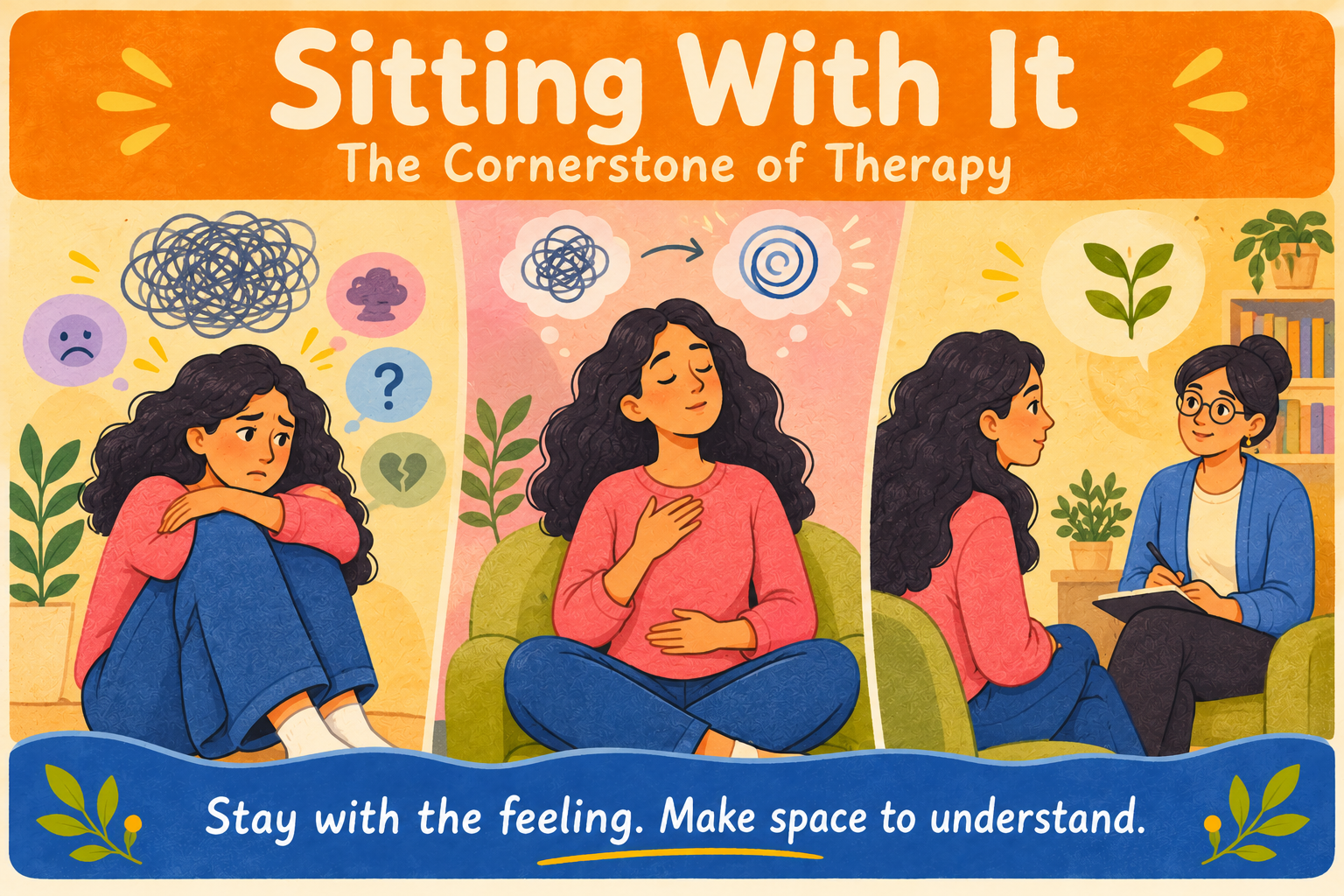
Sitting With It, the Cornerstone of Therapy
“Sit with it.”
It is one of those statements that seems to belong naturally in a therapy room. A therapist says it when a client is overwhelmed by an emotion, confused about a decision, unable to stop thinking about something, or desperately looking for an answer.
Sometimes it is said gently: “Maybe we can sit with that for a moment.”
Sometimes it is almost an invitation: “You don't have to do anything with it right now. Let's just sit with it.”
But there is something interesting about the phrase. We hear it often, but we don't always understand what it actually asks of us. To many people, “sitting with it” sounds like doing nothing. It can sound like lying in bed feeling sad, thinking about the same problem repeatedly, crying without knowing why, or allowing difficult emotions to take over. And if that is what “sitting with it” meant, therapy would be a rather strange exercise. But sitting with it is not about getting stuck.
It is about developing the capacity to stay present with an experience long enough to understand it, rather than immediately escaping from it, judging it, suppressing it, or reacting to it. That is a very different thing. In fact, sitting with it may be some of the hardest work a person does in therapy.
We Are Not Very Good at Sitting
We live in a world that is remarkably uncomfortable with stillness. When something hurts, we want a solution. When something is uncertain, we want an answer. When we are anxious, we want the anxiety to stop. When we are grieving, we want to know when we will be “over it.” When a relationship becomes complicated, we want to know whether we should stay or leave. There is an almost constant pressure to do something.
This pressure is not entirely unreasonable. There are situations where action is necessary. Sometimes we need to leave an unsafe environment. Sometimes we need to set a boundary. Sometimes we need to have a difficult conversation. Sometimes we need medication, professional intervention, financial planning, legal assistance, or practical support.
Therapy is not an argument against action.
The problem begins when action becomes our only relationship with discomfort. If every difficult feeling must immediately be removed, every uncertainty resolved, and every painful thought replaced, we never develop a relationship with our own internal world. We become very good at escaping ourselves. And then we wonder why we don't know ourselves very well.
Sitting With It Is Not Doing Nothing
There is a misconception that sitting with an emotion means simply experiencing it.
Feel sad. Feel angry. Feel anxious. Cry. Wait. There is considerably more happening underneath the phrase. There is attention. There is curiosity. There is observation. There is reflection. There is emotional language.
There is an attempt to understand the relationship between thoughts, emotions, memories, bodily sensations, behaviours and circumstances. There is also restraint. The restraint not to immediately decide that an emotion is bad. The restraint not to immediately believe every thought that accompanies it. The restraint not to turn an emotional experience into an identity.
“I am feeling rejected” is different from “I am unlovable.”
“I am angry” is different from “I am an angry person.”
“I failed” is different from “I am a failure.”
That space between experience and identity is incredibly important. It is where reflection becomes possible, and that is what sitting with it begins to create.
Learning the Language of the Internal World
Most of us receive a fairly extensive education in navigating the external world. We learn mathematics. We learn language. We learn how to work. We learn how to communicate. We learn how to compete. We learn how to perform but many of us are never really taught how to understand what is happening inside us.
We might know that we feel “bad,” but not whether that badness is sadness, shame, loneliness, anger, fear, disappointment, exhaustion, grief or something else entirely.
We might know that we are “stressed,” but not understand what our body does when we feel threatened.
We might know that certain people “annoy” us without understanding why their behaviour activates such a strong response.
Therapy creates an opportunity to learn this language. What am I feeling? What happened immediately before this feeling? What did I interpret that event to mean? Where do I feel it in my body? What does this remind me of? What am I afraid might happen? What do I need? What am I telling myself about myself?
These questions are not designed to produce an instant solution. They are designed to produce awareness, and awareness is often the beginning of choice.
Sitting With Triggers
Consider something as ordinary as not receiving a response to a message. For one person, it may be mildly irritating. For another, it may produce intense anxiety. For someone else, it might result in anger and withdrawal.
The event is the same. The internal experience is not. Sitting with the reaction allows us to become curious about that difference.
What exactly happened? What did I assume it meant? What did I feel first? What did my body do? What did I want to do next? Have I felt this before?
Perhaps the present situation genuinely requires a response. Perhaps someone really was inconsiderate, but perhaps the intensity of the reaction has also touched something older.
This is where therapy can help distinguish the present moment from the history that the present moment has activated. Sometimes what is happening now belongs entirely to now; sometimes it carries the emotional weight of something that happened years ago; often, it is both.
Sitting With Multiple Truths
One of the most important things therapy can teach us is that human experience rarely behaves as neatly as we would like it to. We can love someone and be angry with them. We can be grateful for our life and still be dissatisfied with parts of it. We can understand why somebody hurt us and still decide that we don't want them in our lives. We can forgive someone without trusting them again. We can be successful and still struggle with insecurity. We can fail and still retain our dignity. We can be strong and need help. We can know that someone had good intentions and still acknowledge that they hurt us.
These truths don't necessarily cancel one another out. Yet much of how we are socialized encourages binary thinking. Good or bad. Right or wrong. Strong or weak. Success or failure. Victim or perpetrator. Stay or leave. Move on or remain stuck.
Therapy can create space for the uncomfortable territory in between sometimes the most psychologically mature sentence is simply:
“Both can be true.” That sentence requires us to tolerate complexity and complexity requires us to sit.
The Difference Between Feeling and Judging
There is another layer to this work. Most people don't simply experience emotions. They judge them.
“I shouldn't be angry.” “I shouldn't still be upset.” “This is stupid.” “Other people have it worse.” “I should be over this by now.” “I shouldn't need anybody.” “I should have known better.”
Notice what happens. An emotion appears. Then a judgment arrives. Then shame often follows.
The person is no longer simply sad. They are ashamed that they are sad. They are no longer simply afraid. They are ashamed that they are afraid. Therapy asks us to interrupt this cycle.
Being non-judgmental does not mean believing that everything we do is acceptable. It does not mean abandoning responsibility or refusing to examine harmful behaviour.It means learning to examine ourselves without immediately turning the examination into a prosecution. There is a profound difference between:
“I did something I regret.” and “I am a terrible person.”
The first creates room for accountability. The second often creates shame; sitting with ourselves means becoming capable of meeting ourselves in both success and failure. Not worshipping ourselves when we succeed. Not destroying ourselves when we fail, simply remaining present enough to ask: What happened? What can I learn? What do I want to do differently?
That is a much more sustainable form of growth.
The Problem With a World Obsessed With Productivity
Perhaps one of the reasons “sitting with it” feels so uncomfortable is because it challenges one of the strongest assumptions of modern life: If you aren't producing something, you aren't doing anything valuable.
We measure days by tasks completed. We celebrate being busy. We turn rest into something that needs to be earned. Even mental health practices can become productivity tools. Meditate so you can work better. Sleep so you can perform better. Exercise so you can be more productive. Regulate yourself so you can get back to work. There is nothing inherently wrong with wanting to function well, but something is lost when our emotional lives are valued primarily according to how efficiently they return us to productivity. Grounding can appear insignificant. Mindfulness can look passive. Trauma work can seem slow. Rest can look unproductive, but the nervous system does not operate according to a productivity calendar.
A person who is chronically dysregulated cannot simply instruct themselves to “perform normally.” A person carrying unresolved trauma cannot necessarily think their way out of a physiological response; sometimes the most meaningful work happening in a person's life is invisible from the outside.
They are learning to breathe through something that once overwhelmed them. They are noticing a trigger before reacting to it. They are identifying an emotion instead of numbing it. They are learning that their body can experience safety. They are allowing themselves to rest without guilt. None of these things necessarily produce an immediately visible outcome. But they matter.
Sitting With Trauma
For trauma survivors, the phrase requires even greater nuance. “Sitting with it” should never mean forcing someone to remain inside an overwhelming experience simply because discomfort is supposedly therapeutic. Trauma work requires attention to safety, pacing, regulation, and capacity.
Sitting with an experience means approaching it; it means noticing that it is too much and stepping back; it means learning to ground; it means recognizing that you have become numb; it means staying with an emotion for ten seconds longer than you normally would; it means learning that an emotion can rise, peak, and change without destroying you.
This is important because trauma can fundamentally alter a person's relationship with internal experience; avoidance may once have been necessary, numbing may once have been protective, hypervigilance may once have kept someone safe. Therapy does not add shame to these responses.
Instead, we ask: “What was this response trying to do for you?”
and eventually: “Is it still necessary now?”
That is where healing can become less about fighting ourselves and more about developing a different relationship with what our system learned to do.
Sitting With It Is Reflexive Work
There is a difference between reflection and rumination.
Reflection asks:
What is happening here?
What does this tell me?
What do I need?
What are my options?
Rumination tends to ask the same question repeatedly without moving anywhere.
Why did this happen?
Why am I like this?
What if...?
What if...?
What if...?
Sitting with it therefore does not mean thinking endlessly. It means developing the capacity to notice, understand, integrate and respond.
Sometimes the answer is acceptance. Sometimes it is action. Sometimes it is grief. Sometimes it is a boundary. Sometimes it is forgiveness. Sometimes it is leaving. Sometimes it is staying.
The point is not that sitting always leads to the same outcome. The point is that we become more capable of choosing the outcome rather than being entirely driven by automatic reaction.
Eventually, We Stand
Perhaps this is the part of “sitting with it” that is most often forgotten. We are not supposed to sit forever. At some point, we stand. We make a decision. We have the conversation. We set the boundary. We ask for help. We leave. We stay. We grieve. We try again.
The purpose of sitting is not to make sitting our permanent state. It is to create enough awareness that when we eventually move, we know why we are moving. That distinction matters. Sitting with it is not the opposite of doing. Sometimes, it is what makes intentional doing possible. It is the pause between stimulus and response. It is the space where an emotion can become information rather than instruction.
It is where a trigger can become something to understand rather than something that automatically controls us. It is where conflicting truths can coexist without forcing us into premature certainty. It is where we can learn that being disappointed does not mean being defeated, that failing does not mean being worthless, and that needing someone does not make us weak and perhaps most importantly, it is where we begin to develop a relationship with ourselves that is not dependent on constant achievement.
Sitting With It Is a Way of Being
There is something deeply philosophical about the invitation to sit. It asks us to accept that not everything can be immediately solved. That uncertainty is part of being human; pain cannot always be eliminated; some questions require time, some experiences need to be felt before they can be understood, sometimes we need to stop asking, “How do I get rid of this?” and begin asking, “What is this experience trying to tell me?”
This is why “sitting with it” is far more than a therapeutic cliché. It is an intentional act. It is reflective. It is embodied. It is relational. It is philosophical.
It is, particularly in trauma work, deeply connected to safety and regulation, and it is ultimately about developing the capacity to remain present with ourselves—even when what we find is painful, contradictory, inconvenient, or difficult to understand. Perhaps healing does not always begin when we finally figure out what to do; perhaps sometimes it begins much earlier.
In the moment when we stop running. Take a breath. Notice what is happening and, instead of immediately asking how to make it disappear, quietly ask:
“Can I stay here long enough to understand this?”
That is sitting with it; that is where the real work of therapy begins