
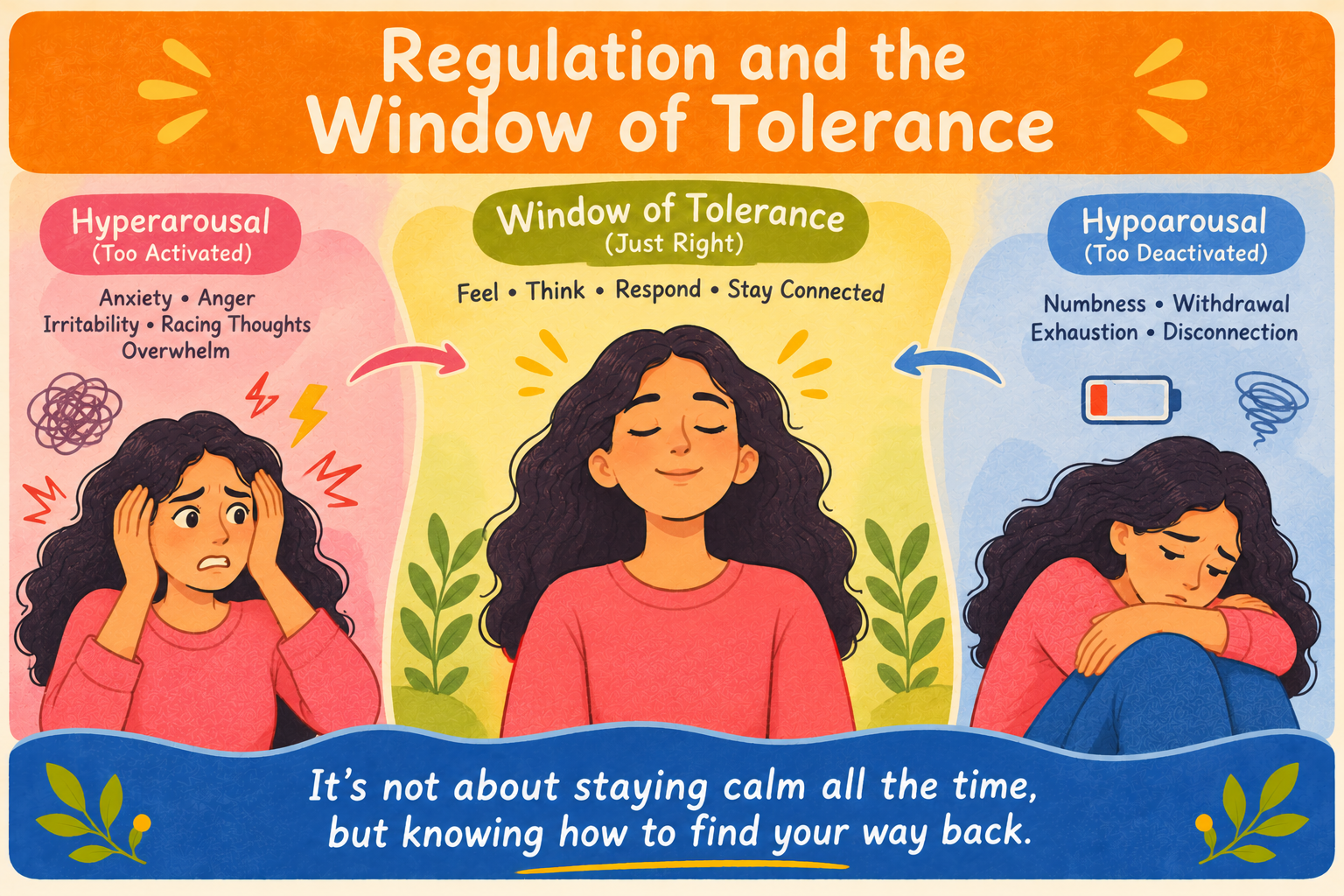
Regulation and the Window of Tolerance
There is something about the way we speak about emotional regulation. We often speak of it as though it were a skill that, once acquired, should remain accessible to us at all times. We imagine that understanding our emotions, recognising our triggers, identifying our needs, and developing ways to respond to difficult situations should eventually make us more capable of navigating life without becoming overwhelmed. Yet, anyone who has spent enough time observing themselves, particularly through the process of therapy, might recognise a striking and uncomfortable contradiction. We can know what is happening to us and still struggle to respond to it. We can recognise that we are becoming overwhelmed and still find ourselves unable to stop it. We can understand our patterns and continue to repeat them.
This is precisely where the idea of regulation needs to be reconsidered. Regulation is not necessarily about maintaining a consistent emotional state. It is about developing the capacity to recognise where we are, understand what is happening within us, and find ways to move through different states without losing our ability to engage with ourselves and the world around us.
The concept of the Window of Tolerance, introduced by psychiatrist Daniel Siegel, offers an interesting framework for understanding this. It describes a range of arousal within which an individual can experience emotions, process information, think, respond, and remain connected to their surroundings. Within this window, we are generally able to tolerate emotional experiences without becoming so overwhelmed or disconnected that our capacity to function is significantly compromised. We can feel anxious without being entirely consumed by anxiety. We can experience anger without necessarily acting upon it. We can feel sadness without becoming incapable of attending to the rest of our lives. However, the window is not a permanent location. It is not a fixed psychological space that we enter once we have achieved sufficient emotional maturity. It fluctuates. Its boundaries can change depending on our physical condition, relationships, environment, experiences, and the demands placed upon us. What we could comfortably manage yesterday might feel intolerable today. A conversation that would ordinarily be manageable might become overwhelming after a difficult week, inadequate sleep, or an accumulation of unresolved stress.
Fluctuation is important because it challenges the tendency to evaluate our emotional responses in isolation. We often ask ourselves why something affected us so much, especially when we have previously managed similar situations. We might interpret this difference as inconsistency, weakness, or a failure to apply what we have learned. But perhaps the more useful question is: what has changed about our capacity to hold this experience today?
This Window of Tolerance is generally understood through two states of dysregulation. Hyperarousal refers to a state of heightened activation, where the nervous system becomes increasingly alert and reactive. Anxiety, agitation, irritability, racing thoughts, heightened sensitivity, and difficulty concentrating can accompany this state. We might find ourselves responding to relatively small inconveniences with disproportionate frustration or feeling an urgent need to resolve something immediately. The body and mind are mobilised, often preparing for a threat even when the immediate situation does not necessarily demand such a response.
Hypoarousal, on the other hand, involves a reduction in activation. Rather than becoming excessively alert, an individual might experience numbness, withdrawal, disconnection, exhaustion, reduced emotional expression, or difficulty engaging with their surroundings. There may be a sense of being unable to think clearly, initiate action, or respond meaningfully to what is happening. Sometimes, this is interpreted as laziness, indifference, or a lack of motivation, when it may actually reflect a system that has moved beyond its capacity to remain actively engaged.
Neither state is a moral or any other type of failure. They are different ways in which the nervous system responds when the demands of an experience exceed an individual's available capacity. Understanding this distinction allows us to move away from simply judging our reactions and towards investigating them.
But how do we recognise these movements in the first place?
One of the difficulties with emotional regulation is that we are not always particularly good at recognising what we feel. We might identify anger when what we are experiencing is actually fear, embarrassment, helplessness, or a sense of being disregarded. We might describe ourselves as stressed without being able to distinguish whether we are overwhelmed, disappointed, threatened, or exhausted. Sometimes, we recognise an emotion only after it has already influenced our behaviour.
This is partly because emotions are not always experienced as clearly defined psychological events. They can appear through bodily sensations, changes in attention, impulses, and patterns of behaviour. A tightening in the chest, an inability to sit still, a sudden urge to leave a conversation, or an unusual reluctance to respond to someone might offer information about what is happening internally. Learning to recognise emotions, therefore, involves becoming curious about these smaller changes rather than waiting for an experience to become intense enough to demand our attention.
There is also a difference between recognising an emotion and understanding it. Knowing that we are angry does not necessarily tell us why we are angry. Recognising anxiety does not automatically reveal what we perceive as threatening. Emotional awareness requires us to investigate the meaning of our experiences, including the expectations, memories, needs, and interpretations that might be influencing them. It is an ongoing process of making sense of ourselves rather than assigning labels to everything we feel. Yet, emotional awareness cannot be distinct from our ability to recognise the environments in which we exist. Sometimes, what appears to be an individual's difficulty with regulation is actually a response to a situation that is persistently unsafe, unpredictable, or demanding. We may spend considerable time trying to regulate ourselves in relationships where our boundaries are repeatedly violated, workplaces where humiliation is normalised, or environments where we are expected to remain constantly available and accommodating.
This raises an important question: are we always attempting to regulate an internal response, or are we sometimes trying to make ourselves comfortable with an external situation that needs to change?
Recognising unsafe situations is an essential part of regulation. Not every uncomfortable feeling is evidence of danger, and not every difficult situation is necessarily harmful. Discomfort can accompany growth, disagreement, uncertainty, and meaningful change. However, repeatedly dismissing our discomfort in the name of emotional maturity can make us less responsive to legitimate concerns. If we interpret every feeling of fear as something that needs to be overcome, we might overlook situations where fear is providing useful information.
Regulation should not become a practice of convincing ourselves that everything is manageable. It should also help us identify when something is not manageable, when a boundary needs to be established, when we need to leave a situation, or when we require support. Sometimes the regulated response is not to remain in the conversation, but to recognise that continuing it is neither safe nor productive.
There is a certain irony here. We often associate regulation with being able to remain composed, but the capacity to recognise danger might require us to become uncomfortable, assertive, or even visibly upset. A person who identifies an unsafe situation and chooses to remove themselves from it is not necessarily dysregulated. They might be responding appropriately to the information available to them.
Another important aspect of regulation is accepting that dysregulation will happen. Despite our efforts to become more aware, despite therapy, reflection, grounding exercises, and the development of healthier patterns, there will be occasions when our capacity is exceeded. We might react impulsively, withdraw unexpectedly, become overwhelmed by an ordinary interaction, or find ourselves unable to access the very skills we have spent months developing.
Perhaps we need to become better prepared for these moments rather than treating them as unexpected interruptions to an otherwise successful process of healing.
Preparation involves understanding our own patterns of dysregulation. What happens to us when we become overwhelmed? Do we become argumentative, excessively accommodating, silent, restless, avoidant, or emotionally unavailable? Do we experience changes in appetite, sleep, concentration, or our willingness to engage with others? Are there particular situations in which we notice ourselves moving towards hyperarousal or hypoarousal more frequently?
Knowing these patterns can help us recognise the early signs of dysregulation. It can also help us identify what might be useful when our capacity begins to narrow. For some individuals, this might mean reducing stimulation, stepping away from an escalating conversation, or seeking physical movement. For others, it might involve reconnecting with a trusted person, establishing a predictable routine, or allowing themselves time before making an important decision.
The objective is not to create a universal response to dysregulation. Different people require different forms of support, and even the same individual might need different things depending on the circumstances. What matters is developing a degree of familiarity with our own responses so that we are not entirely dependent on improvising when we are already overwhelmed.
However, there is another difficulty that deserves attention: maintaining this awareness in everyday life.
It is relatively easy to discuss emotional regulation in the protected environment of a therapy session. We have time to reflect, identify patterns, consider alternative responses, and examine our experiences without necessarily having to respond to them immediately. Everyday life rarely offers this kind of arrangement. We have deadlines, financial responsibilities, relationships, family expectations, commutes, interruptions, and an endless number of small decisions competing for our attention. We cannot spend every waking moment monitoring our emotional state.
In fact, attempting to do so might become another source of pressure. We might begin evaluating every reaction, questioning every uncomfortable feeling, and wondering whether we are regulating ourselves correctly. Emotional awareness can gradually turn into excessive self-surveillance. Instead of participating in an experience, we become occupied with observing ourselves participating in it.
This is worth considering because mindfulness is sometimes presented as though it should be a continuous state of attention. But human attention is inherently limited. We become distracted, preoccupied, tired, and absorbed in what is happening around us. We forget to pause. We overlook our physical needs. We sometimes recognise that we have been overwhelmed only after the situation has passed.
Perhaps the purpose of awareness is not to remain constantly mindful, but to become increasingly capable of returning to ourselves. We might miss the early signs of irritation today and recognise them tomorrow. We might realise after an argument that we were already exhausted before it began. We might notice, several hours later, that our withdrawal was connected to a sense of rejection rather than a lack of interest in the relationship.
These recognitions still matter. They provide information that can influence how we approach similar situations in the future. Regulation is not necessarily demonstrated by how quickly we identify every emotional shift. Sometimes, it is demonstrated by our willingness to revisit an experience, understand what happened, and make a different decision the next time.
This also changes the way we might understand progress in therapy. Progress does not necessarily mean that our window becomes permanently wide, that difficult emotions become less frequent, or that we stop experiencing dysregulation. It might mean that we recognise our emotional shifts earlier, recover with greater flexibility, seek support without excessive shame, or become more capable of distinguishing between an uncomfortable feeling and an unsafe situation.
It might also mean accepting that there are days when our capacity is smaller. We might need more time, fewer demands, clearer boundaries, or greater support. This does not invalidate the work we have done. It acknowledges that our emotional lives are influenced by circumstances that cannot always be controlled.
Ultimately, perhaps regulation is better understood not as a destination but as a collection of states of being that allow movement. The movement between feeling and understanding, between activation and rest, between engagement and withdrawal, between recognising a need and responding to it. We do not need to remain in one particular state to be regulated. We need enough flexibility to move between states without becoming permanently trapped in any one of them.
A window, after all, is not a room in which we are expected to remain. It is an opening through which we observe, interpret, and engage with what exists beyond us. Its purpose is not to restrict movement but to make movement possible.
Perhaps the more meaningful question, then, is not whether we can remain within our Window of Tolerance at all times. It is whether we are gradually becoming more familiar with the ways we move beyond it, what those movements communicate, and what might help us find our way back. And perhaps, more importantly, whether we can allow ourselves to move without turning every departure from emotional stability into evidence that we have failed.