
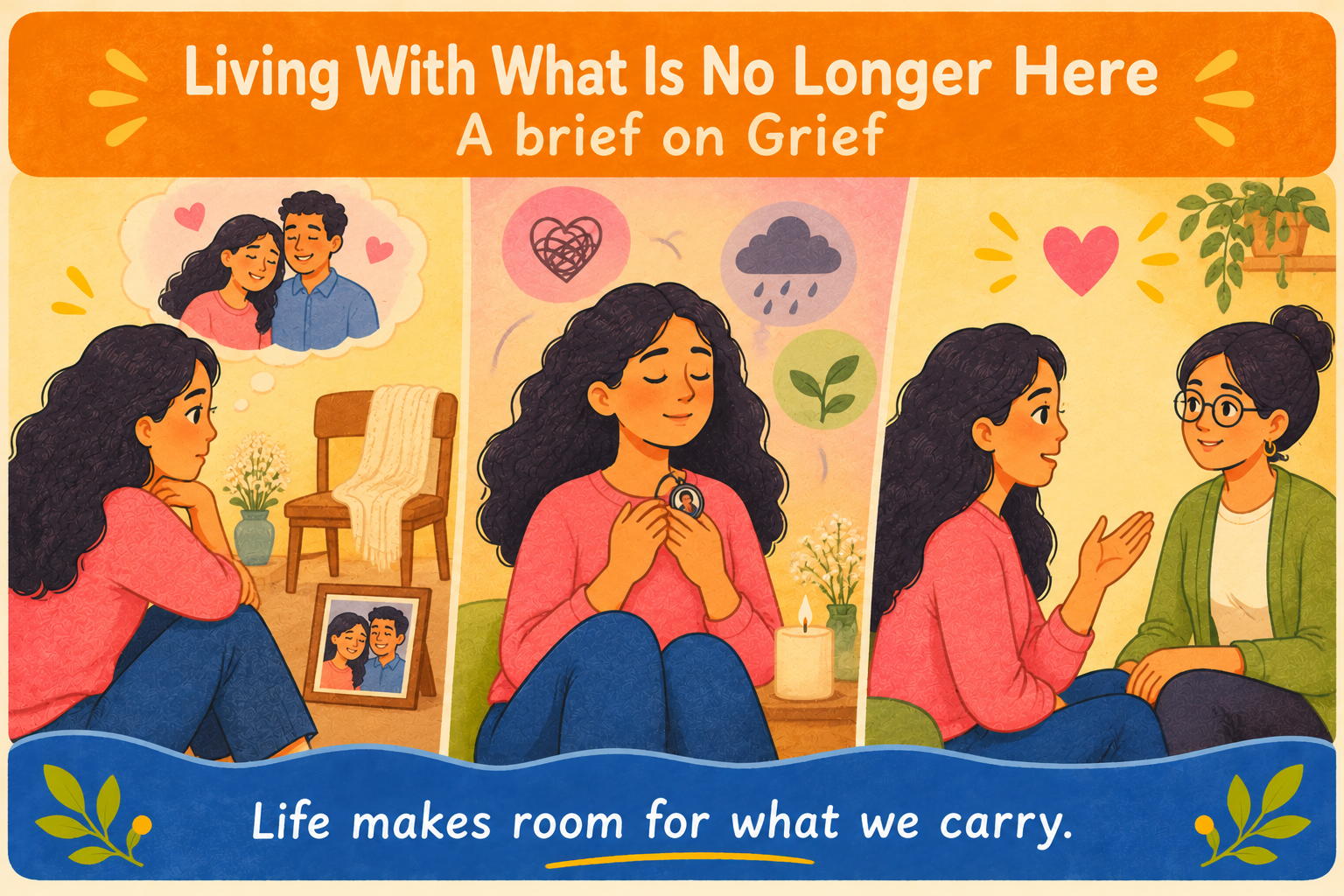
Living With What Is No Longer Here - A brief on Grief
There are but a few experiences that can make the world feel simultaneously familiar and unrecognisable. The road to work remains the same, the morning tea tastes as it always did, and people continue discussing ordinary things. Yet, somewhere within this ordinary world, something fundamental has changed. A person, thing, situation, or process that once occupied a place in our daily lives is no longer there. A relationship has ended. An imagined future is no longer possible. The world, rather cruelly, continues.
We speak about grief as though it is simply the sadness that follows a death. However, grief is far more expansive than that. We can grieve people who have died, relationships that have ended, homes we have left, identities we have outgrown, opportunities we never received and versions of ourselves we can no longer return to. Sometimes we grieve what we had. At other times, we grieve what we needed but never had. There is also grief in recognising that someone may be alive and yet no longer accessible to us in the way they once were.
Perhaps the most difficult thing about grief is that it is not merely the experience of losing something. It is the experience of having to reorganise our lives around its absence.
The Process of Grieving - Not a Straight Line
Grief is often understood as passing through the five stages of denial, anger, bargaining, depression, and acceptance, a model associated with Elisabeth Kübler-Ross. Although these stages can offer language for some experiences, they were originally developed in the context of people facing their own terminal illness. They were never intended to function as a universal sequence that every grieving person must follow.
Grief does not reliably move from denial to anger, then bargaining, depression and finally acceptance. A person may experience several of these emotions in a single afternoon, move between them over months, or never recognise some of them at all. Someone may feel relief after the death of a person who caused them suffering, only to feel guilty about that relief later. Another may appear composed for weeks before an ordinary object, smell or song brings the loss painfully close.
Grief is better understood as an ongoing process of adjustment than as a sequence of emotional milestones. The grieving person is gradually learning to inhabit a reality that their emotional world may not yet have caught up with. Intellectually, they may know that someone has died, but they might still instinctively reach for their phone to call them. They may understand that a relationship has ended while continuing to imagine how the other person would respond to a particular experience.
This is not necessarily denial. It reflects the fact that our attachments are woven into habits, expectations, memories, and our sense of what the future will look like. Reality can change in an instant; the internal world built around that reality takes longer to reorganise.
Some people find themselves moving between confronting the loss and temporarily turning away from it. They may spend an afternoon crying and the evening watching a comedy. They might return to work, laugh with friends and then feel overwhelmed on the anniversary of an ordinary conversation. This movement between loss-oriented experiences and the practical demands of rebuilding life is described in the Dual Process Model of coping with bereavement. Taking a break from grief does not necessarily mean avoiding it. Sometimes, rest is what allows a person to return to it.
Grief in Many Forms
Not all grief begins after a loss has occurred. Anticipatory grief can emerge when someone is living with the knowledge that a loved one may die, perhaps because of a terminal illness. The person may begin mourning a future that has not yet disappeared while simultaneously caring for someone who is still present. There can be guilt in grieving too soon, as though acknowledging the possibility of loss somehow betrays the person who is still alive.
Disenfranchised grief describes grief that is not adequately recognised or supported by society. This may happen after the death of an ex-partner, a miscarriage, the loss of a companion animal, or the ending of a relationship that had to remain secret. A person may be deeply affected but feel they have no legitimate place to mourn. When society does not recognise a loss, the grieving person may end up grieving both the loss itself and the absence of permission to speak about it.
Ambiguous loss occurs when there is no clear resolution to the experience of losing someone or something. A loved one may be physically missing, or they may be physically present but psychologically changed by dementia or another condition. Similar uncertainty can arise when a relationship ends without explanation or when estrangement leaves someone unsure whether to hope for reconciliation. Without a clear ending, the mind struggles to determine what it should prepare for.
There is also traumatic grief, in which bereavement is complicated by the circumstances of the death, such as violence, an accident or a sudden, unexpected loss. Shock, intrusive images and fear may become entangled with yearning and sadness. And when intense longing and preoccupation with the deceased remain persistent, significantly disrupt life and exceed what would be expected within the person's cultural context, the experience may meet the criteria for prolonged grief disorder. This is a recognised clinical condition, not simply a judgement that someone has been grieving for too long.
These distinctions matter because the nature of the loss influences what a person needs. Someone grieving a death may need help integrating an irreversible absence. Someone experiencing ambiguous loss may need support tolerating uncertainty. Someone whose grief is socially unrecognised may first need a space in which the loss can be acknowledged at all.
Presentation - Something more than Sadness
Grief does not always look like crying. It can present as irritability, emotional numbness, exhaustion, anxiety, restlessness, difficulty concentrating, changes in appetite or disrupted sleep. Some people become unusually productive, filling every hour with tasks because stillness makes the absence harder to bear. Others withdraw from relationships, not because they no longer care about people, but because ordinary conversation feels exhausting when their internal world has been rearranged.
There may be guilt about things said, things left unsaid, or decisions made near the end of a relationship. Anger may be directed towards doctors, family members, institutions, the person who died, or even the person themselves. Relief can coexist with sadness, especially after a prolonged illness or an abusive relationship. Sometimes, the loss of a difficult relationship can hurt precisely because the person is also losing the hope that the relationship might one day become what they needed it to be.
Grief can also be physical. People report heaviness in the chest, a lump in the throat, muscular tension, fatigue, and a sense of restlessness. These experiences are not imaginary simply because grief is emotional. The brain and body are deeply interconnected, and distress can affect sleep, appetite, attention and the body's stress responses.
It is equally important to recognise that some people do not experience overwhelming distress all the time. They may feel sadness and continue to enjoy life. They may have moments of laughter without having forgotten the person they lost. We sometimes mistake visible suffering for proof of love, as though the intensity of grief must demonstrate the importance of the relationship. But the depth of an attachment cannot be measured by how long someone cries, how often they speak about the deceased, or how quickly they return to routine.
This brings us to a very interesting question
Does grief serve a purpose? Asking this can feel uncomfortable, as though we are trying to justify suffering. A loss does not need to be useful to deserve compassion. Not every tragedy produces wisdom, resilience, or personal growth, and grieving people should not be pressured to find a lesson in their pain.
Yet grief does involve important psychological work. Our relationships shape our routines, identities, expectations and imagined futures. When a significant attachment disappears, we must gradually learn how to live in a world that no longer responds in the same way. The task is not necessarily to stop loving the person or to erase the relationship. It is to find a way for that relationship to occupy a different place in our lives.
We may begin by asking, Who am I without this person? Later, the question may change: How do I carry what this relationship meant to me into the life I still have to live? This is sometimes described as meaning-making. It does not mean that the loss was meant to happen. It means that the person gradually develops a way of understanding their life that can accommodate the loss without allowing it to become the only thing their life contains.
Some people maintain what psychologists call continuing bonds with the deceased. They speak to them privately, preserve their belongings, follow traditions they shared or make decisions guided by what the relationship taught them. Such bonds are not necessarily signs of an inability to move on. The relationship may continue internally, even though its external form has changed. The purpose of grief, then, is not to make us indifferent to what we have lost. It is to help us live with the reality of that loss while retaining the capacity to participate in the world.
The Neurobiology of Attachment
It is not just a psychological response; grief also reflects the biology of attachment. Human beings are social creatures, and close relationships become integrated into the systems through which we experience safety, reward, familiarity, and belonging. The people we love are not simply people we think about. Their presence becomes part of what our brains learn to expect.
Through repeated interactions, the brain develops predictions: who will answer when we call, whose voice we will hear at the end of the day, who will help us regulate distress, and who will share our excitement. Attachment involves interconnected brain systems associated with memory, emotion, motivation, reward, and stress. When a loved one dies, these systems do not instantly update their expectations to match reality.
This helps explain why grief can feel physically urgent. Reminders of the person can activate memories, longing and the motivation to seek closeness, even when we consciously know that reunion is impossible. Stress responses may affect sleep, concentration, appetite, and bodily arousal. Research into the neural mechanisms of grief is still developing, and no single brain region or chemical explains the whole experience. It is more accurate to understand grief as an interaction between attachment, memory, learning, emotional regulation and stress systems. Over time, new learning can develop. The brain gradually encounters the reality that the person is no longer physically available, while memories and emotional bonds remain. This does not mean that the person is forgotten. Rather, the relationship becomes represented differently: less as an expectation of immediate presence and more as a memory, an internal connection or a continuing influence.
Understanding this biological dimension matters because it challenges the idea that someone should simply decide to move on. Knowing something intellectually and adjusting to it emotionally are different processes. The brain cannot always be persuaded into a new reality merely because the facts are clear.
Giving Grief a Place to Go
Across cultures, people have developed rituals to respond to death. Funerals, prayers, periods of mourning, memorial gatherings, anniversaries, lighting candles, visiting graves, and sharing stories all give grief a form. Their details vary enormously, but many provide a structure through which private pain becomes socially recognised.
Rituals matter partly because death disrupts both personal and social life. A person is lost, but so are familiar roles, routines and expectations. A funeral allows a community to acknowledge the loss together. A mourning period can offer time in which ordinary demands are reduced or temporarily rearranged. An anniversary can provide a socially understood occasion to remember someone who might otherwise become difficult to mention as the months pass.
Rituals also give us something to do when there is very little we can change. We cannot reverse a death, but we can gather, pray, speak, remember, offer food, preserve an object or perform an act of service in someone's memory. These actions do not remove grief; they give it a container. Research on grief interventions has also explored symbolic practices such as writing letters, having an imagined conversation with the deceased, and creating farewell ceremonies, although the individual contribution of rituals to treatment outcomes remains difficult to isolate
Not everyone finds comfort in religious or traditional rituals, and no single form of mourning should be imposed on everyone. Some people need a ceremony; others need solitude, a private letter or a walk to a place they shared with someone. What matters is whether the practice allows the loss to be acknowledged in a way that feels meaningful and safe.
Perhaps rituals remind us that grief is not an inconvenience to be resolved as quickly as possible. It is an experience that deserves time, attention, and recognition.
Learning to Live With the Absence
We often ask grieving people when they will feel better, as though recovery means returning to the person they were before the loss. But some losses change us permanently. There may be no return to the earlier self because the earlier self existed in a world where this person, relationship, or future was still possible. The question may therefore be less about returning to normal and more about discovering what life can look like now. Sometimes that involves talking about the loss; sometimes it means addressing practical problems, rebuilding routines or finding support. Grief counselling can help when the pain feels difficult to navigate, while specialised treatment may be appropriate when prolonged grief or trauma significantly interferes with life.
We should also resist turning grief into a test of character. There is no virtue in suffering indefinitely, just as there is no betrayal in experiencing happiness again. Healing does not require us to stop missing someone. It may mean that we can miss them and still make plans, remember them without being overwhelmed every time, or carry their influence into relationships and experiences they will never physically witness. Grief asks us to confront a difficult truth: love does not guarantee permanence, and understanding a loss does not make it painless. But perhaps the work of grieving is not to erase the importance of what is gone. It is to find a way to acknowledge that importance without surrendering every possibility that remains.
Eventually, the absence may become less consuming. A memory may bring warmth alongside sadness. A familiar song may become something we can listen to again. There will still be moments when the loss feels immediate, because grief does not follow a timetable and perhaps that is what it means to live with grief: not that the absence stops mattering, but that life slowly makes room for it. We learn that we can carry love without requiring the world to return to how it was, and that continuing to live is not a departure from what we have lost. Sometimes, it is the only way we can continue to honour it