
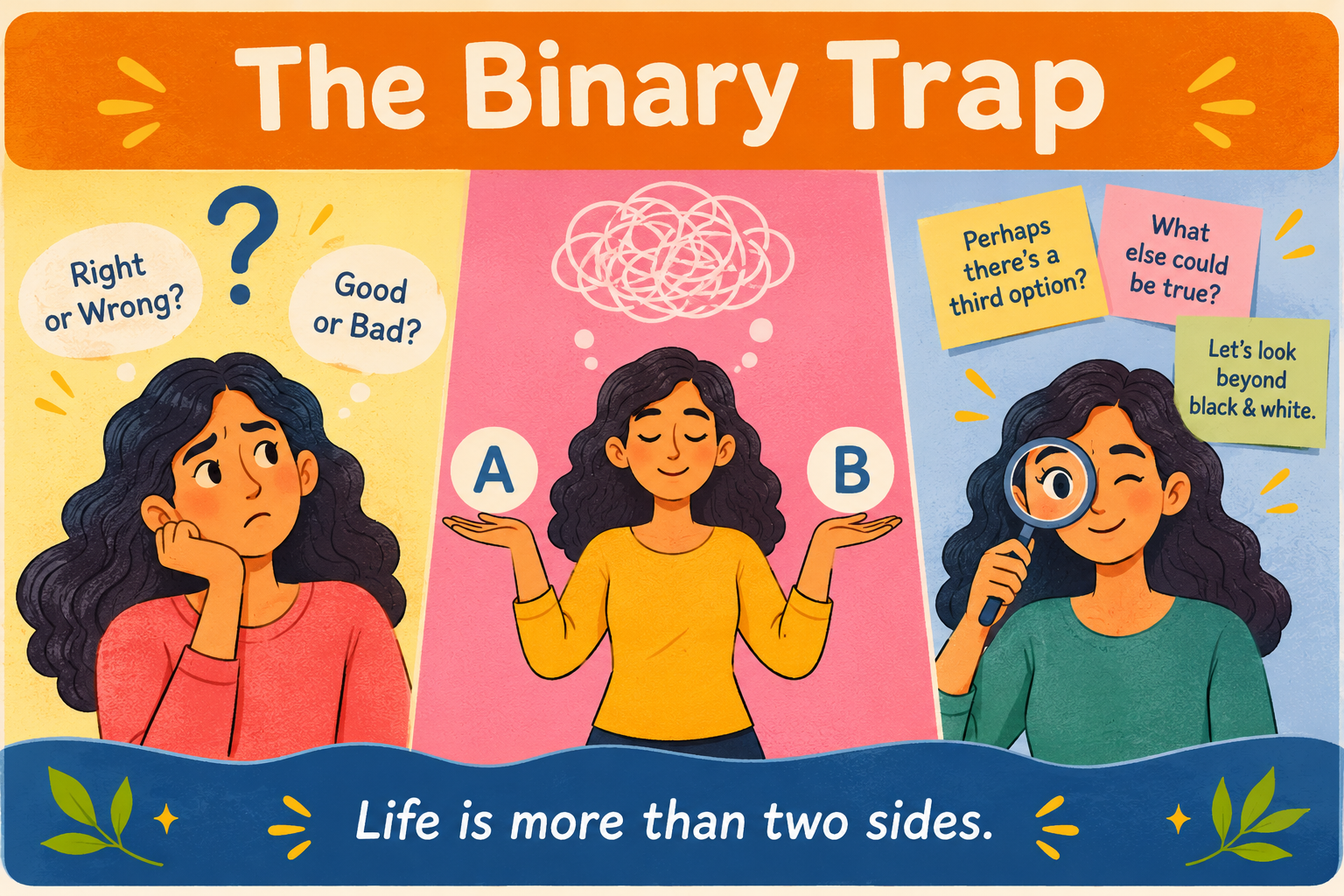
The Binary Trap
Ever noticed how quickly we rush to pick a side?
Someone shares an opinion online and within moments people are divided into camps. A friend makes a mistake and suddenly they're either a good person or a bad one. A relationship ends and one person becomes the villain while the other becomes the victim. We seem to have become increasingly uncomfortable with the possibility that reality might be more complicated than that. Somewhere along the way, many of us were taught that things need to fit neatly into categories. Right or wrong. Success or failure. Good or bad. Win or lose.
While these categories may help us make sense of the world, they can also trap us within it.
What is the Binary Trap?
The Binary Trap is the tendency to believe that there are only two possible ways of understanding something. It's the assumption that every problem has only two sides, every question has one correct answer, and every situation can be neatly sorted into opposing boxes. It is a way of thinking that seeks certainty above all else. We learn it early.
In school, answers are often either correct or incorrect. At home, behavior may be rewarded or punished. In society, people are praised for being right and criticized for being wrong. Over time, we begin to internalize the idea that ambiguity is uncomfortable and uncertainty is something to be avoided. The problem is that life rarely cooperates. People can be both strong and struggling. A parent can be loving and emotionally unavailable. A person can be grateful for what they have and still wish things were different. Two people can disagree and both have valid experiences. Yet binary thinking asks us to choose one truth and discard the other.
The danger is not simply that it limits our perspective. It is that it slowly reduces our capacity to tolerate differences. When we believe there are only two options, anyone who challenges our view begins to feel threatening. Curiosity gives way to certainty. Conversations become arguments. Understanding becomes less important than being correct. And perhaps without realizing it, we become less willing to change.
The Long-Lasting Effect
The way we see the world is not just a matter of opinion. It is deeply connected to how our brains learn. Every time we repeat a thought, reinforce a belief, or respond to a situation in a familiar way, the brain strengthens those pathways. What begins as a learned perspective can eventually feel like reality itself. This is one reason why change can feel so difficult. We are not simply challenging an idea. We are challenging a pattern that may have been reinforced for years.
Research in neuroscience has repeatedly shown that our brains are shaped by experience. The more often we use a particular way of thinking, the easier it becomes to return to it. Even fields like epigenetics have expanded our understanding of how experiences can leave lasting marks on us. While our genes provide a foundation, our environments, relationships, and experiences influence how that foundation is expressed throughout our lives.
In other words, we are shaped by the stories we inherit and the stories we repeatedly tell ourselves. When those stories are rigid and binary, they can narrow our world. Creativity begins to suffer because creativity requires alternatives. Innovation requires the ability to imagine possibilities that do not yet exist. Meaningful conversations require the willingness to hold uncertainty long enough to explore it.
Binary thinking struggles with all of these.
If there are only two options, why look for a third?
If there is only one right answer, why remain curious?
The result is often a life that feels smaller than it needs to be.
Therapy as a Place for Rewiring
One of the most beautiful things about therapy is that it creates space for complexity.
People often arrive in therapy carrying stories that have become rigid over time.
"I am a failure."
"I should be over this by now."
"My family was either good or bad."
"I have to choose between my needs and everyone else's."
These stories usually sound convincing because they have been repeated for years. Yet when we begin to explore them, something interesting happens. We discover there is more to the story. Therapy is not about replacing one certainty with another. It is about developing the capacity to hold nuance. It invites us to move beyond the comfort of black and white thinking and into the often uncomfortable reality of being human.
That reality includes contradictions. It includes grief and gratitude existing together. Love and anger existing together. Fear and courage existing together. Therapy helps us recognize that complexity is not confusion. It is reality. Perhaps most importantly, therapy helps us develop the ability to look for a third option. When life presents us with what appears to be an impossible choice, therapy encourages us to pause and ask:
"What am I not seeing?"
Contrary to popular belief, therapy is not simply about talking about feelings. It is about learning how to think differently, relate differently, and ultimately live differently. Part of this work involves learning to ask better questions.
Not questions that judge or criticize, but questions that invite reflection.
Why do I react this way?
What am I afraid might happen?
Where did I learn this belief?
What need is hidden beneath this emotion?
Questions like these create movement.
Therapy also helps people understand the difference between metacognition and overthinking. Overthinking tends to trap us inside our thoughts. Metacognition allows us to step back and observe them. One creates exhaustion. The other creates awareness. Healing also involves reconnecting with the body.
Many people carry stress, grief, anxiety, and trauma not only in their minds but in their muscles, breathing patterns, posture, and nervous systems. Therapy helps individuals develop a deeper awareness of these connections and learn how to respond to them with compassion rather than judgment. Over time, people begin to recognize possibilities they previously could not see.
They become better able to understand their emotions rather than fear them. They learn to process difficult experiences rather than be controlled by them. They begin to reclaim agency over their lives. The goal is not perfection. The goal is flexibility. The ability to hold multiple truths. The willingness to remain curious. The courage to question old assumptions. Perhaps most importantly, the wisdom to recognize that life is rarely as simple as right or wrong, yes or no, black or white. There is often another possibility waiting to be discovered.
We can only find it once we are willing to look beyond the binary with nuance, curiosity, care and compassion. Would you care to look