

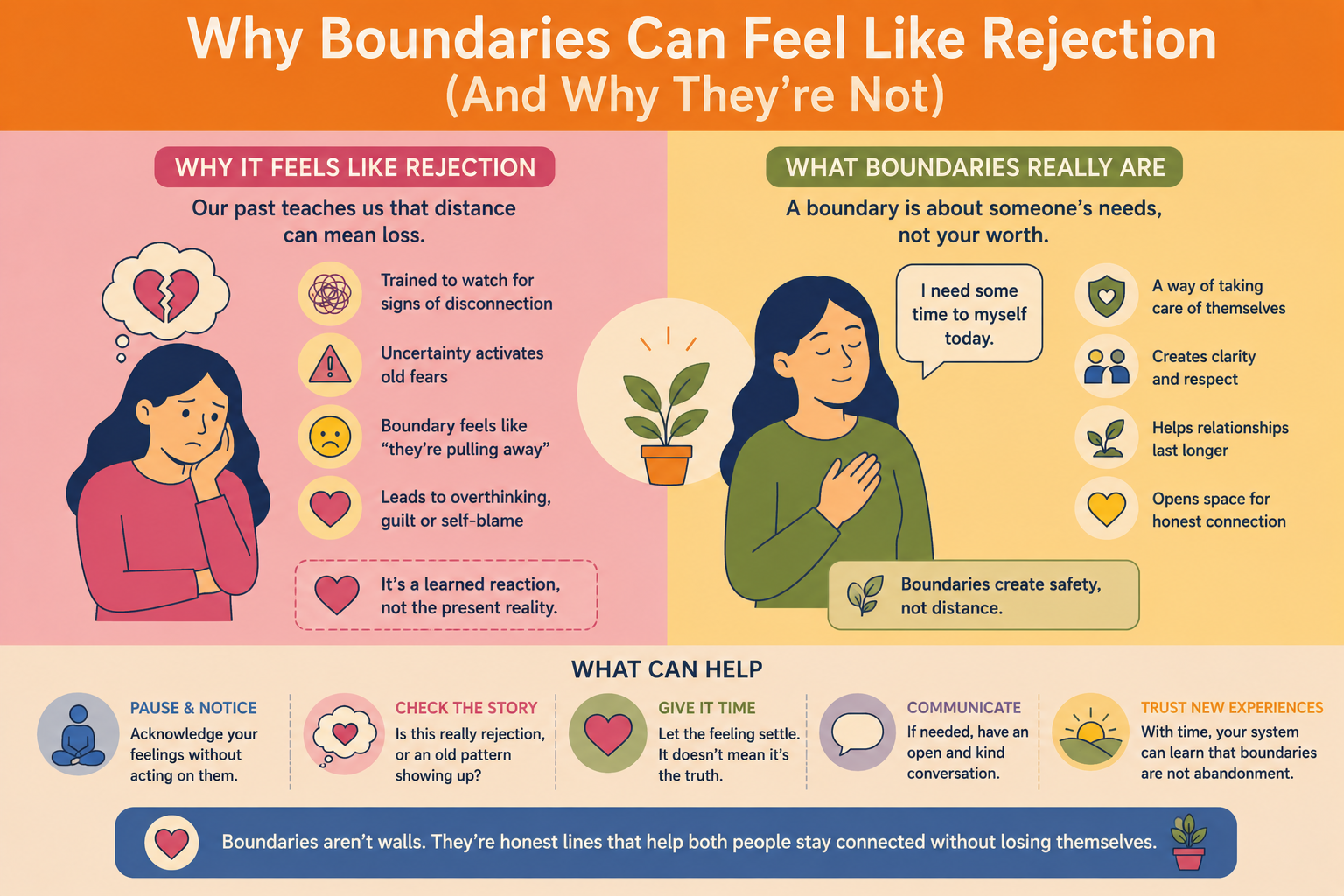
Why Boundaries Can Feel Like Rejection (And Why They’re Not)
There’s a very particular kind of feeling that comes up when someone sets a boundary with you. It’s not always loud or dramatic, it can be quiet, subtle, but still heavy. A message like “I need some time to myself today” or “I can’t talk about this right now” can suddenly leave you feeling off, even if you understand it on a rational level.
It can feel like distance. Like something has shifted. Like you’ve done something wrong.
And if you’ve ever found yourself overthinking after someone sets a boundary, or feeling unexpectedly hurt by it, there’s nothing strange about that. A lot of people experience boundaries as rejection, not because they actually are, but because of what they feel like in the moment.
For many of us, this has less to do with the present situation and more to do with what our system has learned about relationships over time.
If you’ve grown up in environments where connection felt inconsistent, unpredictable, or something you had to earn, then closeness may have come with a certain kind of vigilance. You learn to read into tone, timing, and small shifts. You learn that availability equals safety, and distance, no matter how small, can feel like the beginning of loss.
So when someone says they need space or sets a limit, your mind might understand it as a healthy choice, but your body reacts differently. It might register it as “they’re pulling away” or “this isn’t safe anymore.” That reaction can feel immediate and hard to control.
This is often what people refer to when they talk about abandonment wounds. It’s not always about being physically abandoned. It can come from emotional experiences where connection didn’t feel steady or secure. And because those experiences live in the background, moments like these can bring them right to the surface.
You might notice yourself wanting to fix things quickly, or replaying conversations in your head, trying to figure out what you did. Sometimes people respond by pulling away first, almost as a way to protect themselves from being hurt. Sometimes it just sits as a quiet heaviness that’s hard to name.
What’s important to understand here is that this reaction makes sense. It’s not an overreaction, it’s a learned one.
At the same time, it can help to gently separate what a boundary is from what it feels like.
A boundary is simply someone being clear about what they can and cannot do. It’s a way of saying, “This is where I am right now” or “This is what works for me.” It’s not a statement about your worth or your place in their life, even though it can feel that way.
In fact, boundaries often make relationships more sustainable, not less. Without them, people tend to overextend themselves, say yes when they mean no, and slowly build resentment. That kind of dynamic might feel like closeness in the beginning, but it usually leads to disconnection later on.
Boundaries, on the other hand, bring clarity. They make it easier to understand each other’s needs and limits without guessing or overanalyzing. They allow people to show up more honestly, rather than out of obligation.
But even when you understand this, the emotional part doesn’t just switch off. You can know all of this and still feel hurt. That gap between what you know and what you feel can be frustrating.
Instead of trying to convince yourself that you shouldn’t feel this way, it can be more helpful to acknowledge what’s coming up. Something as simple as, “This feels like rejection right now” or “This is bringing up something old” can create a bit of space between the feeling and the reaction.
That space matters. It gives you a chance to respond rather than react.
Over time, it can also help to shift how you see boundaries, not as distance, but as information. When someone sets a boundary, they’re telling you something real about themselves, their capacity, their needs, the way they stay present in relationships.
That kind of clarity can actually make things feel more stable. You’re not left guessing where you stand or trying to read between the lines.
Interestingly, the same difficulty often shows up when it comes to setting your own boundaries. If receiving them feels like rejection, setting them can feel like you’re the one doing the rejecting. There’s often a fear that saying no or asking for space will push people away.
So instead, you might say yes when you don’t want to, or stretch yourself thin to keep things smooth. It works in the short term, but over time it can feel exhausting or even create quiet resentment.
Learning to set boundaries is really about allowing yourself to show up more honestly, not less. And the people who are able to meet you in that honesty are usually the ones who can hold space for a more balanced kind of connection.
If boundaries have always felt uncomfortable or threatening, it doesn’t mean you’re bad at relationships. It usually means you’ve learned to associate closeness with constant availability, and anything that interrupts that can feel unsettling.
That association can change, but it takes time and repeated experiences of safe, consistent connection.
For now, it might just start with noticing your reactions a little more gently. Letting yourself feel what comes up, without immediately acting on it or judging it.
Because a boundary, even if it feels like rejection in the moment, is often the opposite. It’s a way of staying in connection without losing yourself, and of allowing others to do the same.