

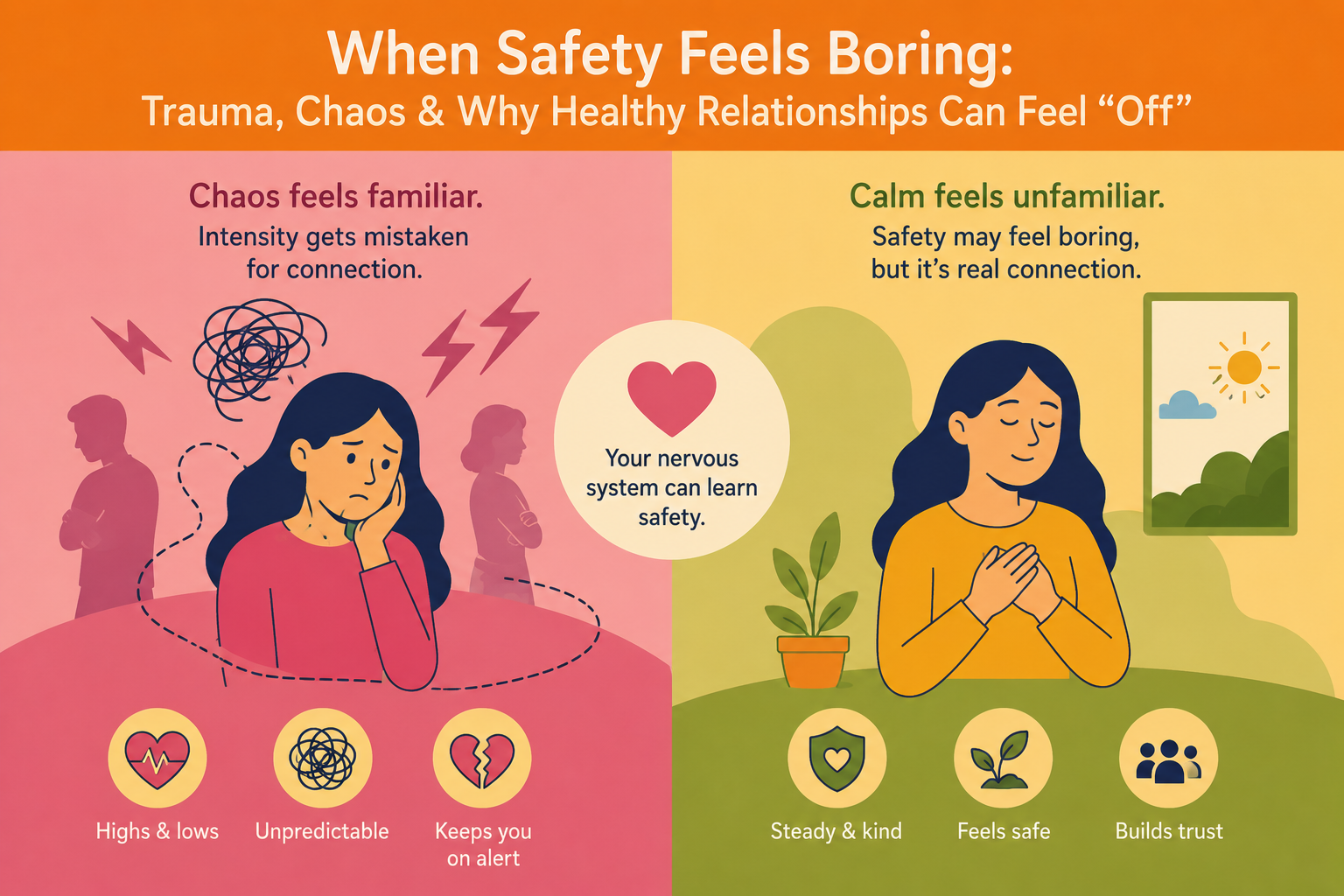
When Safety Feels Boring: Trauma, Chaos & Why Healthy Relationships Can Feel “Off”
If you’ve ever found yourself losing interest in someone who treats you well, or feeling strangely uneasy in a calm, consistent relationship, you’re not alone. Many people quietly carry a confusing question: Why does safety feel… boring? Or worse- Why does it feel wrong?
This isn’t a flaw in you or a sign that you “don’t know what you want.” It’s often a sign that your nervous system learned to equate intensity with connection. When chaos, unpredictability, or emotional highs and lows were part of your early relationships, calm can feel unfamiliar, and unfamiliar can feel unsafe.
How Trauma Shapes What Feels “Normal”
Our nervous system learns through experience. If you grew up in an environment where love was inconsistent, conditional, or mixed with fear, your body adapted to survive in that context. Maybe affection came after conflict. Maybe attention arrived only during a crisis. Maybe emotional closeness was paired with volatility, silence, or withdrawal.
Over time, your nervous system learned a specific rhythm: heightened alertness, emotional spikes, uncertainty, and relief. That cycle became familiar. And familiarity, even when painful, often feels safer than the unknown.
So when you encounter a relationship that is steady, respectful, and predictable, your nervous system may not read it as “safe.” Instead, it may read it as flat, boring, or off. Not because something is wrong but because your body doesn’t recognise calm as a connection yet.
Why Intensity Can Feel Like Chemistry
We often mistake nervous system activation for attraction. The butterflies, the anxiety, the constant thinking about someone, the emotional push-and-pull. These sensations can feel like passion or chemistry. But for many trauma survivors, they are actually signs of hyperarousal: the body staying on high alert, scanning for danger or abandonment.
Healthy relationships, on the other hand, don’t activate the same alarms. They tend to feel slower. Quieter. More grounded. And when your system has been trained to expect intensity, that quiet can feel uncomfortable or even threatening.
This is why people sometimes describe healthy partners as “too nice,” “not exciting enough,” or “missing something,” even when the relationship is objectively caring and secure. What’s missing isn’t love, it’s chaos.
When Calm Feels Unsafe
For someone with a trauma history, calm can feel like the moment before something goes wrong. If peace was always temporary in the past, your body may brace itself during stability, waiting for the other shoe to drop. You may feel restless, emotionally disconnected, or suspicious of ease.
This doesn’t mean you’re incapable of healthy love. It means your nervous system learned survival before safety.
And survival responses don’t disappear just because your circumstances improve.
Retraining the Nervous System Takes Time
Healing from this pattern isn’t about forcing yourself to like calmness or shaming yourself for craving intensity. It’s about gently expanding your nervous system’s capacity to tolerate safety.
This process often starts with awareness: recognising when your body is reacting to calm as if it’s danger. You might notice urges to withdraw emotionally, overthink, or chase unavailable people when things feel stable. Instead of judging these responses, you can begin to meet them with curiosity.
You may ask yourself: Is this actually boring or is it just unfamiliar? Is my body craving chaos because it feels known?
Over time, small experiences of consistent care, predictability, and emotional safety begin to teach your nervous system something new: that connection doesn’t have to hurt to be real.
Learning to Stay With Safety
One of the hardest parts of this work is learning to stay. To remain present when things feel calm instead of self-sabotaging or disengaging. This might mean sitting with the discomfort of not feeling intensely activated. It might mean letting silence exist without filling it. It might mean allowing someone to show up consistently without testing their commitment.
At first, safety may feel dull. But dull doesn’t mean empty. Often, it means regulated.
As your nervous system settles, you may start to notice a different kind of connection- one built on trust, ease, and mutual respect rather than adrenaline and fear.
If you resonate with this experience, it’s important to remember: you are not broken. You are patterned. And patterns can change.
Your attraction to intensity once made sense. It helped you navigate relationships that required vigilance. But healing doesn’t mean erasing your past, rather it means teaching your body that it no longer has to live there.
Safety may not feel exciting at first. But with time, it can feel nourishing. Spacious. Grounded. And deeply real.
A Gentle Reflection
Take a moment to reflect on these questions:
- When I feel calm in a relationship, what sensations show up in my body?
- What did intensity once protect me from?
- What might it be like to slowly learn that peace can be safe?
There’s no rush. Your nervous system learned its patterns over years. It deserves patience, compassion, and time.
Healing doesn’t always feel dramatic. Sometimes, it feels like choosing calm—and staying long enough to let your body believe it.