
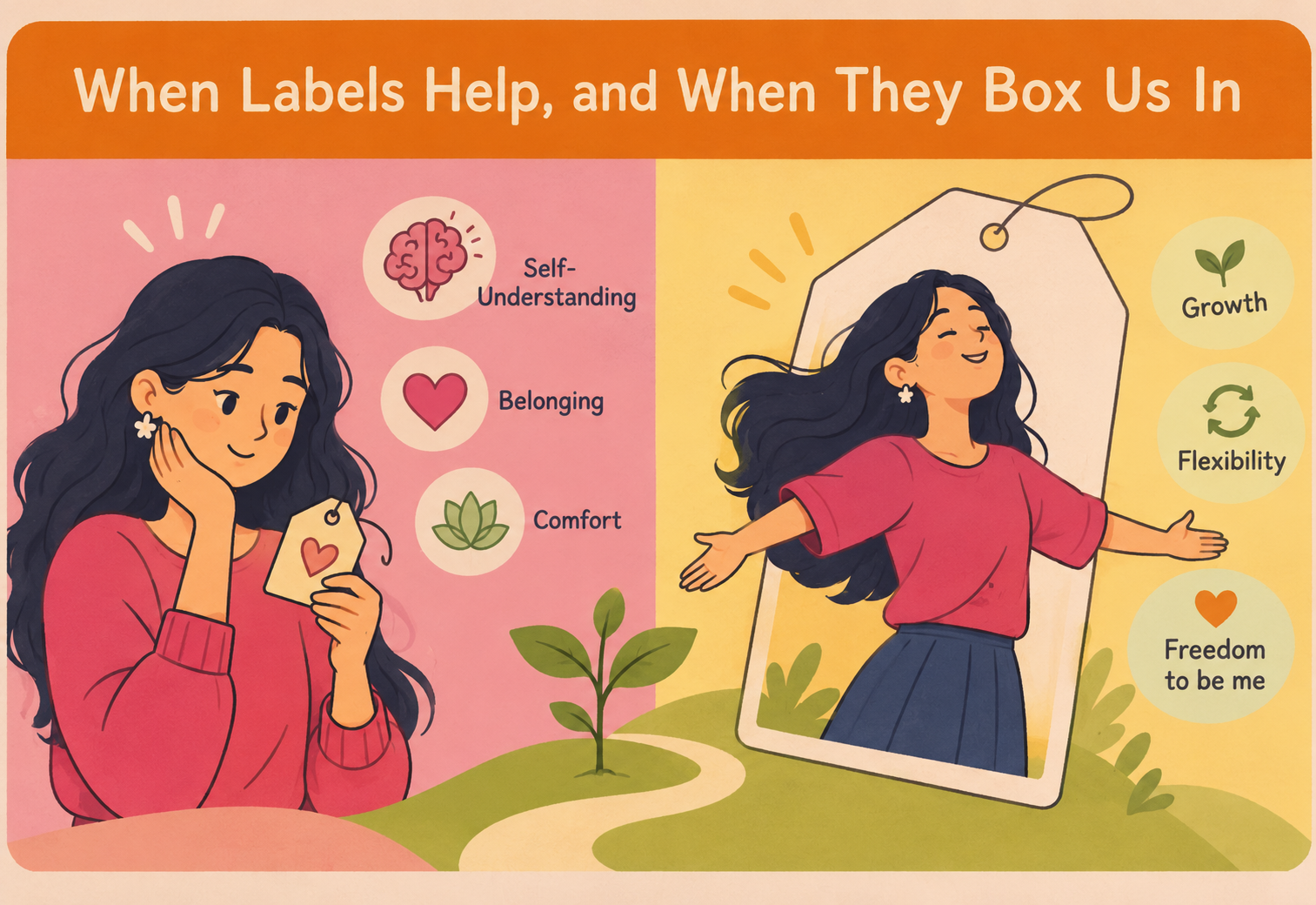
When Labels Help, and When They Box Us In
There’s something deeply comforting about finally finding words for yourself.
Maybe it’s discovering an attachment style that suddenly explains why relationships feel hard. Maybe it’s identifying with being an introvert, neurodivergent, highly sensitive, anxious, queer, avoidant, people-pleaser, eldest daughter, overthinker, or someone who struggles deeply with certain emotions or experiences. Sometimes, finding language for yourself can feel like relief.
It can sound like: “Oh, so it’s not just me.” “This finally makes sense.” “There’s a reason I feel the way I do.”
And honestly, there’s something incredibly validating about that.
As humans, we naturally look for meaning. We want language for our experiences. We want to understand ourselves, especially the parts that have felt confusing, difficult, or hard to explain. Labels can offer structure when things feel messy. They can help us feel seen, understood, and less alone. Sometimes, they even help us make sense of patterns we’ve been carrying for years without knowing why.
You finally understand why certain things affect you deeply. Why some relationships feel harder than others. Why situations that seem small to others feel overwhelming to you. Instead of wondering, “Why am I like this?” you begin to think, “Oh, maybe this explains why this feels hard for me.”
That shift matters.
Because often, self-understanding creates softness. It helps reduce shame. It gives context to experiences we may have spent years criticizing ourselves for. Sometimes, labels help us realize that what we thought was “something wrong with us” is actually something that can be understood.
But somewhere along the way, something else can happen too.
The thing that once helped us understand ourselves can slowly start becoming something we feel stuck inside.
Without even realizing it, a label can move from being a way to describe an experience to becoming something we feel pressured to stay loyal to. What starts as “I struggle with anxiety sometimes” quietly becomes “This is just who I am.” What begins as “I tend to avoid conflict” turns into “I’m avoidant, relationships are always going to be hard for me.”
And while labels can absolutely help us understand ourselves, sometimes they can begin to limit how we see ourselves too.
Not because labels are inherently bad, but because human beings are far more fluid than the categories we place ourselves into.
The truth is, most of us are constantly changing.
You might be deeply introverted in one season of your life and suddenly crave connection in another. You might strongly identify with being independent, only to later realise that you actually want closeness and support. You might resonate deeply with a certain attachment style today and find that, over time and through different experiences, it feels less true than it once did.
That doesn’t mean you were wrong before.
It simply means you changed.
And changing is not inconsistency. It’s part of being human.
Sometimes, though, labels can create pressure in ways we don’t immediately notice. Pressure to stay the same. Pressure to explain ourselves clearly. Pressure to fit neatly into something fixed.
You’ll often hear people say things like, “This is just how I am” or “That’s my personality.” And while there’s truth in knowing yourself, there’s also a fine line between understanding yourself and accidentally closing the door on growth.
Because when identity becomes too rigid, we stop exploring who else we might be.
We stop asking questions like: Could this change? Is there more to me than this? What parts of me haven’t had space to emerge yet?
Instead, we sometimes begin living inside the expectations of the label. Sometimes we even protect it, without realising it.
You may have noticed this online too. There’s often so much emphasis on defining yourself quickly and clearly. Knowing exactly who you are. Having the “right” language. And while language can absolutely make us feel understood, there’s also something deeply human about not having everything figured out.
You are allowed to be contradictory.
You are allowed to outgrow parts of yourself.
You are allowed to stop resonating with a label, even if it once felt important to you.
And you are allowed to still be figuring things out.
One of the gentlest shifts people often make in therapy is moving from identity as certainty to identity as curiosity.
Instead of saying, “This is exactly who I am,” it slowly becomes, “This is what I understand about myself right now.”
It may seem like a small shift, but it changes a lot.
Because suddenly, there’s room.
Room for complexity.
Room for change.
Room to surprise yourself.
It allows labels to become tools rather than rules. Something that supports understanding, rather than something that defines the entire shape of who you are.
Because labels can absolutely be helpful. They can help us make sense of our experiences, communicate our needs, advocate for ourselves, and feel less alone in what we’re carrying.
But they were never meant to hold the entirety of who you are.
You are always more than one word. More than one diagnosis. More than one personality trait. More than one difficult season.
Maybe the goal isn’t to define yourself perfectly.
Maybe it’s to stay open to meeting yourself again and again, allowing who you are to shift, deepen, and evolve over time.
Because identity isn’t something you figure out once and finish.
It’s a relationship.
And like any relationship, it changes as you do.