
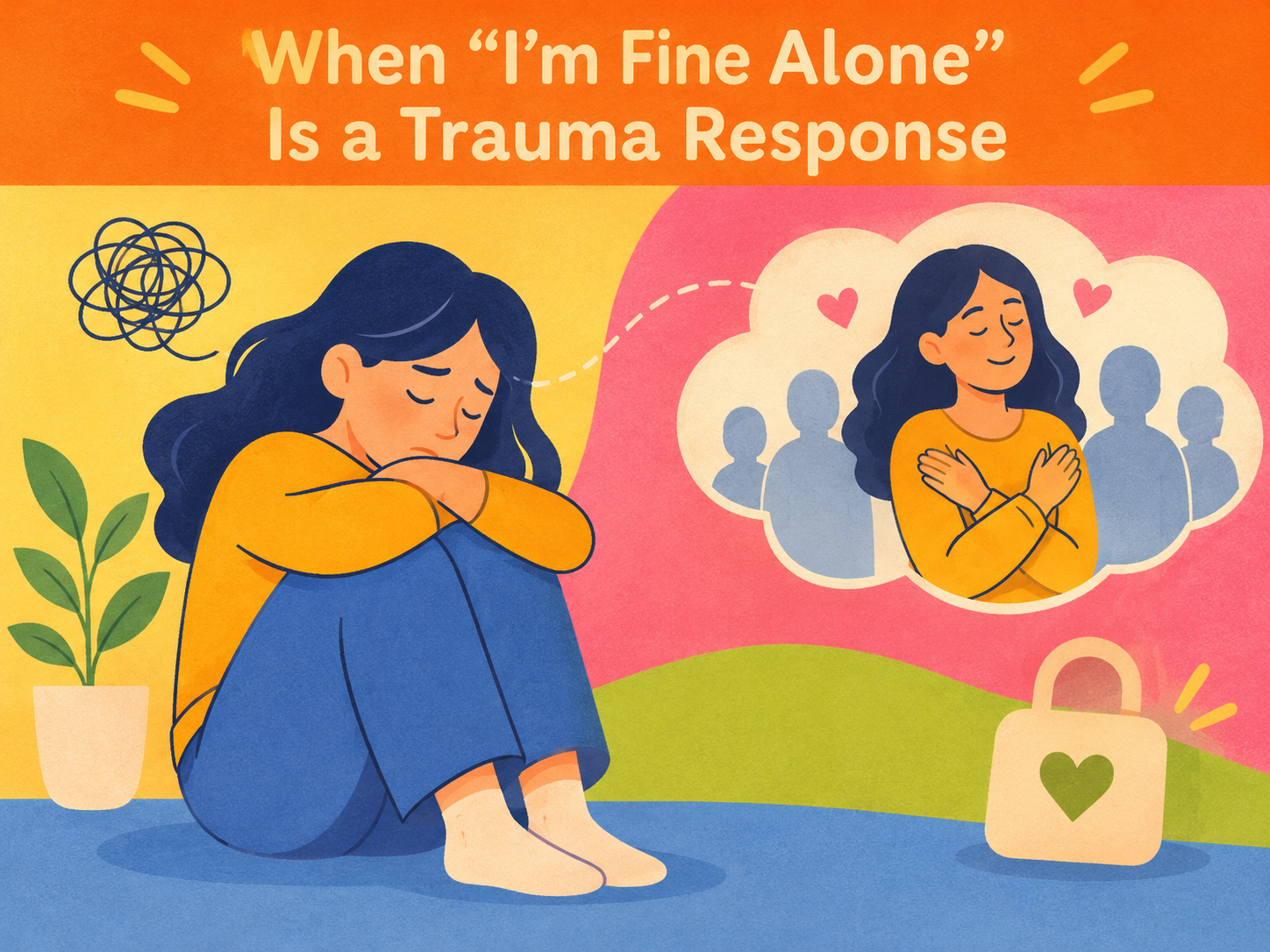
When “I’m Fine Alone” Is a Trauma Response
“I’m fine on my own.”
It can be a statement of confidence. It can mean that you enjoy your own company, value your independence, or simply don't feel the need to constantly be around other people. But sometimes, being alone isn't really a preference. Sometimes, it is a way of staying safe.
For people who have experienced trauma, independence can become more than a personality trait. It can become a survival strategy. You learn that depending on other people can be disappointing, unsafe, unpredictable, or even painful, and slowly, you stop asking. You stop needing. You stop expecting. Eventually, you become very good at taking care of everything yourself.
From the outside, this can look like strength. You might be the person everyone comes to when they need help. You handle your own problems, rarely ask for support, and find it uncomfortable when someone offers to do something for you. You may pride yourself on being "low maintenance" or tell yourself that you simply don't like relying on people.
And perhaps you genuinely do value your independence. The question isn't whether being independent is good or bad. The question is whether you have a choice.
There is a difference between “I can do this myself” and “I have to do this myself because I don't feel safe depending on anyone.”
Hyper-independence often develops when relying on others has not felt safe. Maybe you grew up having to manage your emotions without much support. Maybe asking for help was met with criticism, rejection, guilt, or indifference. Maybe the people you depended on were inconsistent—there one moment and unavailable the next. Or perhaps you learned through relationships that having needs gave someone else the power to hurt, control, or disappoint you.
When experiences like these happen repeatedly, it makes sense for the nervous system to arrive at a conclusion: I am safer when I don't need anyone.
So you learn to anticipate your own needs. You don't ask someone to pick you up because you can take a cab. You don't tell someone you're struggling because you'll probably figure it out. You don't ask for reassurance because needing reassurance feels embarrassing or burdensome. You might even pull away when someone gets too close—not because you don't care about them, but because closeness can bring with it the possibility of dependence.
The difficult part is that the same strategy that once protected you can eventually become limiting.
You may deeply want connection while finding it difficult to let people care for you. You may want a relationship but feel uncomfortable being emotionally dependent on someone. You may miss people but struggle to reach out. You may feel overwhelmed when someone offers support, because accepting it brings up an unfamiliar vulnerability.
Sometimes, being cared for can feel more uncomfortable than being alone.
This can also create a particular kind of loneliness. You can be surrounded by people who love you and still feel like you're carrying everything by yourself. People may assume you don't need support because you've become so good at appearing like you don't. And because you rarely ask for anything, others may not realise how much effort it takes to keep saying, “I'm fine.”
Learning to rely on others doesn't mean giving up your independence. It doesn't mean becoming dependent on another person for your sense of stability or making someone else responsible for your wellbeing. In fact, healthy relationships aren't built around complete independence or complete dependence. They are built around interdependence—the ability to care for yourself while also allowing other people to care for you.
Interdependence means being able to say, “I can handle this, but I don't have to handle it alone.”
For someone who has spent years relying only on themselves, this can feel incredibly unfamiliar. It may start with very small things. Letting a friend help you with something you could have done yourself. Telling someone that you've had a difficult day instead of automatically saying you're fine. Asking for reassurance when you need it. Allowing someone to show up for you without immediately feeling that you owe them something in return.
These moments might seem insignificant, but they can be meaningful experiences for a nervous system that has learned that needing people is dangerous.
It is also important to recognise that rebuilding trust doesn't mean ignoring red flags or forcing yourself to depend on people who have not earned your trust. Trauma-informed healing isn't about convincing yourself that everyone is safe. It's about developing the ability to recognise who is safe, what you need, and when it feels okay to let someone a little closer.
You are allowed to have boundaries. You are allowed to say no. You are allowed to maintain your autonomy. And you are also allowed to ask for help.
Perhaps the goal isn't to become someone who needs other people all the time. Perhaps it's to become someone who knows they have a choice.
Someone who can be alone without feeling abandoned.
Someone who can be close to others without feeling trapped.
Someone who can receive care without feeling weak.
Someone who can say, “I can do this myself,” while also knowing that they don't always have to.
Because sometimes healing doesn't look like learning how to stand on your own.
Sometimes, it looks like finally discovering that you don't always have to.