
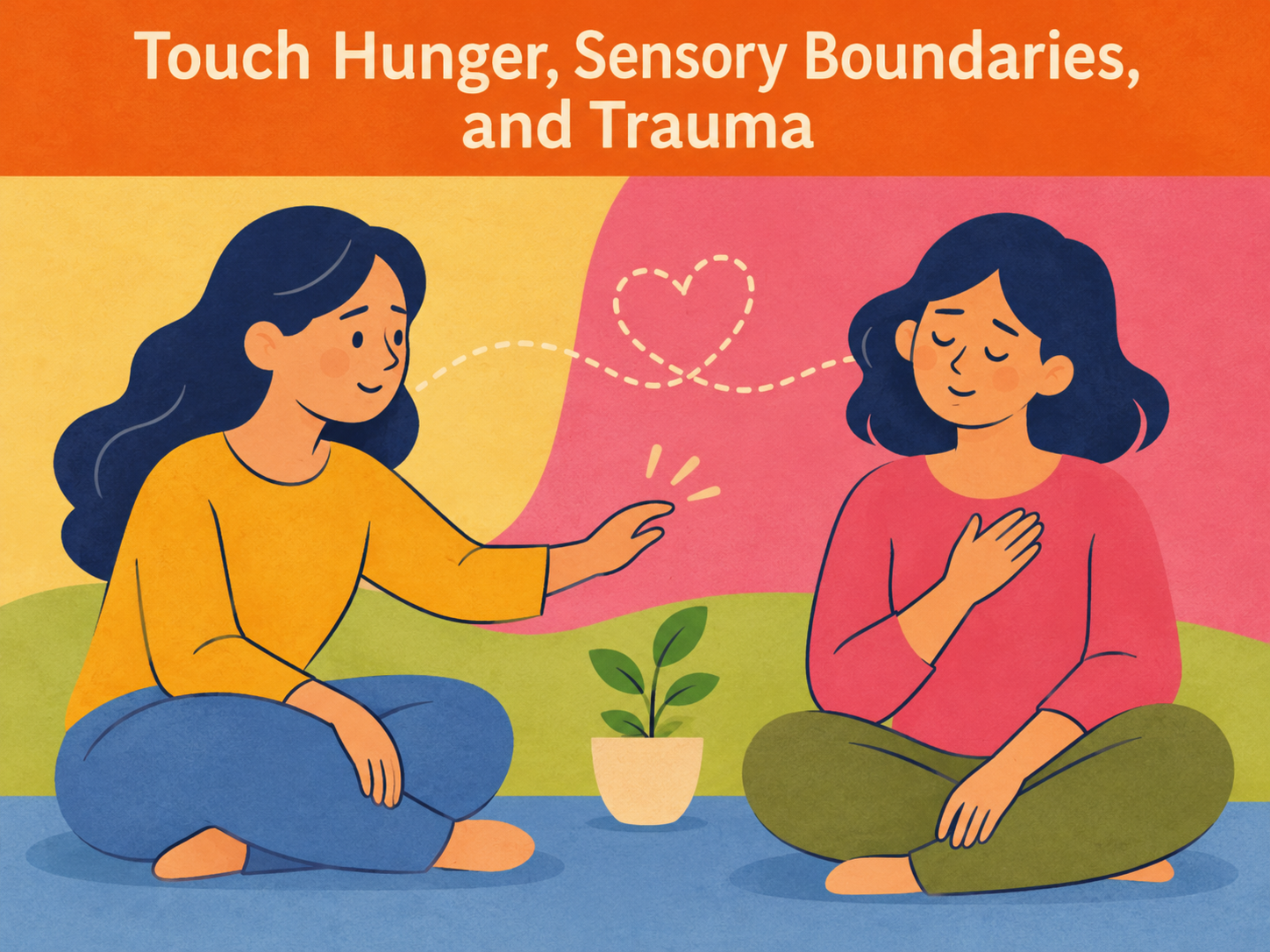
Touch Hunger, Sensory Boundaries, and Trauma
There are moments when you long for someone to hold you. You imagine what it would feel like to lean into another person, to be hugged, to have your hand held, or simply to exist in the comforting presence of someone who feels safe. And yet, when that closeness is actually offered, your body tenses. You pull away. You freeze. You suddenly feel overwhelmed, even if it's coming from someone you trust.
If you've ever experienced this contradiction, you're not alone.
Many people who have experienced trauma describe feeling caught between craving closeness and feeling uncomfortable with it. It can be confusing. You might wonder, "If I wanted this, why does it suddenly feel like too much?" or "Why does my body react this way when my mind knows I'm safe?"
The answer often lies in understanding that our need for connection and our sense of safety are deeply intertwined, but they don't always move at the same pace.
As human beings, we are wired for connection. Touch is one of the earliest ways we experience comfort and care. A hand on our back, a warm embrace, someone sitting beside us during a difficult moment—these experiences can communicate safety in ways that words sometimes cannot. But when touch has been associated with fear, unpredictability, coercion, or harm, the body begins to respond differently. What once had the potential to soothe can also become something the nervous system experiences as overwhelming.
This doesn't mean you've stopped wanting connection. It means your body has learned to be cautious about how that connection happens.
Trauma can change the way our nervous system responds to physical closeness. For some people, even gentle touch can feel startling or intrusive. For others, the discomfort isn't with touch itself but with the lack of control over it. A hug that arrives unexpectedly, someone sitting too close, or a hand resting on your shoulder without permission may trigger discomfort that feels difficult to explain. The body isn't necessarily responding to the present moment alone—it may also be responding to experiences where choice, safety, or autonomy were taken away.
This is where conversations around consent often need to become a little broader. We tend to think of consent in the context of sexual intimacy, but consent exists in everyday moments too. It can look like asking before hugging someone, checking whether they would like physical comfort, or respecting a "not right now" without taking it personally. Consent isn't only about saying yes or no. It's about having the space to choose.
For people navigating trauma, that sense of choice can make all the difference. Knowing that you can move away, ask someone to stop, or change your mind halfway through allows the nervous system to experience something it may not have experienced before: safety alongside closeness.
It's also worth remembering that not everyone experiences connection through touch. Some people feel safest sitting quietly beside someone. Others feel connected through conversation, shared activities, eye contact, or simply knowing another person is present. There is no hierarchy of intimacy. Physical touch is only one way of expressing care, and it doesn't have to be the starting point.
For those who do want to rebuild a comfortable relationship with touch, the process is rarely about forcing yourself to "get used to it." More often, it's about moving at a pace your body can tolerate. Healing doesn't happen by overriding discomfort. It happens by listening to it with curiosity.
Sometimes that means beginning with very small moments of physical connection. It could be noticing how it feels to hold someone's hand for a few seconds before letting go. It could be choosing when to initiate a hug rather than feeling expected to receive one. It could even be becoming more aware of what kinds of touch feel comforting and which ones don't.
There is no right timeline for this. Your boundaries are allowed to change from one day to the next. Some days your body may welcome closeness, while on others it may need more space. Neither response is wrong. Boundaries are not signs that you're pushing people away; they are often the very thing that makes genuine closeness possible.
One of the most common misconceptions about trauma is that healing means eventually becoming comfortable with everything. In reality, healing often looks like becoming more attuned to yourself. It means recognising what feels safe, what doesn't, and trusting that your body's responses deserve attention rather than judgment.
If you find yourself craving closeness while simultaneously feeling overwhelmed by it, it doesn't mean you're broken or sending mixed signals. It means different parts of you are trying to meet different needs. One part longs for connection. Another is trying to protect you from being hurt again. Both parts make sense.
Over time, with relationships that are patient, respectful, and grounded in choice, the nervous system can begin to learn something new. It can learn that closeness doesn't always have to come at the cost of safety. That touch can be invited rather than expected. That intimacy can move slowly. And that being cared for doesn't require you to ignore what your body is trying to tell you.
Perhaps healing isn't about becoming someone who is always comfortable with touch. Perhaps it's about building relationships where your "yes" feels genuine, your "no" is respected, and your body no longer has to choose between connection and safety.