
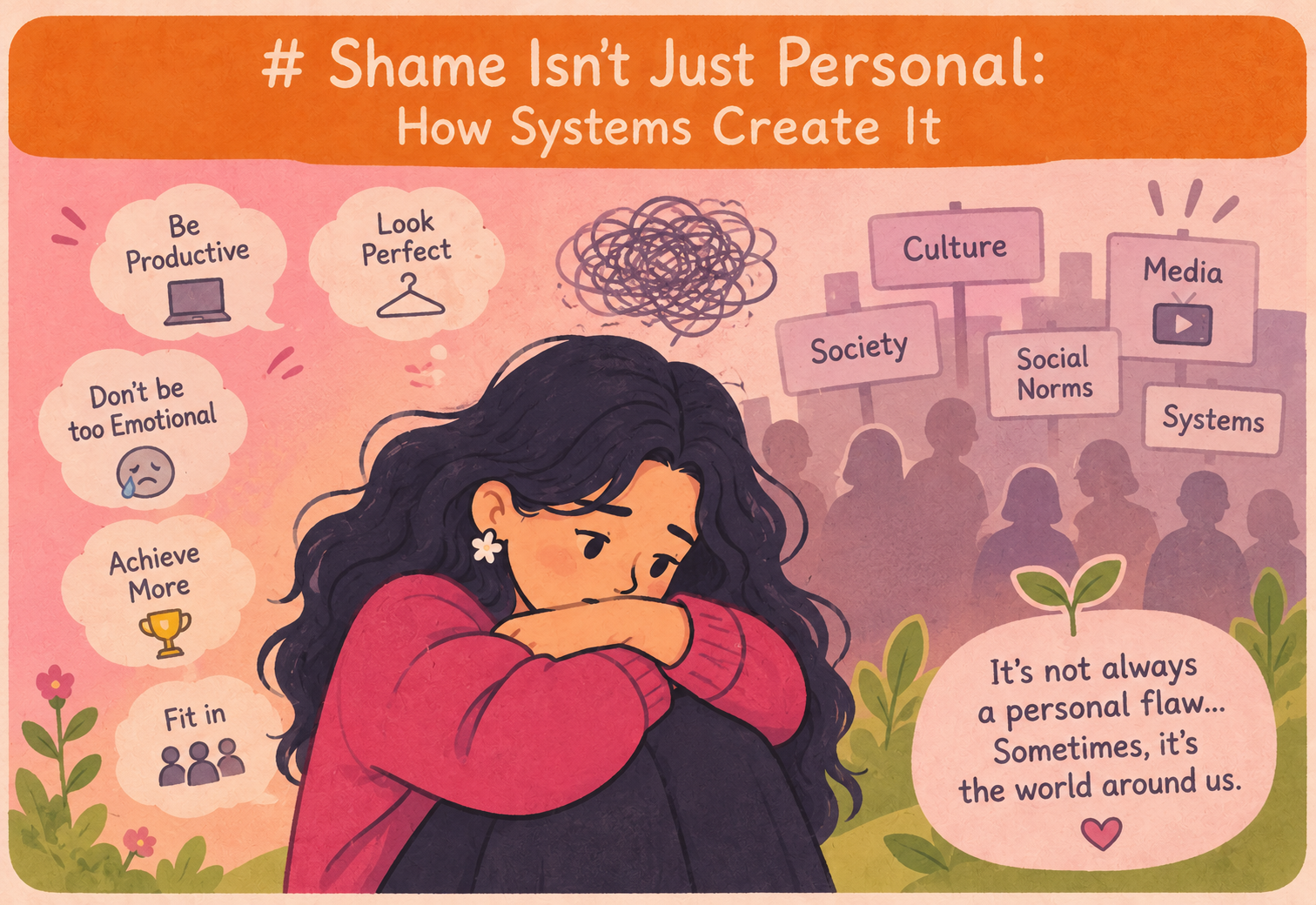
Shame Isn't Just Personal: How Systems Create It
When we talk about shame, it's often framed as something deeply personal. Something that lives inside us. We talk about being ashamed of our bodies, our emotions, our choices, our mistakes, our desires, or the ways we move through the world. The conversation often becomes about how to overcome shame, how to heal it, or how to stop feeling it. While these conversations are important, they can sometimes miss a crucial question: where did the shame come from in the first place?
Many of us are taught to see shame as evidence that something is wrong with us. If we feel ashamed, we assume we must have done something wrong, failed in some way, or fallen short of who we are supposed to be. But shame does not emerge in a vacuum. It develops within relationships, communities, cultures, and systems. Long before we form opinions about ourselves, we are absorbing messages about what is acceptable, desirable, respectable, and worthy.
We learn what kinds of bodies are celebrated and which ones are criticised. We learn which emotions are acceptable to express and which ones should be hidden. We learn what success is supposed to look like, what relationships are considered normal, what kind of life is worth aspiring to, and what parts of ourselves need to be softened, changed, or concealed in order to belong. These messages are often so common that we stop noticing them. They begin to feel like facts rather than social expectations.
Over time, these expectations can become woven into the way we see ourselves. A person who grows up hearing that their worth is tied to achievement may struggle with intense shame whenever they make a mistake. Someone who has repeatedly received messages that they are "too emotional" may begin to feel embarrassed by their own feelings. A person whose identity, body, or way of being falls outside dominant social norms may spend years wondering why they feel inadequate without recognising that they have been navigating systems that were never designed with them in mind.
One of the most painful things about shame is that it convinces us that the problem begins and ends with us. It turns our attention inward. Instead of asking why a particular expectation exists, we ask why we cannot meet it. Instead of questioning the standards we are being measured against, we question our own worth. Shame is incredibly effective at making social problems feel like individual failures.
This is particularly true in cultures that place a high value on productivity, independence, and constant self-improvement. We are surrounded by messages telling us that we should be doing more, achieving more, healing faster, earning more, looking better, and somehow managing it all with ease. When we inevitably struggle under these expectations, the response is often self-criticism rather than curiosity. We tell ourselves we are lazy, weak, behind, or not trying hard enough. Rarely do we stop to ask whether the standards themselves are unrealistic.
Even when we begin to understand this intellectually, shame does not simply disappear. Shame lives in the body as much as it lives in our thoughts. It can show up as the urge to shrink, to hide parts of ourselves, to stay quiet, to avoid taking up space. It can appear as a knot in the stomach before speaking honestly, a tightness in the chest when asking for help, or the instinct to apologise for needs that are entirely reasonable. The body often carries the weight of messages it has received for years, sometimes decades.
This is why healing shame is not simply about becoming more confident or learning to think positively. Sometimes it involves recognising that the story we have been telling ourselves was never entirely ours. It involves questioning who benefits when we believe we are not enough. It involves noticing the ways broader systems shape our self-perception and understanding that many of our struggles make sense in the context of the environments we have lived in.
Externalising shame does not mean avoiding accountability or refusing self-reflection. It simply means recognising that not everything we carry belongs solely to us. Some of what we call personal shame is actually the result of years of social conditioning, exclusion, judgment, and impossible expectations. Understanding this can create room for a different kind of compassion—not the kind that says "there is nothing wrong," but the kind that says "it makes sense that I feel this way given what I have been taught."
There is something deeply relieving about realising that shame is not always evidence of a personal flaw. Sometimes it is evidence of the messages we have been surrounded by. Sometimes it reflects the pressure of trying to fit into spaces that were not built for us. Sometimes it tells us more about the systems we are navigating than it does about who we are.
Perhaps the goal is not to get rid of shame as quickly as possible. Perhaps the goal is to become curious about it. To ask where it came from, whose voice it sounds like, and what expectations it is trying to uphold. Because when we stop viewing shame as proof that something is wrong with us, we create the possibility of relating to ourselves with a little more understanding and a little less blame.