

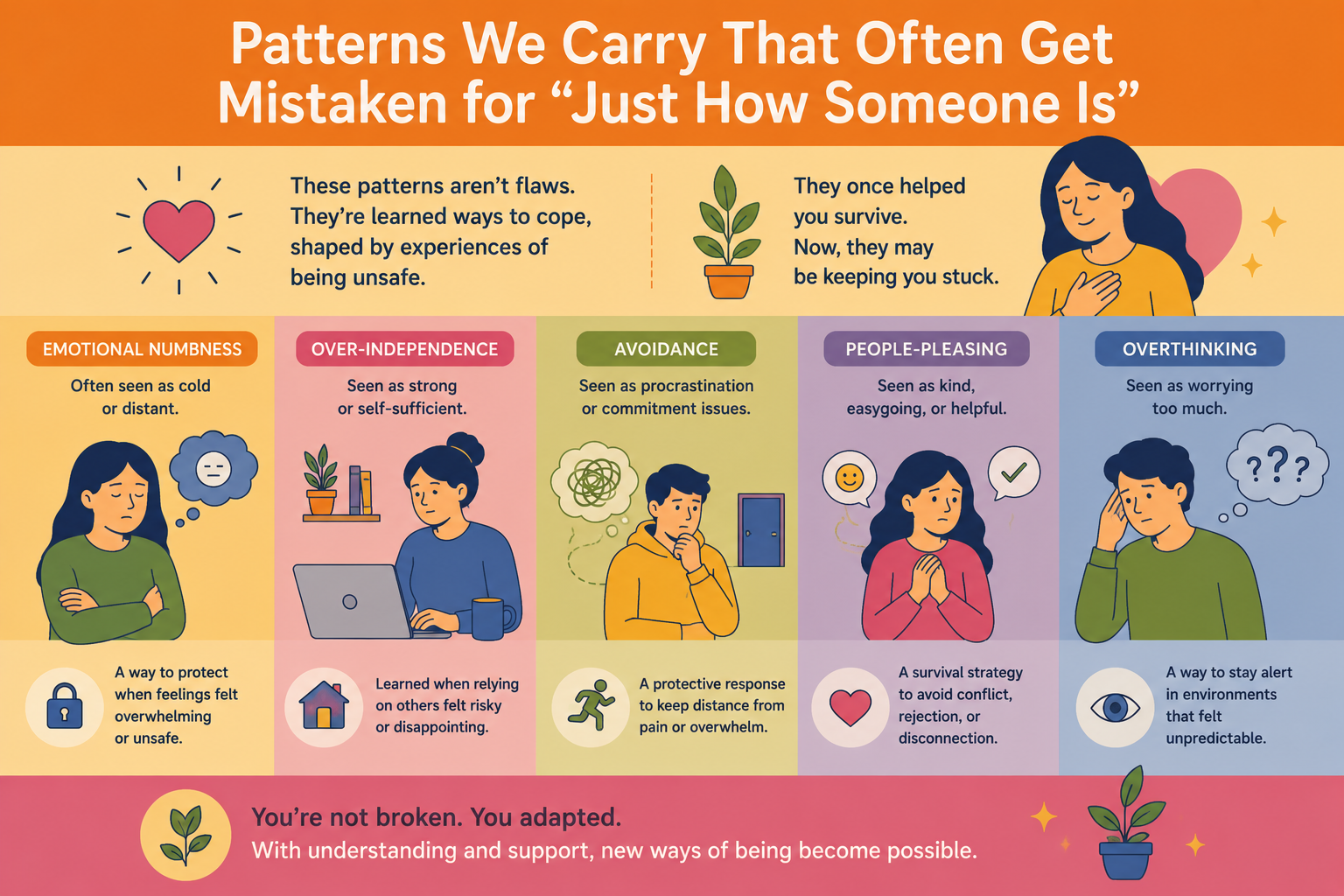
Patterns We Carry That Often Get Mistaken for “Just How Someone Is”
We’re used to describing people in neat, fixed ways. “She’s very distant.” “He’s too independent.” “They avoid everything.” “I’m just bad at expressing emotions.” These labels can feel simple, even reassuring sometimes. They give us a way to make sense of behavior: our own and other people’s. But sometimes, these descriptions aren’t really about who someone is at their core. Sometimes, they’re ways we’ve learned to cope.
Not all difficult experiences look dramatic or obvious. Sometimes they are subtle, repeated, or woven into everyday life shaping how safe or unsafe the world feels over time. And when something feels unsafe for long enough, the mind and body adjust. Quietly. Gradually. In ways that aren’t always easy to recognize.
Take emotional numbness, for instance. You might have been told you’re emotionally unavailable, or that you don’t react enough. Maybe you’ve even wondered that about yourself- why don’t I feel things the way others seem to? But numbness isn’t emptiness. It’s often what happens when feeling everything would be too much. If emotions were once overwhelming, dismissed, or unsafe to express, the body learns to turn the intensity down. Not because it doesn’t care, but because it had to protect itself. It’s less about not feeling and more about not being able to safely feel everything at once.
Something similar can happen with independence. On the surface, being independent is seen as a strength, and it can be. But sometimes it comes with a quiet edge- a difficulty in asking for help, trusting others, or leaning on someone. That kind of independence is often learned, not chosen. It can come from experiences where support wasn’t available, or where depending on someone led to disappointment or hurt. Over time, needing others starts to feel risky. So you stop. Not because you don’t want connection, but because it doesn’t feel safe enough to reach for it.
Avoidance is another pattern that gets misunderstood. We often call it procrastination, commitment issues, or running away. And yes, sometimes it can get in the way of things we want. But at its core, avoidance is a protective pattern. If something like a conversation, a situation, even a feeling reminds your system of something painful, your body will try to steer you away from it. It doesn’t pause to check whether the danger is still real. It just knows that something like this once didn’t feel okay. So it creates distance. Not because you’re incapable, but because some part of you is trying to keep you from getting hurt again.
Then there’s people-pleasing. Being the easygoing one. The one who adjusts. The one who says yes, even when they want to say no. From the outside, it can look like a lack of boundaries. But often, it’s something more layered. If you’ve learned that conflict leads to disconnection or emotional risk, keeping others happy can start to feel like the safest option. You become good at reading the room, anticipating needs, smoothing things over. Not because you don’t have needs of your own, but because somewhere along the way, it felt safer to put them aside.
Even something like “overthinking” can be understood differently. Constantly replaying conversations, reading between the lines, preparing for what might go wrong, it’s easy to dismiss this as overthinking. But for many people, it’s closer to staying alert. If you’ve experienced unpredictability, where things could shift suddenly or without warning, your system learns to stay on guard. To notice patterns, to anticipate, to try and stay one step ahead. It’s tiring, but it makes sense. Your mind is doing what it learned to do: watch carefully, so nothing catches you off guard.
When these patterns get reduced to “this is just how I am” or “that’s just how they are,” there’s often an unspoken message that this is fixed, that it can’t really change. And that can feel heavy. But when we begin to see them as learned ways of coping, something shifts. Instead of asking, “What’s wrong with me?”, the question becomes, “What did I have to learn to get through what I experienced?” That question tends to open more space, more understanding. Because these patterns didn’t come out of nowhere. They formed in specific contexts, for specific reasons. At some point, they were useful. Necessary, even.
Understanding this doesn’t mean you’re stuck this way forever. It just means you don’t have to fight yourself to change. Change often comes about in small, quiet ways- noticing your patterns without immediately judging them, recognizing what feels unsafe, slowly allowing new experiences of safety to exist. It’s not about forcing yourself to be more open, more dependent, or less avoidant overnight. It’s about gently expanding what feels possible, at your own pace.
If you see yourself in any of this, it doesn’t mean something is wrong with you. It probably means something happened or didn’t happen that shaped how you learned to cope. And those ways of coping stayed. Not because this is just who you are, but because your system did what it needed to do. The work isn’t to erase those parts of you. It’s to understand them. And slowly, when it feels safe enough, to build new ways of being alongside them.