
The Micro-Griefs of Everyday Identity
Not every loss comes with a goodbye.
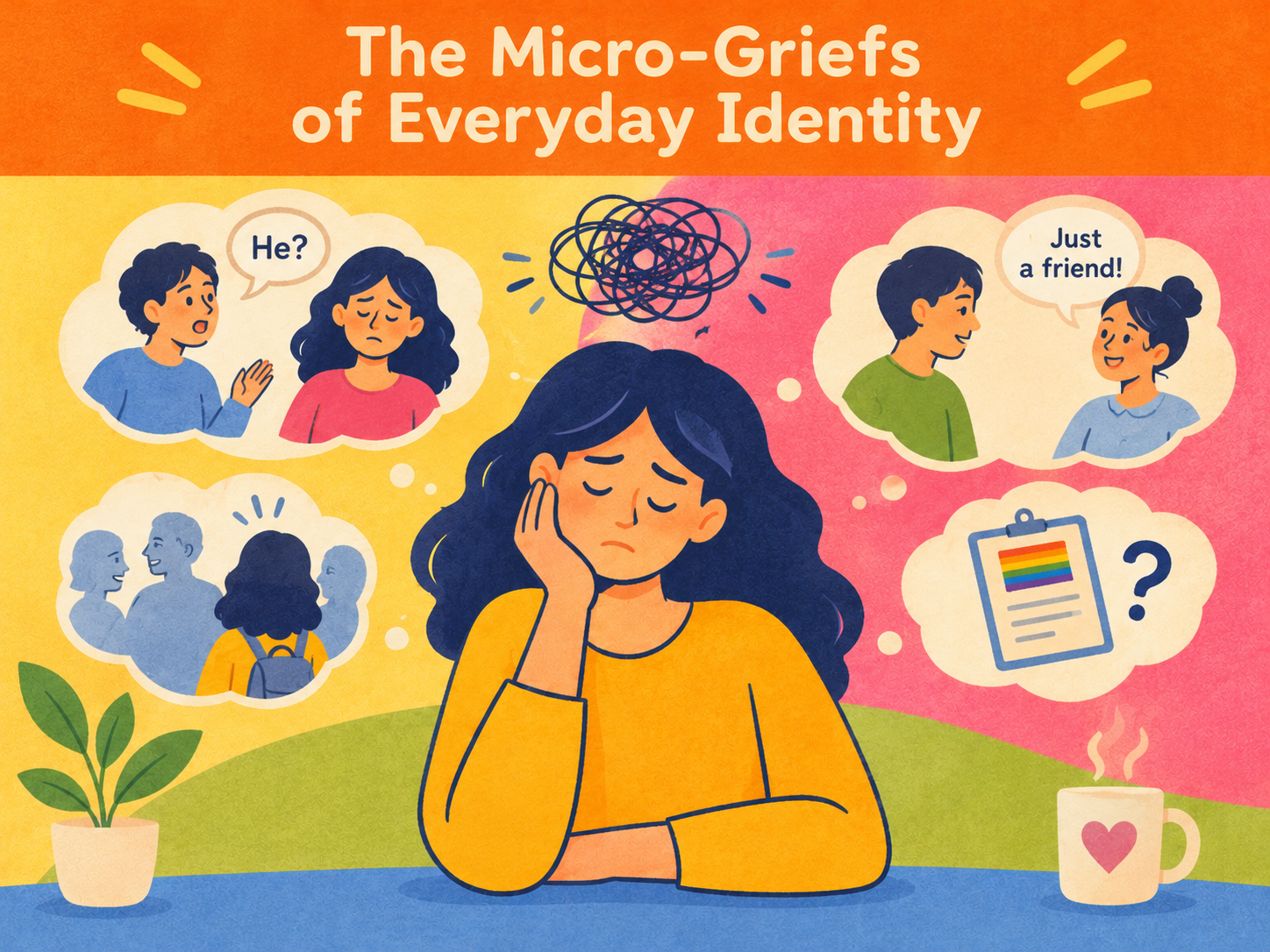
Sometimes, grief looks like hearing the wrong name again. Sometimes it is being misgendered by someone who knows better, watching a part of yourself disappear from a conversation, or realising that you are once again explaining something about your identity that you wish you didn't have to explain. Sometimes it is the moment someone makes an assumption about you and you decide not to correct them because you don't have the energy for what might come next.
These moments can seem small when looked at individually. You might even find yourself thinking, “It's not a big deal,” or “I shouldn't be so affected by this.” But when these experiences happen repeatedly, they can carry a weight that is difficult to explain.
This is where the idea of micro-griefs can be useful. Micro-griefs are the small, often unnoticed losses that accumulate over time. They aren't necessarily dramatic events. They can be ordinary moments that remind you that the world doesn't always see you in the way you see yourself, or in the way you wish to be seen.
For many people, identity is something that is continually negotiated in everyday life. You might have to decide whether to correct someone who uses the wrong pronouns. Whether it feels safe to mention your partner. Whether you want to disclose something about yourself to a new colleague. Whether you want to explain why a particular comment was hurtful or simply let it pass.
Each decision may take only a few seconds, but the emotional effort behind it can be much greater.
Being repeatedly misgendered, for example, isn't necessarily experienced as one isolated mistake. When it happens again and again, it can become a repeated reminder of being misunderstood or unseen. A person may know who they are with complete certainty and still feel the exhaustion of having to continually negotiate that identity with the people around them.
The same can happen with invisibility. Sometimes invisibility isn't about being completely ignored. It can be about parts of your life being treated as though they don't exist. A partner who is referred to as a “friend.” A family member who avoids using your name. A workplace where certain kinds of relationships or identities are never acknowledged. A social space where you constantly have to assess whether being fully yourself will change how people treat you.
None of these moments necessarily look significant from the outside. But being unseen repeatedly can affect how safe it feels to be visible at all.
There can also be grief in the things you never got to experience.
You might grieve the ease of growing up without having to question whether you were different. You might grieve relationships that could have looked different if you had felt safe enough to be yourself. You might grieve the version of your family you wished you could have had, or the childhood you imagine you might have experienced if you had been understood earlier.
Sometimes there is grief for the person you had to become in order to survive.
Maybe you learned to make yourself smaller. Maybe you became exceptionally good at reading a room before deciding what parts of yourself could be revealed. Maybe you learned to laugh at comments that hurt because responding honestly felt too risky. Maybe you became skilled at appearing unaffected.
These adaptations can be protective. They can help us navigate environments where being fully ourselves doesn't always feel safe. But they can also come with a cost.
Over time, the accumulation of these experiences can create an exhaustion that is difficult to name. You may find yourself reacting strongly to something that seems minor to someone else. You may wonder why one comment stayed with you all day. You may feel unexpectedly emotional after being misgendered, left out, or misunderstood.
It doesn't necessarily mean that the moment itself was enormous.
It may be carrying the weight of all the other moments that came before it.
This is one reason it can be unhelpful to tell ourselves to simply “let the small things go.” Sometimes the small thing is not small when it is the hundredth version of the same experience.
This doesn't mean that every uncomfortable interaction is traumatic or that every mistake someone makes carries the same meaning. People can make genuine mistakes, misunderstand us, or say the wrong thing without intending harm. What matters is also the larger pattern—the frequency, the context, the power dynamics, and what these experiences repeatedly communicate about whether you are seen, respected, and allowed to exist as yourself.
Giving these experiences space doesn't mean living in resentment. It can simply mean acknowledging that they affected you.
Therapy can sometimes offer a place to do exactly that. Not every experience needs to be turned into a major event before it is considered worthy of attention. You don't have to prove that something was “bad enough” to justify feeling hurt by it.
You can be affected by something and still know that someone didn't mean to hurt you.
You can understand why someone made a mistake and still wish they had gotten it right.
You can move forward and still grieve what you didn't get.
Perhaps part of healing is learning to stop measuring pain only by the size of the individual moment. Sometimes what hurts is not just what happened today, but what today's experience reminds your body of.
And perhaps those small moments deserve to be acknowledged—not because they define your life, but because you shouldn't have to minimise yourself in order to make other people comfortable with the weight you carry.
Some grief doesn't arrive all at once.
Sometimes, it accumulates quietly, in moments that other people barely notice.
And sometimes, healing begins with finally allowing yourself to notice them too.