

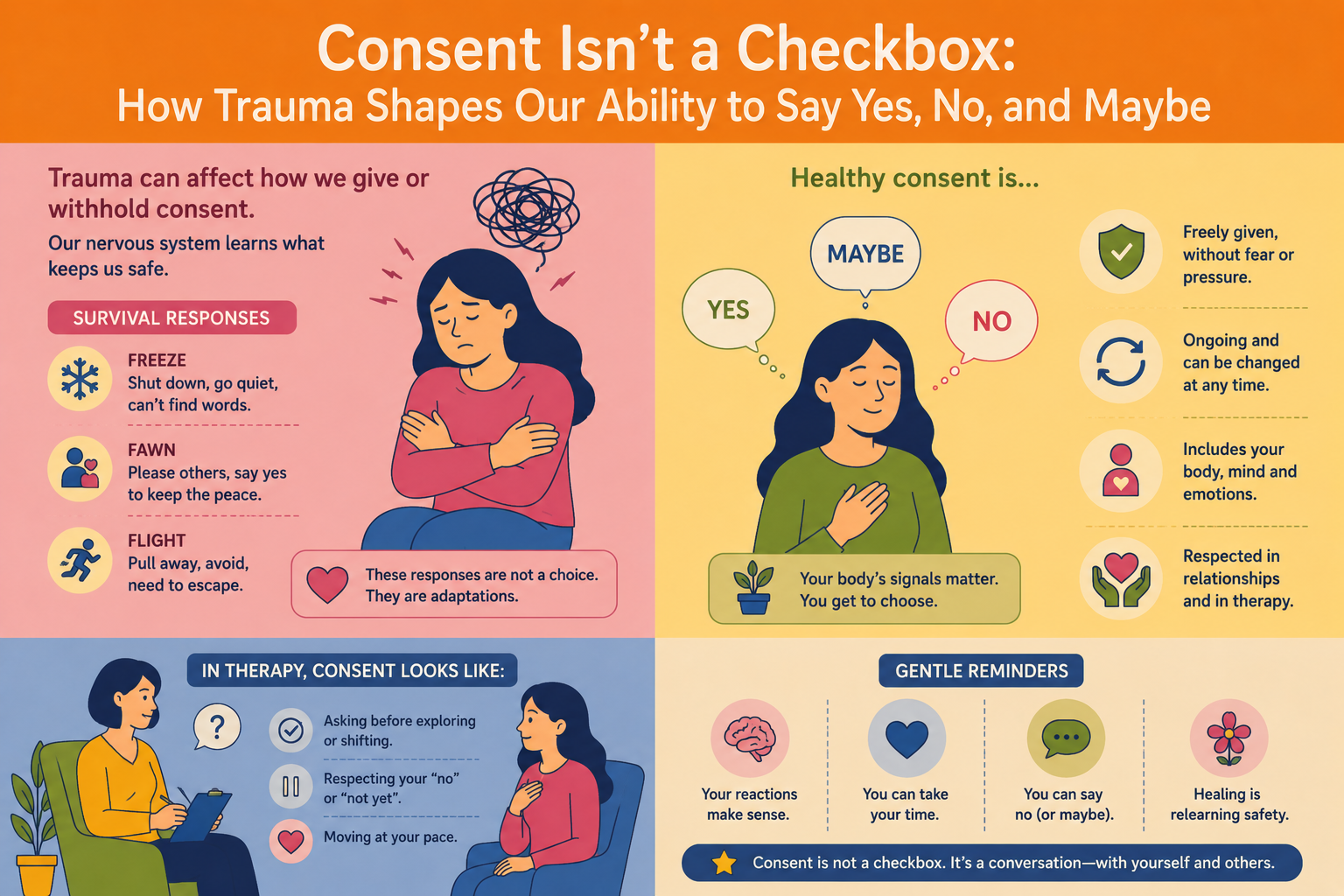
Consent Isn’t a Checkbox: How Trauma Shapes Our Ability to Say Yes, No, and Maybe
We often talk about consent like it’s simple.
You either say yes or no
End of the story.
But for many people, especially those with relational trauma, consent is rarely that straightforward.
Because consent doesn’t only live in words. It lives in the body. In the nervous system. In the parts of us that learned, long ago, what was safe to say and what wasn’t.
And sometimes, those parts learned that saying “no” wasn’t an option.
When you grow up in environments where your needs were dismissed, boundaries were violated, or love felt conditional, your body adapts. It figures out what keeps you the safest. For some people, that adaptation looks like fight which means pushing back, asserting, resisting. But for many others, it looks like freeze or fawn.
Freeze is the nervous system shutting things down when something feels overwhelming. You might go quiet. Numb. Blank. Unable to find words. Later, you may replay the situation and think, Why didn’t I say anything? But in the moment, your body chose immobility because that once kept you safe.
Fawning is different, but just as powerful. It’s when you automatically move toward pleasing, accommodating, softening yourself to prevent conflict or rejection. You might say yes quickly. You might laugh something off. You might agree to things you don’t actually want. And it doesn’t always feel conscious. It feels automatic.
Flight is another common response. Unlike freeze, which shuts down, or fawn, which appeases, flight means moving away. It can look like pulling back quickly, avoiding conversations, emotionally checking out, or feeling an urgent need to leave when something feels intense. Flight isn’t always a conscious boundary, sometimes it’s the nervous system trying to create safety through distance. Learning consent here often means slowing down just enough to ask yourself: Am I leaving because I truly want to, or because I feel overwhelmed?
Neither of these responses mean you “failed” to consent properly. They mean your nervous system was prioritizing safety.
That’s why consent isn’t just about whether someone said the word “yes.” It’s about whether that yes was freely given without fear, pressure, shutdown, or survival strategies running the show.
Trauma can blur the internal signals that help us know what we want. If you were taught to override discomfort, minimize your feelings, or take responsibility for other people’s emotions, it can be hard to locate your own yes and no.
Sometimes the body says no long before the mouth does. A tight chest. A heavy stomach. A sudden urge to disappear or hide. But if you’ve spent years disconnecting from those cues, you might not notice them until later or at all.
This is where the idea of embodied consent becomes important. Consent isn’t just a verbal agreement; it’s a felt sense of alignment. It’s your body and mind both on board. It’s the absence of coercion, even subtle coercion. It’s the ability to change your mind without fear.
And importantly, consent is ongoing.
You can say yes and then feel differently.
You can say maybe.
You can pause.
You can renegotiate.
A healthy dynamic makes space for that fluidity and flexibility. It doesn’t treat consent like a contract that was signed once and can’t be revisited.
People-pleasing complicates this even further. When your sense of safety is tied to being liked or not disappointing others, saying no can feel threatening. Not uncomfortable but threatening. Your nervous system may react as if rejection equals danger. So you agree. You go along. You tell yourself it’s fine.
Later, resentment shows up. Or shame. Or confusion about why you feel unsettled.
Learning consent after trauma often means rebuilding trust with your own body. Slowing down enough to check in. Giving yourself permission to not respond immediately. Practicing small no’s in low-stakes situations. Letting maybe exist without rushing it into yes.
How consent shows up in therapy
Consent also shows up in therapy, though we don’t always name it that way.
Micro-consent in therapy can look like a therapist asking, “Is it okay if we explore that a bit more?” or “Would you like to try a grounding exercise right now?” It’s the ongoing checking in not assuming readiness, not pushing disclosure, not interpreting silence as agreement.
For clients with trauma histories, this matters deeply. Therapy can unintentionally recreate dynamics where power feels unequal. When therapists actively seek consent even for small shifts in direction it reinforces something powerful: your pace matters. Your no is welcome here. Your maybe will be respected.
And for clients, learning to say, “I’m not ready to talk about that,” or “Can we slow down?” can be incredibly reparative. It challenges the old narrative that you must comply to stay safe.
Consent is not a checkbox you tick once and move past. It’s relational. It’s layered. It’s influenced by history.
If you struggle to say no, that doesn’t mean you’re weak. If you freeze, that doesn’t mean you agreed. If you change your mind, that doesn’t make you unreliable.
It means your nervous system learned certain rules a long time ago.
Healing doesn’t require forcing yourself into bold boundaries overnight. It starts smaller. It starts with noticing. With pausing. With asking yourself, quietly, What do I actually want right now? And allowing the answer even if it’s uncertain to matter.
Because real consent isn’t about performance.
It’s about safety.