
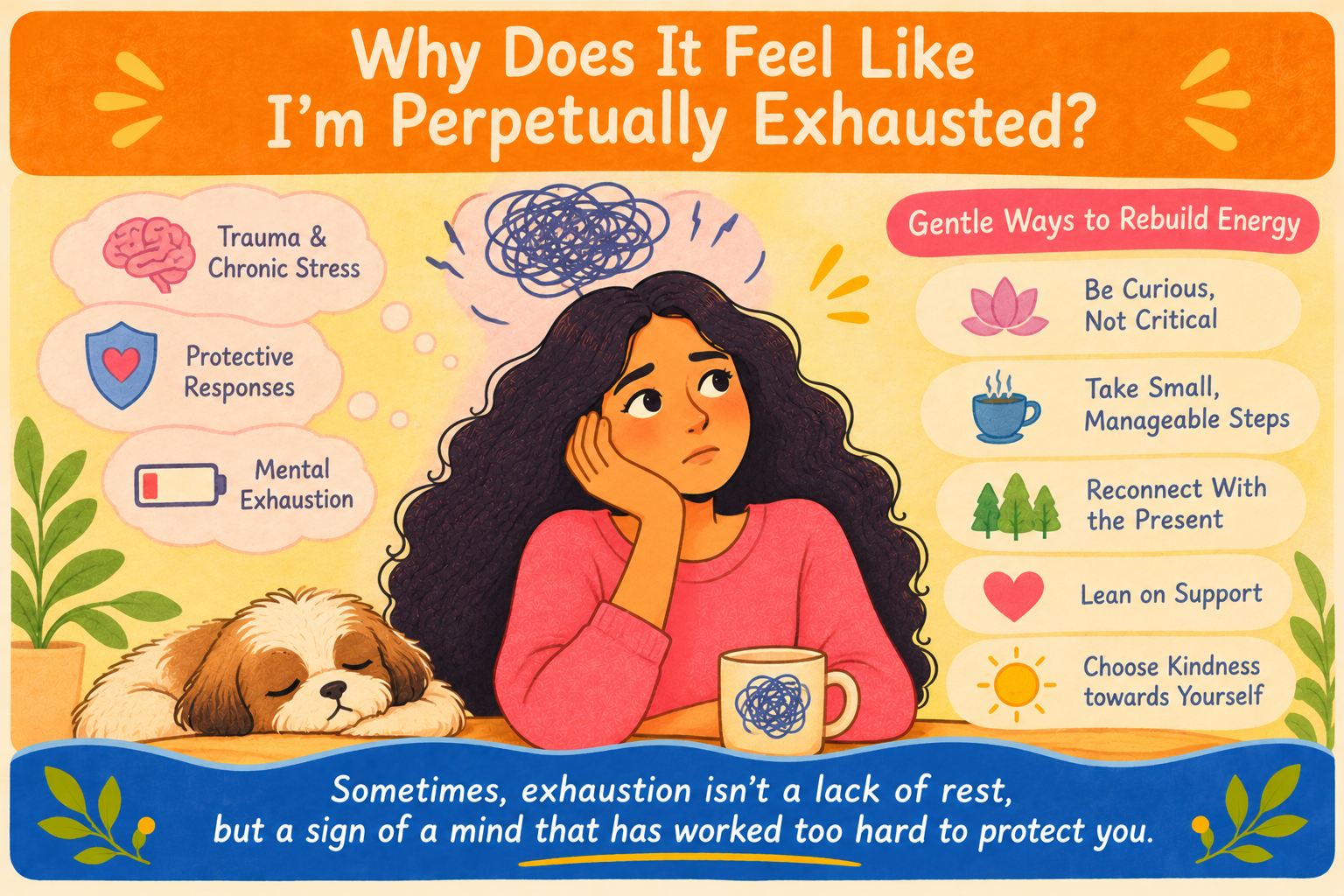
Why Does It Feel Like I’m Perpetually Exhausted?
“I’ve rested all weekend. I’ve slept enough. So why do I still feel exhausted?” is something I have heart, one too many times.
Most of us expect tiredness to disappear after a good night’s sleep or a quiet weekend. There are times when it does as physical exhaustion usually follows periods of increased demand, whether that’s exercise, illness, caregiving, or a stressful week at work, and rest generally allows the body to recover. However, sometimes exhaustion can linger. We sleep, take time off, eat well, and still feel as though we’re carrying an invisible weight. If this sounds familiar, your body may not simply be asking for more rest. It may be responding to prolonged stress or trauma.
When Rest Isn’t Enough
Trauma isn’t solely what happened to us, but it is also about how our minds and bodies adapted to survive overwhelming experiences. Research has consistently shown that chronic stress and trauma can affect attention, memory, emotional regulation, and energy levels long after the original event has passed.
If life has repeatedly felt unpredictable, unsafe, or emotionally overwhelming, the brain may continue allocating energy towards monitoring potential threats, making sense of past experiences, and preparing for future ones. So, rather than switching the response “off” after the danger has passed, our brains still keep the responses available, and ready-to-go at even a slightest resemblance to the danger. These processes happen largely outside of our awareness but require considerable mental and emotional resources.
As a result, exhaustion can become less about how much you've done physically and more about how much your mind has been carrying.
Understanding Protective Responses
Internal Family Systems (IFS), developed by psychiatrist Dr Richard Schwartz, offers a compassionate way of understanding this experience. Rather than viewing exhaustion as laziness or a lack of motivation, IFS suggests that our minds naturally develop protective parts in response to difficult experiences.
These protective parts aren’t signs that something is wrong with us. Instead, they emerge because they believe they are helping us survive.
For some people, a protective part may encourage perfectionism or constant productivity and for others, it may do the opposite, e.g. slowing everything down, encouraging withdrawal, emotional numbness, or shutting out overwhelming feelings. While these responses can be frustrating, they often began as adaptive strategies when emotional demands exceeded what felt manageable.
From this perspective, exhaustion may be understood not as a personal weakness, but as a protective response from a system that has been working incredibly hard for a long time.
What About “Dorsal Vagal Shutdown”?
You may have come across the term dorsal vagal shutdown, often discussed within the Polyvagal Theory. While many trauma-informed clinicians find this framework useful for describing experiences of emotional numbness, dissociation, withdrawal, or feeling “shut down,” it remains a theoretical model that continues to be debated within neuroscience.
Regardless of the terminology, there is broad agreement that overwhelming or prolonged stress can alter how our brains and bodies regulate emotion, attention, and energy. Whether we describe the experience as nervous system shutdown, protective withdrawal, or trauma-related exhaustion, the important message remains the same: these responses are adaptive attempts to cope, not evidence that you are lazy or broken.
Rebuilding Energy Gently
When exhaustion has emotional roots, pushing yourself harder often isn’t the answer. Recovery usually begins by helping your mind and body experience moments of safety rather than demanding more productivity.
Some gentle ways to begin include:
- Notice your inner dialogue. Instead of asking, “Why am I so lazy?”, try asking, “What might this tired part of me be trying to protect?” Curiosity often creates more space than self-criticism.
- Focus on small, manageable actions. Completing one achievable task is often more regulating than forcing yourself through an overwhelming list.
- Reconnect with the present. Spending time in nature, practising mindful breathing, engaging with music, or noticing comforting sensory experiences can help gently shift attention away from constant mental vigilance.
- Allow meaningful connection. Feeling emotionally safe with another person is one of the most viable predictors of psychological resilience and recovery from stress.
- Seek support when needed. If exhaustion persists or significantly affects your daily life, speaking with a trauma-informed mental health professional can help you understand the patterns maintaining it and identify approaches that support recovery.
Persistent exhaustion isn't always a sign that you need more sleep. Sometimes it reflects the tremendous effort your mind has invested in protecting you.
Our brains are remarkably adaptable. The same capacity that allowed us to survive difficult experiences also allows us to heal, if we direct it gently. Recovery often begins not by fighting our exhaustion, but by understanding it with compassion.
Instead of asking, “What’s wrong with me?”, perhaps a gentler question is:
“What has my mind been working so hard to protect me from?”
Sometimes, that small shift in perspective is the beginning of finding our energy again.