
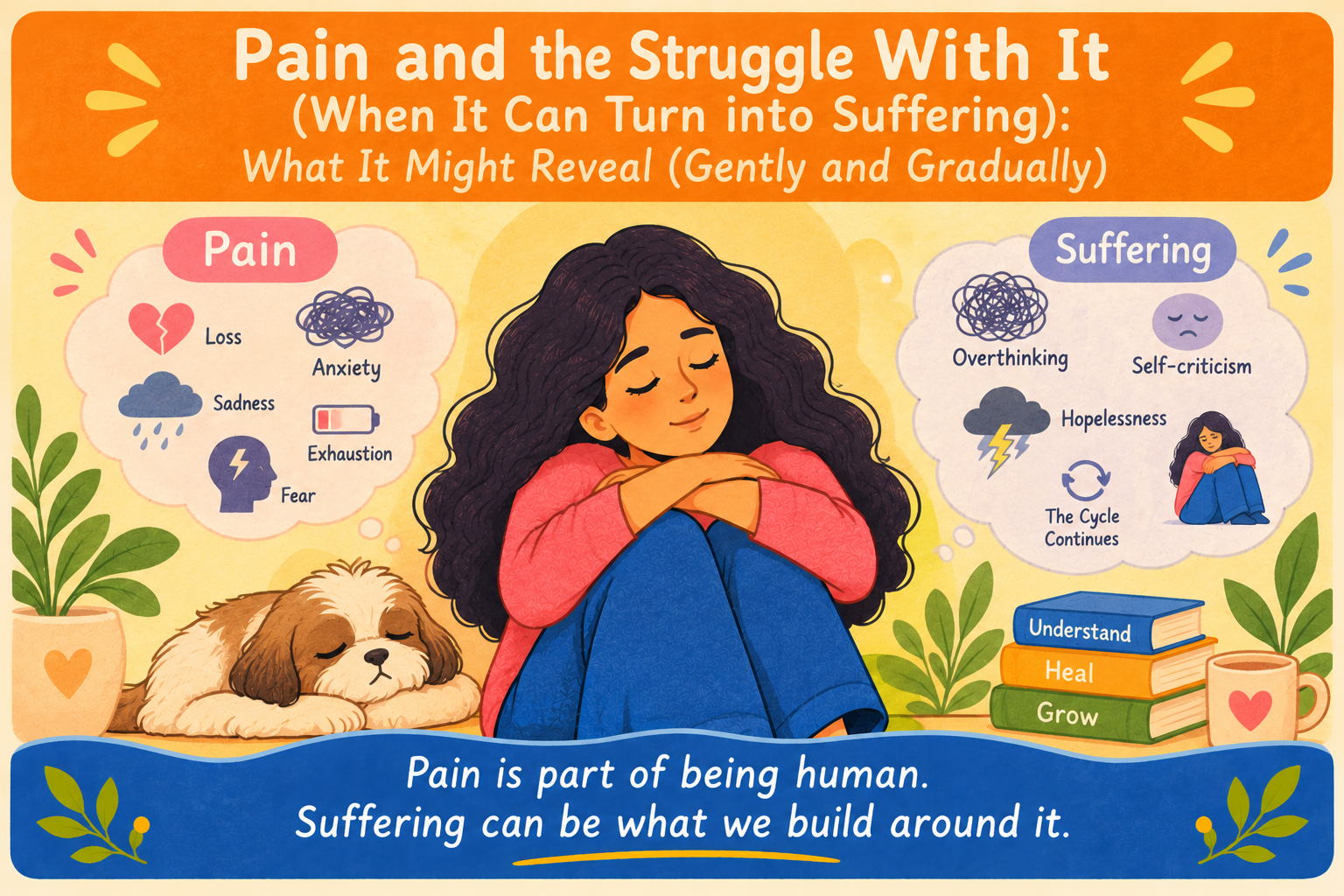
Pain and the Struggle With It (When It Can Turn into Suffering): What It Might Reveal (Gently and Gradually)
There are moments when pain feels constant, where it may feel like it’s sitting heavily in the background of everyday life or on other days, it may arrive in unpredictable waves. During these times, even support can feel complicated. Someone’s concern may feel overwhelming, while another person’s reassurance may not quite reach the part that hurts and this can be deeply confusing, especially when we genuinely want relief.
What may help to remember in such situations, at times, is that our responses make sense in the context of our experiences. When we have felt unseen, dismissed, hurt, or unsafe, our nervous system often learns to stay alert and guarded, meaning, here, protection and survival become a priority over anything else. So, what may appear from the outside as resistance, withdrawal, overreaction, or difficulty accepting support is often a system doing its best to prevent further pain.
Now, there is an important distinction here between pain and suffering.
Pain is a natural part of being human, where grief, anxiety, disappointment, loneliness, fear, shame, loss, and heartbreak, all of it can bring pain. We do not choose these experiences that lead to such painful emotions, and they do not necessarily mean that something is wrong with us. However, suffering, can sometimes develop when additional layers begin to gather around that pain. These layers may include self-criticism, hopelessness, avoidance, constant rumination, or the pressure to make the pain disappear immediately. The original wound remains, but it becomes surrounded by a growing network of reactions, fears, and protective strategies, resulting in amplifying and prolonging the experiences and this is not a failure. It is often an attempt to cope.
Many therapeutic models describe how protective parts of us can become activated when pain feels overwhelming. In Internal Family Systems (IFS), for example, protective "firefighter" parts often step in when emotional pain becomes too intense. Their job is to extinguish distress as quickly as possible and they might show up and encourage us to stay busy, numb out, scroll endlessly, overwork, isolate, overeat, seek reassurance repeatedly, or engage in other behaviours that provide temporary relief. These responses are often intelligent adaptations that have developed for a reason.
The challenge with this, that we end up facing is that while firefighters may reduce discomfort in the short term, they can also make it harder to stay connected to the underlying pain. Over time, the effort of constantly managing distress can become exhausting and many people find themselves feeling stuck in a cycle of pain, protection, temporary relief, and renewed exhaustion in the longer term.
Now, this does not mean that the protective parts are the problem because often, they are carrying out a role they have held for a very long time which they notice has served them initially at least. So, as safety begins to develop, whether it be through therapy, supportive relationships, personal reflection, or other forms of healing, something different can gradually become possible where there can be a shift from rather than forcing ourselves to confront overwhelming emotions, we may begin to notice them in small, manageable pieces.
Sometimes this starts with simple curiosity. For example, instead of asking, “How do I get rid of this feeling?” we might gently wonder, “What is this feeling trying to tell me?”
The answer is not always immediate, especially perhaps at the start. However, if we stay with it long enough with patience, presence and compassion, pain can sometimes reveal an unmet need: a need for rest, care, connection, understanding, or protection. Sometimes it highlights a boundary that has been crossed too many times, or it can point toward grief that has never had enough space to be acknowledged or reveals parts of ourselves that have been carrying burdens quietly for years. It’s important to note that these insights rarely emerge through force but rather tend to appear gradually, often when we feel safe enough to listen.
It is also important to recognise that not every painful experience contains a hidden lesson waiting to be uncovered. Sometimes pain is simply pain and here the most compassionate response is not analysis but support, stability, and kindness toward ourselves. Healing does not require turning every difficult experience into a revelation.
What can help is learning to distinguish between the pain itself and the struggle that may have formed around it. With time, we may begin to notice when we are fighting the pain, judging it, or trying desperately to escape it. We may also begin to recognise the protective parts that have been working tirelessly to help us survive.
When those parts are met with understanding rather than criticism, something often softens as safety starts to develop. Here, the goal is not to eliminate pain or to force insight before it is ready, but rather, it is to create enough safety that we can stay present with small pieces of our experience, at a pace our system can tolerate.
Over time, what once felt like endless suffering may begin to reveal itself differently, not because the pain was erased, but because it was finally given space to be seen, understood, and heard. One equation that may help to remember is “Pain + Resistance to the Pain = Suffering”
A Gentle Reflection To Consider
If it feels safe to have some space to consider, you can ask yourself:
“If my pain could speak without being interrupted or fixed, what might it want me to know?”
There is no need to find an immediate answer. Sometimes the act of listening, with patience and compassion, is enough