
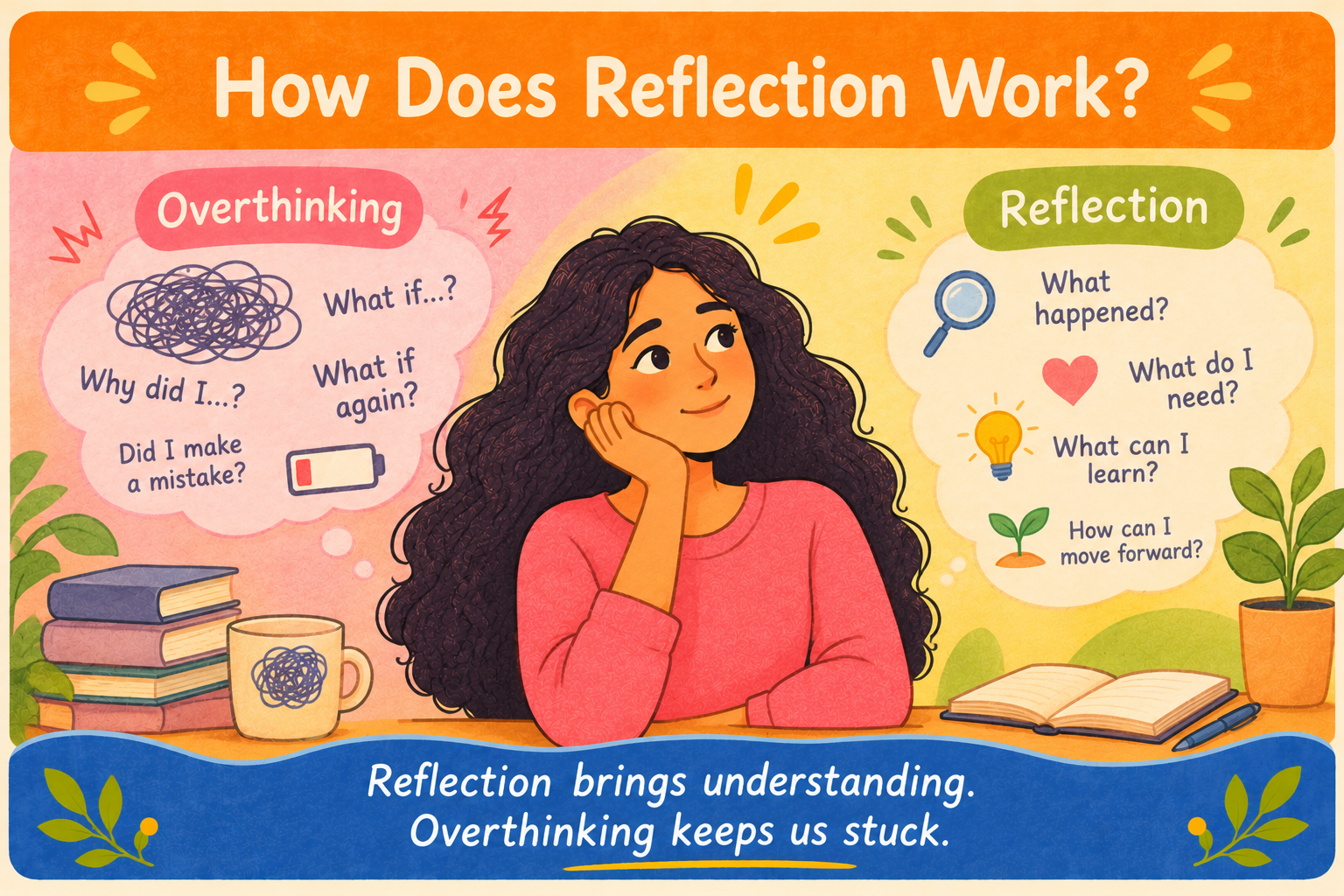
How Does Reflection Work?
Many of us have been told that reflection is a healthy practice and we are often encouraged to reflect on our experiences, relationships, mistakes, and emotions so that we can learn and grow. Yet, for many people, reflection can sometimes feel suspiciously similar to overthinking.
“If both involve thinking about our experiences, what is the difference?” is a question I notice within my clients often.
So, understanding the distinction matters because reflection can help us gain insight and provide us with a direction to move towards, while overthinking often leaves us feeling stuck, overwhelmed, and emotionally exhausted.
Reflection vs. Overthinking: What's the Difference?
At first glance, reflection and overthinking can look alike. Both involve revisiting situations, thoughts, or feelings. However, they tend to have very different purposes and outcomes.
Reflection is generally curious, compassionate, and focused on understanding. It witnesses our experiences (including pain, stress, body sensations, thoughts, beliefs, etc.) and asks questions to channel the energy into something such as:
- What happened?
- How did that affect me?
- Where in my body did I feel this? What intensity did I feel it with?
- What can I learn from this experience?
- What do I need going forward? How can I meet this need?
Overthinking, on the other hand, often becomes repetitive and circular. Rather than seeking understanding, it repeatedly searches for certainty, control, or answers that may not exist while re-experiencing the stress, pain, distressing sensations and delving deeper into them. It can sound like:
- Why did I do that? Why did I say this?
- What if I made a mistake?
- What if they meant something else?
- What if this happens again?
- How can I be this stupid?
Instead of creating clarity, overthinking tends to create more questions, more doubt, and more distress.
Why We Sometimes Slip Into Overthinking
Overthinking is not a sign that something is wrong with us, as in many cases it develops as an attempt to protect ourselves. When we have experienced uncertainty, criticism, rejection, or difficult life events, our minds may become highly focused on preventing future pain. So here, we might analyse conversations repeatedly, search for hidden meanings, or replay events in an effort to feel safer or more prepared. However, here the challenge is that the brain can become trapped in a loop. The more we search for complete certainty, the more uncertainty we notice.
Particularly for individuals who have experienced trauma, difficult experiences, or prolonged stress, thinking deeply about a situation may feel necessary for survival as it can provide a sense of direction to go into, an attempt to channel the overwhelming energy, only to create more of it. However, not every problem can be solved through continued analysis.
Signs You May Be Overthinking Rather Than Reflecting
Sometimes the easiest way to tell the difference is to notice what happens after the thinking.
You may be reflecting if:
- You gain a clearer understanding of yourself or the situation.
- New insights emerge.
- You feel more grounded and may have a sense of “I can handle it”, even if the topic is painful.
- You can eventually shift your attention elsewhere without suppressing the emotions and feelings.
You may be overthinking if:
- The same thoughts repeat without new conclusions.
- You feel increasingly anxious, guilty, or distressed.
- You find yourself asking the same questions repeatedly.
- You feel mentally exhausted but no closer to an answer.
- The thinking feels difficult to stop and feel more of a spiral.
A useful question can be: “Am I learning something new, or am I replaying the same material?”
How to Shift From Overthinking Into Reflection
The goal is not to stop thinking altogether, but to think in a way that promotes understanding rather than becoming trapped in a cycle of mental repetition.
1. Pause and Notice the Process
Before focusing on the content of your thoughts, notice how you are engaging with them and the sensations associated with them.
Ask yourself:
- Am I exploring this situation, or am I chasing certainty?
- Is this helping me understand something, or am I going around in circles?
- How is my body state as I consider these questions? Does it feel more of a misfired attempt to regulate or does it feel like I can manage and feel more open and curious?
Sometimes simply noticing the loop can reduce its grip.
2. Focus on Understanding Rather Than Solving Everything
Reflection does not require perfect answers.
Instead of asking, “Why did this happen?” repeatedly, try asking:
- What was this experience like for me?
- What emotions came up? What did they perhaps wish to convey?
- What mattered to me in this situation?
These questions encourage insight rather than endless problem-solving.
3. Bring Compassion Into the Conversation
Reflection is often gentler than overthinking. So, if you notice self-criticism appearing, consider how you might speak to a trusted friend or a child who was struggling with the same or a similar experience. Understanding tends to grow more easily in an atmosphere of compassion than in one of judgment (Try to remember and notice how your body and mind have felt in the past in situations of compassion vs judgment).
4. Give Reflection Boundaries
Reflection does not need to last all day. We might set aside a few minutes to journal, think, or process an experience and then intentionally return our attention to the present moment. This helps to prevent reflection from gradually turning into rumination and overthinking.
A Gentle Reminder
Not every difficult feeling needs to be analysed immediately. Sometimes understanding develops gradually, through lived experience, supportive conversations, rest, and time. Reflection is less about finding the perfect answer and more about creating space to understand ourselves with curiosity and care. Our cue to understanding when reflection is working is when we may notice that after it, it leaves us with a little more clarity, self-understanding, and a little more room to move forward.
Finally, here’s one small reflective question that may help to just get started:
When you think about a recent challenge, do you notice yourself moving toward greater understanding—or becoming caught in a search for certainty