
Privilege Misunderstood
As the new year 2026 unfolds, India awakens to a new phase in its own journey, with the recent protests against the UGC Anti caste discrimination policy, the conversations around privilege take center stage yet again. It has become the latest buzz word to be used when playing the role of enlightened and educated with zero stake in the matter at hand, and thus demonstrations, bundhs, and hartals.
The therapeutic space allows and honours all experiences and thereby it becomes a unique vortex for the mingling of the privileged, the underprivileged and the ignorant. But we have gotten ahead of ourselves. What is this Privilege that is quoted, shouted and held in such high esteem within the classrooms of our beautiful nation?
Privilege, refers to a continuous, divisive, and systematic form of social construct that breeds and widens the inequality within any social structure. It is not simply about individual opportunities or single incidents where equity takes a back seat. It is a generational pattern of preferential treatment towards specific groups for the establishment and sustained proximity to power that naturally and fundamentally excludes those groups that do not receive (or) are not allowed to receive this preferential treatment.
Let us look at this through a hypothetical.
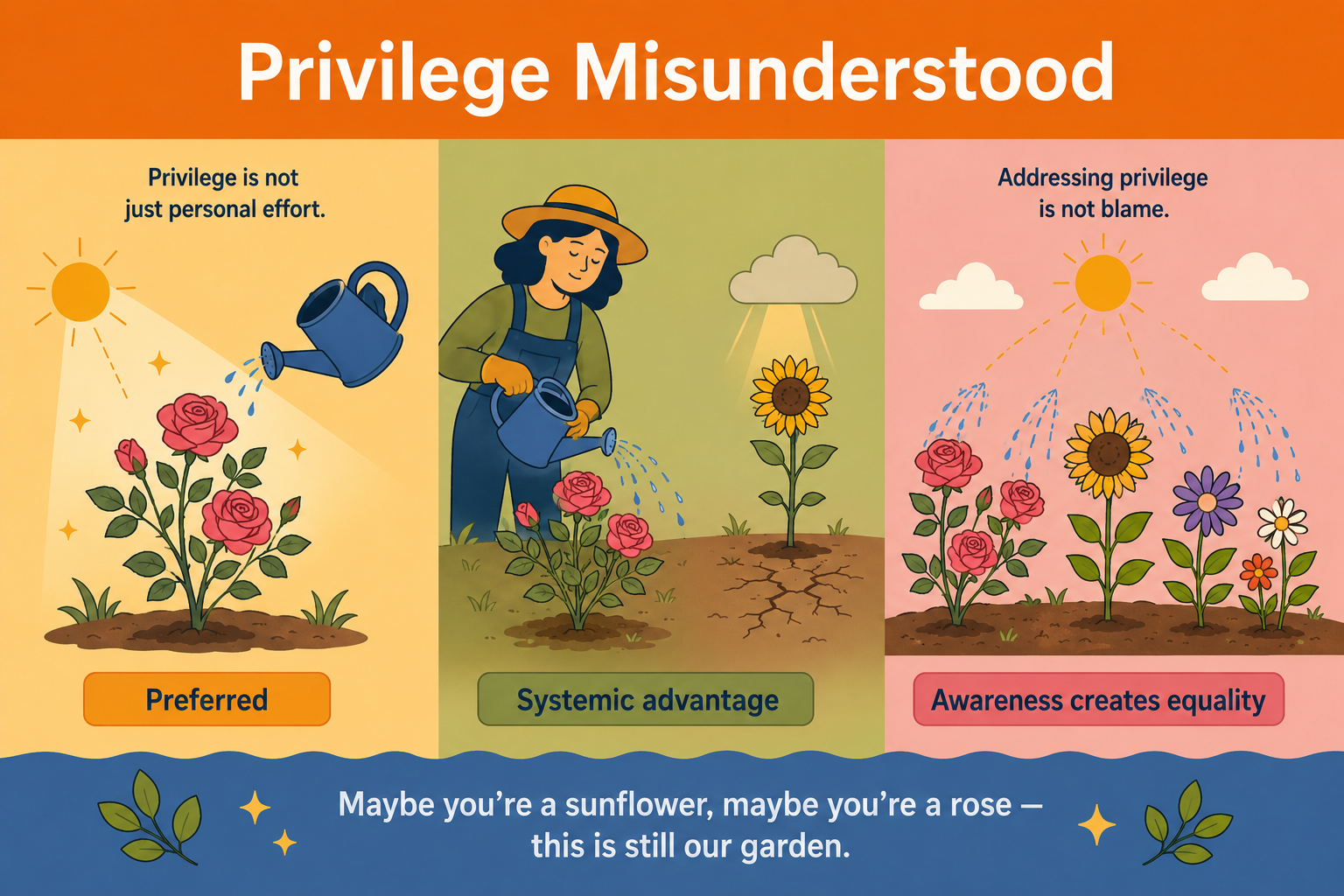
Imagine for a moment that you are a flower in a garden, a sunflower to be specific. Throughout the garden one can notice a wide variety of trees, plants, shrubs, and saplings. Nothing particularly special, just your typical summer garden. Now the gardener is quite prolific and able to tend to this vast assortment of flora but the owner of the garden is very particular about being seen as sophisticated and of refined taste and has therefore instructed the gardner that roses be strategically placed within the garden such that they (the roses) receive more sunlight, are the first to receive water and any added nutrients. The roses are also the first to be viewed by any guests or passerby. Years pass and you and your family continue to cohabitate within the garden and you notice that you are given very specific boundaries from which to grow. You notice that you are the last to receive any water or nutrients and often the gardener comes to the "Sunflower section” towards the very end of his work day exhausted and least bothered about the equitable distribution of water or nutrients.
How would you react to such a hypothetical situation?
This may not be your reality, but it is a reality for a majority of people in our county and thus the importance of the debate on Privilege.
Even when this particular topic is taken up within the confines of our institutions of higher education, it can be noticed that there is a misunderstanding of the basic premise of this debate. Privilege is not a “bad word” or something that one should feel “ashamed” for having. Neither is it the answer to all arguments such that in any given situation those who are privileged have no stake and therefore no say.
Privilege is, to put it in quite plain terms, “a living reality” that needs to be understood, addressed, and modified to serve the greater vision of a society with minimal inequality. But what does this mean?
Let us look at the ever present reality of reservation in higher education. Every year we see the newspapers filled with students fighting against reservation as it is a policy that “prefers” those from groups that were historically ill treated, underrepresented and segregated. The logic of the protesters are along the lines of “This is simply yet another system of inequality, that is against us”
If we were to go back into the garden hypothetical in this situation, it would be similar to the roses saying “we no longer get the fringe benefits that we used to and thus it is an unequal system and should be put to an end”.
Essentially denying the fact that for numerous years the roses were able to benefit and are at this point in time at a much more suitable position to grow and develop, thus taking nothing away from the roses when the gardner is instructed to provide the same attention to the rest of the garden. This is the current situation of what we know as “Affirmative Action” or “Reservation”. The element of privilege that arises here is the fact that even while being in a stable and secure position many groups are threatened by the mere possibility of those previously illtreated groups being perceived and considered equals, and this ugly element raises its head even within those ill treated groups, who consider those below them as unworthy of being called equals.
Notice how the idea of privilege also takes the shape of familiarity and an aversion to the discomfort of being treated as equals.
In the therapeutic setting, Privilege is something that we often interact with, and here it is extremely noticeable how much privilege is denied, distorted, and deeply ingrained. Therefore a lot of time and effort is spent in rethinking and understanding Privilege as a concept. Given below are some of the ways to avoid basic misconception on this topic
- Individual Concerns vs Systemic Concerns
It becomes all too easy to for us to engage in the discussion on privilege from a view point that this is a single incident concerning “bad people” or the “filthy rich” or the “helpless poor”, and it is important to remember that privilege does not come from simply “working hard” or “having a spot of good luck”. Privilege is assigned, assumed, and safeguarded by our society that has clear preferences in a binary world. So everything is placed in terms of “good/bad” with the good/acceptable/fitting/ being preferred over what is considered bad/unacceptable/illfitting.
We must therefore be aware of minimizing such complex topics into simple binaries and make an active effort to appreciate and address the nuances of privilege as a systemic concern
- Privilege as a Bad Word (Slur)
Yet another pattern, that is often visible in the therapy space, is the use of privilege as something that should be avoided, left unspoken and makes individuals uncomfortable or put on the spot. Here the normalization of this topic takes precedence over defensiveness or denial. Privilege plays a role in our life on a daily basis and cannot be discounted. It is also not an attempt to place blame or minimize any individual. Talking about privilege is more focused on reflecting lived experience and bringing awareness to those elements of ourselves that we would rather ignore.
- Theory vs Practice
It is also quite common to hear that this topic of privilege is “Ideal” and “impractical” and cannot be visualized in the real world. This could not be farther from the truth. Let us take the example of post apartheid south africa a nation that was engulfed with racial violence, civil war, famine, and political instability. In the midst of all of this peace and equality were achievable when privilege was addressed and intentionally abolished.
It becomes important to understand and reflect on the reality of the struggle it would take to move this concept of privilege from its theoretical origins to its practical application. Difficult yes, but impossible? Definitely not.
It begins with bringing about awareness, of its existence, its nature, It’s history, it’s internal mechanism, its effect, and it’s consequences.
Naturally the next question is How can we address privilege?
Here are some strategies that allow us to safely address privilege, build and get one step closer to an egalitarian society
- Educate yourself - The internet truly makes ignorance a choice, so take the opportunity to interact with the literature on both sides of the issue. Your interpretation can truly make a difference to how we as a society engage with the idea of privilege. There is no specific way to engage with the debate so make it your own!
- Take the time to become aware - Within our own immediate environment it is extremely easy to generalize our reality and thus shield ourselves from the discomfort of facts. Interacting with individuals outside of your comfort zone will provide one with the perspective, knowledge, and experience of those who live different realities. The manufactured isolation among social groups and social structures often convey a message much different that that of the reality on the ground.
- Shift focus onto the humanity of it - It becomes all too simple to reduce the idea of privilege into something that is not about people and more about philosophy, culture, tradition, and social order. This perspective shifts individuals who have inherent value and purpose into numbers who are assigned value and purpose. Pause and reflect if that is a pattern that you can notice. Take the time to think more about the details on the ground (the flowers) and then take a step back to look at the bigger picture (the garden).
- Addressing Shame and Guilt - When addressing privilege, those who live with privilege often feel the need to defend themselves, feel shame and guilt for having such privilege. It is essential to realize that the goal is not to “give up” privileges but rather to become aware and work towards establishing a baseline where such privileges or preferential treatment and exclusion are no longer the norm. Addressing does not mean Accusing, and Equality does not mean Deprivation.
Maybe you’re a sunflower, maybe you’re a rose, this is still our garden, let’s act like it and take ownership of our mistakes, our struggles, but most importantly our future.