
The Language Of Therapy
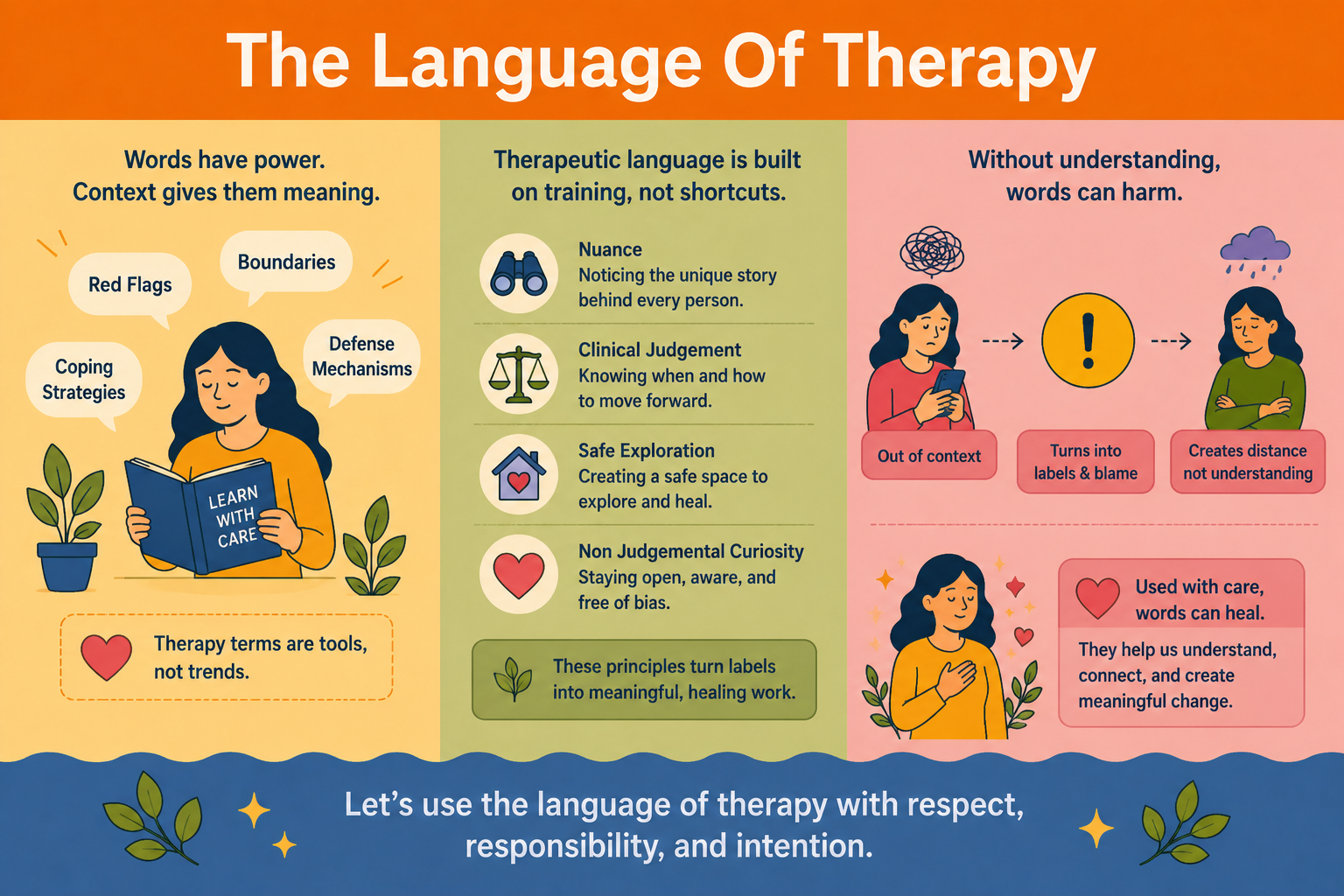
Red Flags!
Boundaries!
Coping Strategies!
Defense Mechanisms!
All words that one undoubtedly hears in and around therapy. Everyday we see an influx of newly enlightened individuals who access the internet and use these therapy specific terms in everyday jargon. Effectively removing context, nuance, and purpose. Take any random hour of the day and dive into your closest social media platform and you will notice exactly what we are attempting to address. “Therapy speak” has become fashionable and reason enough for individuals to use this half baked knowledge to deny accountability and through these terms create a semblance of meaning behind their own inexcusable patterns or avoid situations, conversations, and engagements that would truly challenge them.
Making a blanket statement such as “Therapy speak has gotten out of hand” would still remain inaccurate and misleading. Practitioners across the board have reported an increase in those with access being able to name their feelings, couples being able to be attuned to their inner worlds and being able to express their needs without disengaging, stonewalling or getting lost, adolescents and young adults being able to notice triggers and engage with grounding techniques (Medaris, 2024). This still brings us back to an interesting question.
“How is this Language of therapy being used today and what impact does it pose in the long run?”
Let us look at this a little deeper
Language is the primary unit of sharing knowledge, comprehension and the means by which we can communicate and express our values to others. Therefore acknowledging and understanding the history and emergence of this language that we use on a daily basis will allow us to gain insight into the origins, context, and purpose that guided the development of this language.
This is where the “Medical Model” makes its appearance, this model focuses on pathologizing, which is a round about word for “viewing and classifying experiences as diseases that need to be cured or managed”, this serves a great purpose in observable conditions such as a broken bone, or a series of symptoms that point towards fever, dengue, cholera and other biological and physical ailments (Cox & Fritz, 2022). This model was co-opted and put to use in the understanding and treatment of psychological concerns, thus leading to the creation of the category we now know as “disorders”.
This classification and compilation led to the establishment of order and structure within the field of psychology. The fruit of this remains in the ICD and DSM that we as practitioners study and rely on.
An important detail that often seems missing or is often overlooked is the fact that along with this language practitioners are taught, nuance, clinical judgement, safe exploration and non judgemental curiosity that prepares and allows us to convert this “diagnostic language” of labels into something intentional and educational thereby using the diagnostic criteria as a dynamic yardstick that provides each session and the work that we do a direction.
Let’s take a minute to understand why these are important and how they affect the use of this language
Nuance - This refers to the ability to notice, observe, and identify subtle and often hidden differences in client presentation, and client history which uniquely affects how the client interacts with themselves, others, and the world. This skill is trained into mental health practitioners as we accept and live with the reality of not having “one solution that fits all”. Thus this nuance allows use to cater to the client’s individual needs while drawing from a robust and scientific base of knowledge that can be applied towards collaborative goals in therapy.
Clinical Judgement - This refers to the ability of a practitioner to be mindful and aware of the various pain points with regard to their client and ability to judge the client’s readiness to move towards the next step (which can range from anywhere between safety and stabilisation to active change and meaning making). This skill affords us the opportunity to honour the client’s lived experience and ensure that we move at a pace that is suitably comfortable and challenging for the client while minimizing risk.
Safe Exploration - This refers to an ability to traverse the client’s history and pain points in a manner that is respectful, reflective, restrained and responsive to the client’s needs at all times. This skill provides practitioners with the tools to create a safe space for the client and assist them in self exploration, trauma recovery, resilience building and meaning making such that clients are able to expand their quality of life and be present.
Non Judgemental Curiosity - This refers to reflexive practice that practitioners follow to be mindful of self, personal biases, and its effect on the body. Thus allowing space to engage with the client without judgement and in a supportive yet neutral manner. This mindset allows practitioners to notice and highlight patterns, empathetically confront, and aid clients in self discovery.
It is this training coupled with the medical language that we as practitioners use on a daily basis in our interactions with clients. Using this language without the training, permits the metamorphosis of the language into a meaningless, purposeless, and confusing lexicon that focuses on labels and placing blame.
This brings us back to yet another question: How can we move forward with this evolving language while taking into account both the positives and the possible challenges. Given below are a few pointers that may be helpful
- Context - It becomes increasingly important to take a minute to step back and realize that the language that we use has great power and impact. Thus being mindful of the context within which one is using this language can be a wonderful tool that aids in the responsible and judicious use of this language. Our goal is never to gatekeep or to say “only therapists are allowed to use this language”. Our goal remains being able to create systemic changes that are deeply rooted in introspection, accountability, and personal growth. Thus being able to recognize and differentiate when such language will be helpful and when such language could lead to undue shifting of blame and/or lack of accountability and noticing when the language shifts from being a common knowledge system to a set of rules and regulations and labels that categorize rather than simple expression that encourages reflection and introspection.
- Evolution - Coming to terms with the fact that language continues to evolve and develop as we grow as a society is yet another avenue to making responsible decisions when using this language. What was unacceptable and shunned in the yesteryears has now become our new normal and thus being able to hold space and view the use and dissemination of this language as a part of that progress will guide us in ensuring that the language is not misused, and allows our society to be inclusive, tolerant, reflexive, empathic, and conscious. Yes evolution will take its own way, but we can make informed decisions and guide that evolution to be better that we are.
- Psychoeducation - Encouraging the responsible use of this language is not only for the lay person but remains a crucial part of the work within the therapy space. It falls on us who have the burden of this knowledge to ensure that those we interact with, our peers, our client’s, our support systems and immediate environments are made aware of the proper use of this language, the negative effects of it’s misuse and the constant fluidity and dynamism that govern the use and proliferation of this language. Taking the time to educate with patience, empathy and understanding will ensure that a grassroot level change occurs. So use your platforms, use your voice and let’s work together to bring back meaning, purpose and nuance of this language of therapy!
As you continue to engage with therapy, or even if you have decided to take this new step and explore therapy. Ensure that you add this to your checklist, take the time and effort to understand that the language used within these mental health spaces focuses on identifying patterns, highlighting maladaptive patterns and spirals, providing clarity and direction, and allowing you to function with a little more agency and control. Have a conversation with your therapist regarding the language that is being used, ask your doubts, clarify your interpretations, and most importantly use this language wisely.
References
Cox, C., & Fritz, Z. (2022, April 27). Presenting complaint: use of language that disempowers patients. PMC. Retrieved March 12, 2026, from https://pmc.ncbi.nlm.nih.gov/articles/PMC9273034/
Medaris, A. (2024, September 1). How to harness the power of therapy-speak. American Psychological Association (APA). Retrieved March 12, 2026, from https://www.apa.org/monitor/2024/09/therapy-speak