

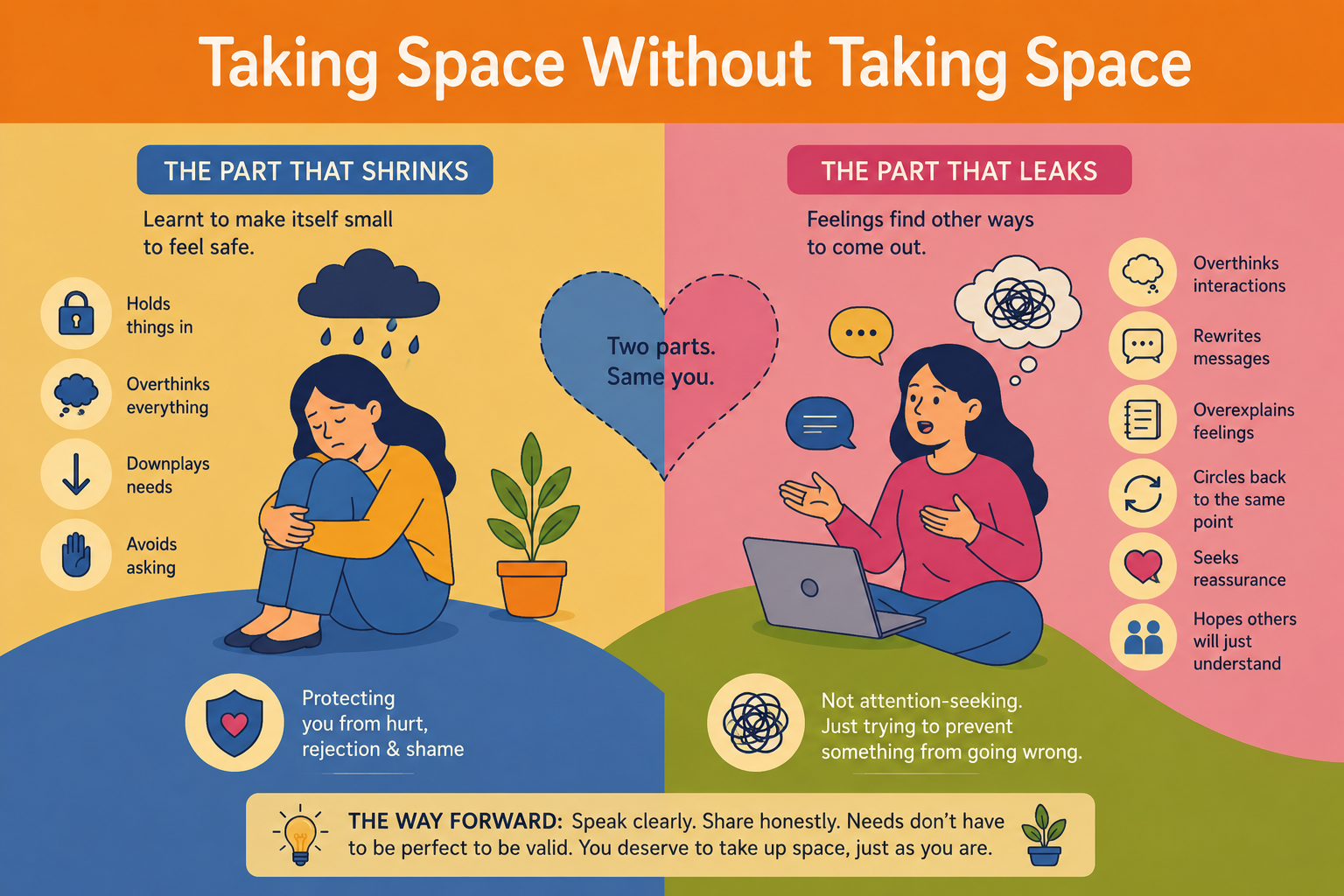
Taking Space Without Taking Space
Some of us are deeply afraid to take up space. We don’t want to be “too much,” too loud, too emotional, or too needy, and so we can knowingly or unknowingly shrink ourselves in conversations, second-guess our texts, replay things we said hours later in hopes of trying be easy to be around. And yet… somehow, we still end up taking up space.
This is not in the obvious “centre of attention” kind of way, but in a quieter, more confusing way, where it can leave us wondering why people seem to pull back, or why relationships start to feel heavy even when we’re trying so hard to be “low-maintenance”. This is where it gets a bit tricky because it’s not about blame but about understanding the two different parts that can live inside us at the same time.
So, here’s a fair warning before you proceed. This article might feel a little uncomfortable, maybe even a bit unfair at first, but stay with it for a moment and see if it makes sense.
The Part That Shrinks
There’s usually a part that somewhere along the way learned that if we make ourselves small, it can be safer to operate in the world. Safety in this context is not only necessarily an active physical threat like being hit or, quite literally, having a lion in the room, but also the quieter ways, such as being scolded or being made fun of.
Maybe being expressive didn’t go well our needs were dismissed, we were made to feel dramatic, or we had to grow up around people whose own emotions took up all the oxygen in the room. So, the best strategy at that moment was to adapt.
We learned to:
- Hold things in
- Think things through before saying them (and then think them through again)
- Downplay even the basic needs
- Avoid asking for too much
This part of you isn’t weak. It’s actually very intelligent as it’s been trying to protect you from hurt from rejection, from shame, or from being misunderstood.
The Part That Leaks
But here’s the thing about this adaptation: feelings don’t just disappear because we don’t express them, but rather find other ways to come out.
So, alongside the shrinking part, there’s often another part that starts to… leak.
And sometimes, this is the part people don’t recognise, which may be “taking up space” because it doesn’t feel like that from the inside.
It can look like:
- Overthinking interactions long after they’ve happened
- Rewriting messages multiple times before sending them
- Adding extra explanations/ context so you’re not misunderstood
- Talking more than you meant to because you’re trying to say things “just right”
- Overexplaining your feelings so they don’t seem unreasonable
- Circling back to the same point in different ways, hoping it’ll land better
- Reading into small shifts in tone or behaviour
- Wanting reassurance but not quite asking for it directly
- Hoping the other person will just sense what you need
From the outside, this can look like a lot of talking and taking up the room, but on the inside, it doesn’t feel like confidence or entitlement. It feels like anxiety, almost like trying to prevent something from going wrong.
A lot of overexplaining, for example, doesn’t come from wanting attention but rather to avoid being misread. It’s a way of saying, “Let me make this as clear and acceptable as possible so there’s no reason to reject me.”
But the sad reality is that the effect can be the opposite of what you intended. This is because when everything is explained in detail, when conversations get layered with all the context and qualifiers and “just in case” clarifications, it can start to feel like a lot for the other person to hold.
Now this is the important bit: This is not because your feelings are too much, but because they’re coming out in a way that’s hard to track or respond to. It’s like instead of saying, “I felt hurt when that happened,” the feeling gets wrapped in paragraphs of reasoning, softening, and self-correction; and somewhere in all of that, the core need gets a bit lost.
But I’m Not Asking for Much Part
This is often the most painful part. From our perspective, we’re not asking for much at all. In fact, there may be a feeling of asking for less than most people would. Here, we are actively trying to be considerate and not to overwhelm anyone. So when someone distances themselves, it feels confusing and even unfair at times.
But what’s happening underneath all this is: when we don’t allow ourselves to take up space in direct, honest ways, the space doesn’t disappear, but just becomes harder to navigate.
Clear needs are actually easier for people to respond to than carefully edited, overexplained ones. This is because direct expression creates clean edges, whereas indirect or overprocessed expression creates fog. And fog, over time, can feel heavy.
How This Shows Up in Therapy Too
This dynamic can show up in therapy as well. We may worry about being “too much” for the therapist. So, editing words, softening things, or going into long explanations so that everything being said may feel reasonable and justified. You might notice yourself talking around a feeling instead of naming it directly. Or giving a lot of background so the therapist fully understands before you get to the point.
At the same time, there can be a quiet hope that they’ll still really get you, and that they’ll pick up on what’s underneath all the explaining. So, when that doesn’t quite happen, it can feel disappointing and maybe even like they’re missing you.
But often, what helps isn’t better explaining, but rather being simpler and more honest. Even something like, “I think I’m overexplaining right now because I’m scared this won’t make sense,” can help provide quite some clarity for ourselves and the others, as this kind of clarity creates more connection than getting every detail “right.”
This Isn’t About “Fixing” Yourself
If you’re recognising yourself in this, it’s not because you’re doing something wrong, but rather because you learned to survive in a certain emotional environment. So, of course, you’d hesitate to take up space, as at some point, taking up space felt risky; and of course, another part of you would still want connection, reassurance, and to be fully held, and so there was a split forming two parts which start existing side by side.
It may seem contradictory and odd to have these two different parts existing, but in truth, there’s nothing contradictory about that. It makes sense.
A Different Way Forward
The shift here isn’t about suddenly becoming someone who takes up a lot of space confidently. This is technically not realistic, and honestly, may not be the goal either.
It’s more about experimenting with cleaner ways of taking up space and, firstly, acknowledging both parts, allowing them the compassion they deserve for their roles and finding a way for them to either coexist in harmony if these parts may not wish to let go of the pain just yet.
Things like:
- Saying, “I think I need a bit of reassurance right now,” instead of hinting at it
- Letting yourself say less, not more
- Trusting that your feelings don’t need a full defence argument
- Naming the core feeling instead of explaining all its layers
- Allowing yourself to be a bit more direct, even if it feels uncomfortable
Not all the time. Not perfectly. Just… sometimes, can make a difference, because when you take up space in a clear, direct way, something surprising tends to happen.
You actually take up less confusing space, and things may start feeling more open.
One Last Thing…
If any part of this felt a bit confronting or hurtful, that’s okay, as it’s not easy to see ourselves in these patterns, especially when they’ve been protecting us for a long time and for a good reason at that.
Know that you don’t have to rush to change anything right this moment, perhaps, but maybe you can start by noticing: Where do I disappear, and where do I overexplain?
That awareness alone is already a big step forward.