

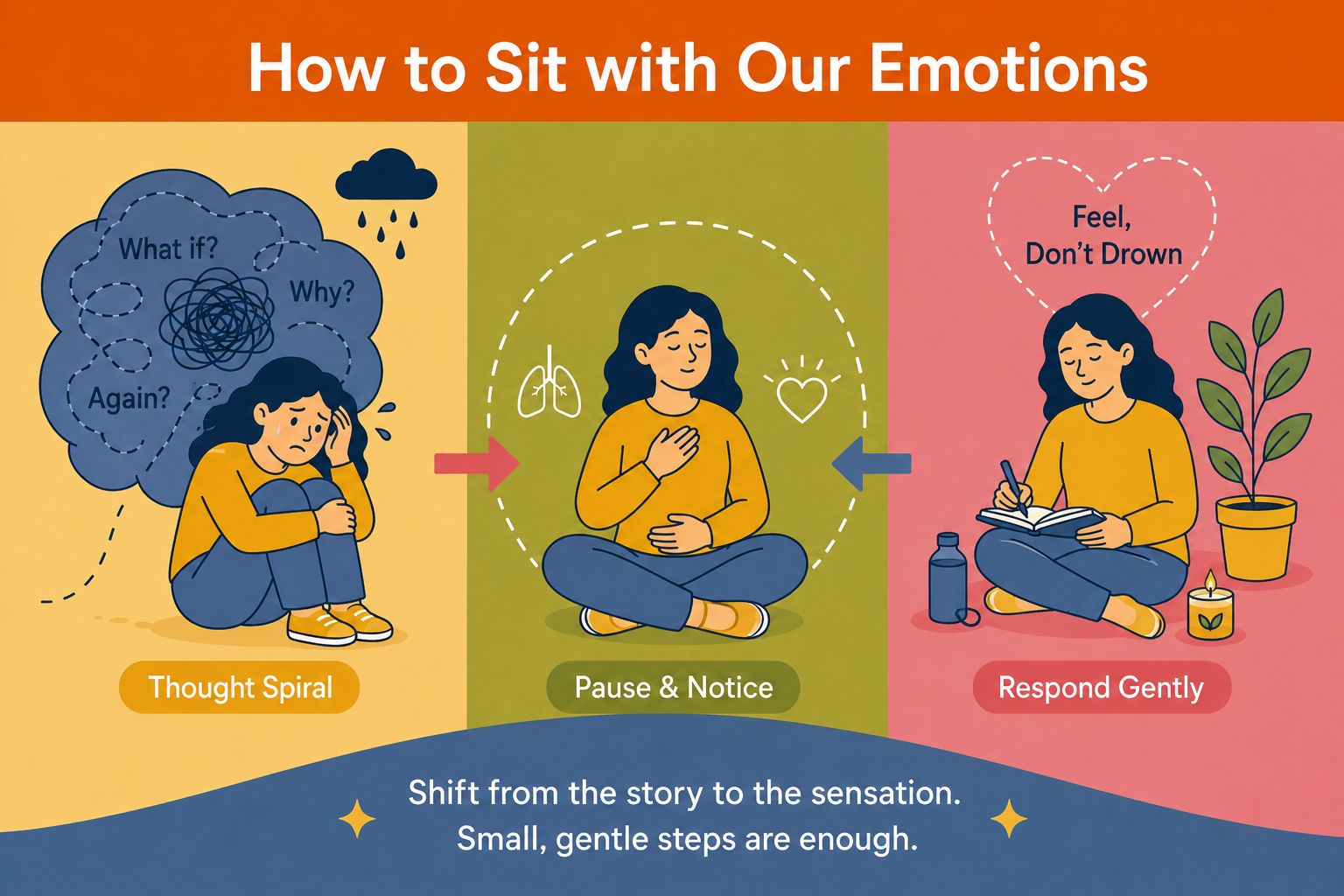
How to Sit with Our Emotions (Without Drowning in Them)
“Sit with your emotions” can sound simple, and even gentle, but if you’ve ever actually tried to do it, you might have found yourself thinking: What does that even mean? Am I supposed to just feel worse on purpose? Am I overthinking? Am I doing this wrong?
For many of us, especially those who grew up in environments where emotions were dismissed, punished, or ignored, this instruction can feel confusing or even unsafe. In trauma-informed spaces, we understand that emotions are not just fleeting moods, but that they can feel big, overwhelming, and sometimes tied to memories our bodies haven’t fully processed.
So let’s slow this down.
What “Sitting with Emotions” Actually Means
Sitting with an emotion doesn’t mean diving headfirst into the story of it, replaying the past, analysing every detail, and especially not forcing yourself to stay in the pain. But rather, that we can allow the emotion to exist in our awareness, without trying to immediately fix it, suppress it, or escape it.
Imagine a small child tugging at your sleeve. If you keep pushing them away, they pull harder. However, if you turn toward them and say, “I see you,” something shifts. Sitting with emotions is pretty much like that. It’s a moment of turning toward yourself, toward the communication from your body.
But here’s the important distinction:
There’s a difference between being with an emotion and becoming blended in it.
So, When Do We Start Engaging the Pain?
To distinguish what sitting with an emotion, vs. being in one, knowing when we start engaging with the pain becomes important. Often, a thought shows up first, such as, “I shouldn’t have said that.” “They must think I’m stupid.” “This always happens to me.”
If we follow the thought, it can spiral. We might start rationalising, defending ourselves internally, going back into the past, or imagining worst-case futures. Here, our body may tighten, our chest might constrict, our stomach may experience knots, and/ or our breathing may become shallow.
This is a very human response as our mind is trying to protect us by solving or preventing something. But sometimes, instead of soothing us, this mental engagement intensifies the emotional charge.
When you notice that engaging a thought leads to more tightness, agitation, or heaviness, it may be a sign that you’re moving deeper into the storyline rather than staying with the underlying feeling. This is not to blame, but rather communication from our body of important information.
The invitation then isn’t to criticise yourself. It’s to gently shift direction.
Taking a Step Back
Instead of asking, “Why am I like this?” or “How do I fix this?” try asking:
- Can we take a step back and notice the train as it passes, rather than being inside it?
- If we can’t take a step back, what’s it worried would happen?
- What is happening in my body right now?
- Where do I feel this?
- If this feeling had a voice, what would it say?
Trauma-informed work often emphasises that emotions are experienced physically before they are understood cognitively. So rather than analysing the situation, we turn toward the sensation.
Here, we need to stay curious, not intense or investigative. Just gently noticing.
You might even place a hand where you feel the sensation. This is not dramatic, but regulating as it signals safety to the nervous system.
Checking in with the Part
Sometimes it can help to think of emotions as “parts” of us, i.e. aspects that developed to protect or survive. So, instead of saying, “I am anxious,” you might say, “A part of me feels anxious.”
This small shift creates space, enough for us to perhaps just notice, if not take a step back yet. Eventually, with more practice and the more space we create, the easier it will get to take a step back.
From there, you can internally ask:
- What does this part need right now?
- Does it need to speak?
- Does it need movement?
- Does it need stillness?
- Does it need reassurance?
The key here is permission. Rather than forcing yourself to breathe deeply or calm down, you check whether the part is open to that or if it needs something else.
For example, how often has it happened that during intense anxiety, if someone asked you to calm down, you feel like lashing out. This is because, while sometimes the anxious part may need breathing, other times it doesn’t want to calm down through deep breathing, but rather to be heard. Or the angry part doesn’t want to be analysed, but rather wants your acknowledgement.
When we move too quickly to “fix” a feeling, it can feel internally invalidating. So, sitting with emotions is less about changing them and more about being in a relationship with them and noticing what they need.
Executing What’s Needed
If the feeling in your body wants movement, maybe you stretch, shake your arms, or go for a short walk.
If it wants slowing down, maybe you soften your shoulders or lengthen your exhale.
If it wants expression, maybe you journal a few uncensored lines, draw lines incessantly.
Here, you’re not performing regulation techniques because someone told you to, but rather responding to what your system is asking for. That responsiveness builds trust within yourself. The most important aspect here is executing these needs with intention and awareness.
The Difference Between Sitting and Sinking
A common fear is: If I sit with this, won’t it swallow me? This fear makes sense, especially if emotions have felt overwhelming in the past and if they still do. Sitting with an emotion is not the same as immersing yourself in it without support.
If you notice the intensity rising beyond what feels manageable, e.g. if you notice dizziness, dissociation, panic, it’s okay to shift toward grounding instead. Look around the room. Smell something intense, name five things you see, and feel your feet pressing into the floor.
Sitting with emotions works best within a “window of tolerance”. This is essentially the range in which you can feel without becoming flooded or shut down. Expanding that window takes time and gentleness.
What If I Do This Wrong?
One of the most painful layers that unconsciously gets added to emotional work is shame. It can manifest through statements like:
“I should be better at this.”
“Other people can handle their feelings.”
“Why is this so hard for me?”
If sitting with emotions feels difficult, it may simply mean that your system learned early on that emotions were unsafe, so of course, it hesitates and tries to analyse instead of feel. That response was adaptive in nature, and it helped protect us once. This essentially means that you are not behind, but are learning something new.
And again, in case you are scared you are doing it wrong, you can revisit the “When Do We Start Engaging the Pain?” and start from there. Anytime you feel that you are engaging with the pain again, that’s powerful information, signalling us to take a step back.
A Small Practice
Next time a wave of emotion arises, try this sequence:
- Notice the thought that appears.
- Observe whether following/ fueling it by engaging in it increases tightness or intensity.
- Gently shift attention to the body.
- Locate the sensation.
- Place a hand there if that feels okay.
- Ask what is needed — and respond in a small, doable way.
That’s it.
This does not require a big breakthrough, nor perfect stillness. Just presence, and that in itself can be a major step.
Over time, this practice builds a quiet kind of resilience, not the harsh, push-through kind, but the soft strength that comes from knowing you can be with yourself. Notice the shift in energy, and perhaps you may eventually discover that what truly sitting with emotions can be: Not enduring pain, not fixing yourself, but rather learning, slowly, that you can stay, and that, for today, is enough.