

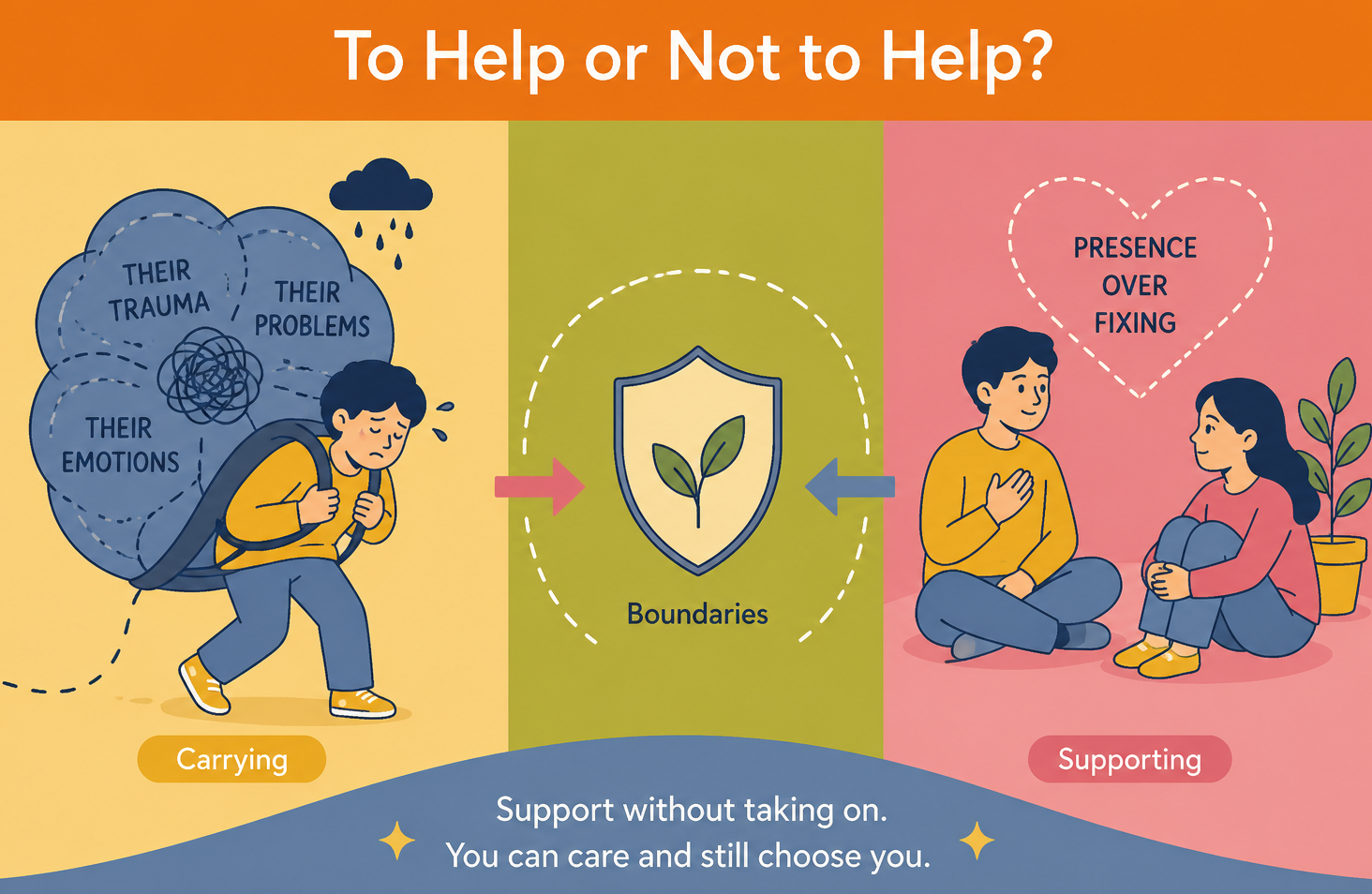
To Help or Not to Help?
The desire to help others is deeply human. Many of us are taught from an early age that being kind, caring, and supportive is a virtue. We get praised for being “the strong one,” “the listener,” or “the one who always shows up.” Moreover, helping can feel meaningful, allow us to connect, and even aid in healing.
But what happens when helping stops feeling like a choice and starts feeling like a responsibility?
Or when the emotional pain of others becomes something we feel compelled to manage, carry, or resolve, often at the cost of our own wellbeing?
Well, I’m going to say something that may not sit well, especially when one deeply believes that they “should” help no matter their feelings: When it is someone else’s trauma, it is not your responsibility to fix it. This does not make us uncaring, but rather allows us to engage with others in ways that are healthier, more sustainable for them and ourselves.
Helping vs. Carrying
I have often found myself falling into the category of deeply wanting to help, but had times when it came at a cost of me. Here, understanding the distinction between helping vs. carrying really helped. Helping, at its healthiest, is offered freely and within one’s capacity. It respects autonomy, boundaries, and mutual consent. Carrying, on the other hand, often emerges from a sense of obligation rather than being a choice.
When helping becomes carrying, you might notice:
- Excessive feelings of anxiety or guilt when you don’t check in on someone, despite having real constraints
- Feeling responsible for regulating another person’s emotions
- Believing that if you step back, you are abandoning them
- Prioritising others’ distress over your own needs consistently
- Feeling emotionally exhausted, resentful, or trapped
This shift often happens subtly, especially for people who have their own trauma histories.
How Trauma Can Create a Compulsion to Help
Many people who feel overly responsible for others’ pain are not “too kind” or “too sensitive.” They are often responding to learned survival patterns stemming from childhood.
For individuals who grew up in emotionally unpredictable, neglectful, or unsafe environments, helping others can become a way to:
- Maintain connection and avoid the fear of abandonment
- Create a sense of control in chaos
- Earn safety, approval, or love
- Avoid their own unmet needs or painful emotions
In these contexts, helping is not just kindness; it is a coping strategy.
Children who had to emotionally support caregivers, manage family conflict, or anticipate others’ moods often internalise the belief: “If I don’t take care of them, something bad will happen.” As adults, this belief can persist, even when it no longer serves them.
Trauma-informed care recognises that these patterns were once adaptive. The goal is not to judge them, but to gently examine whether they are still necessary, and if yes, in which context and how they are necessary.
“If I Don’t Help, Who Will?”
One of the most common beliefs that keeps people stuck in over-helping roles is the idea that they are the only ones who can help. This belief can feel convincing, especially when others turn to you consistently or express dependence.
But this belief comes with a cost.
When we take responsibility for healing others:
- We may unintentionally disempower them
- We blur our own and their emotional boundaries
- We neglect our own capacity and limits
- We risk burnout, compassion fatigue, and emotional depletion
Importantly, no one heals because someone else worked harder than they did. Trauma recovery requires agency, choice, and self-directed meaning-making with support. When one person takes on the role of fixer, it can interfere with these processes, even when done with the best of intentions.
Trauma-Informed Helping: Support Without Fixing
A trauma-informed approach to helping does not mean withdrawing care. It means shifting how care is offered.
Here, instead of asking:
- “How can I make this better for them?”
- “What should I do so they don’t fall apart?”
Trauma-informed helping asks:
- “What is within my role and capacity?”
- “Am I offering support, or am I trying to regulate their pain for them?”
- “Is this help freely chosen, or driven by fear, guilt, or obligation?”
Support can look like:
- Listening without problem-solving
- Validating emotions without taking ownership of them
- Encouraging professional or community support when appropriate
- Being present without over-functioning
- Allowing others to experience discomfort without rushing to remove it
These responses respect both parties’ autonomy and nervous systems.
Boundaries Are Not Abandonment
One of the most painful fears for people with trauma histories is that setting boundaries equals harm. Many worry that stepping back will retraumatise the other person, or that it makes them selfish or uncaring.
In reality, boundaries are a form of care.
Healthy boundaries:
- Clarify where you end, and someone else begins
- Prevent resentment from building
- Protect relationships from imbalance
- Model self-respect and self-regulation
Trauma-informed boundaries are communicated with compassion and clarity, rather than as a means of punishment. They do not require justification, over-explaining, or apology. Saying “I care about you, and I can’t hold this right now” is not rejection, but honesty, where a relationship can grow and nurture.
When Helping Becomes Harmful to You
It is important to notice when helping begins to mirror past dynamics, particularly if you have experienced parentification, emotional neglect, or relational trauma.
You may need to pause and reflect if:
- Your sense of worth is tied to being needed
- You feel anxious when others become more independent
- You ignore your own distress to stay available
- You feel responsible for preventing others’ crises
It’s important to note that these patterns did not come from nowhere and so, need curiosity rather than judgement and deserve care and attention.
Choosing Presence Over Responsibility
It’s important to remember these points when you feel like helping someone:
- You are allowed to care and support without carrying.
- You are allowed to empathise without absorbing.
- You are allowed to step back without being cruel.
When it is someone else’s trauma, it is not your responsibility to fix it. Healing does not happen because someone sacrifices themselves enough, but when people are supported without being controlled or rescued.
Choosing presence over responsibility allows relationships to become more mutual, more respectful, and more sustainable. It also allows you to reclaim energy, space, and compassion for yourself.
Connection heals, but only when it is safe for everyone involved.