

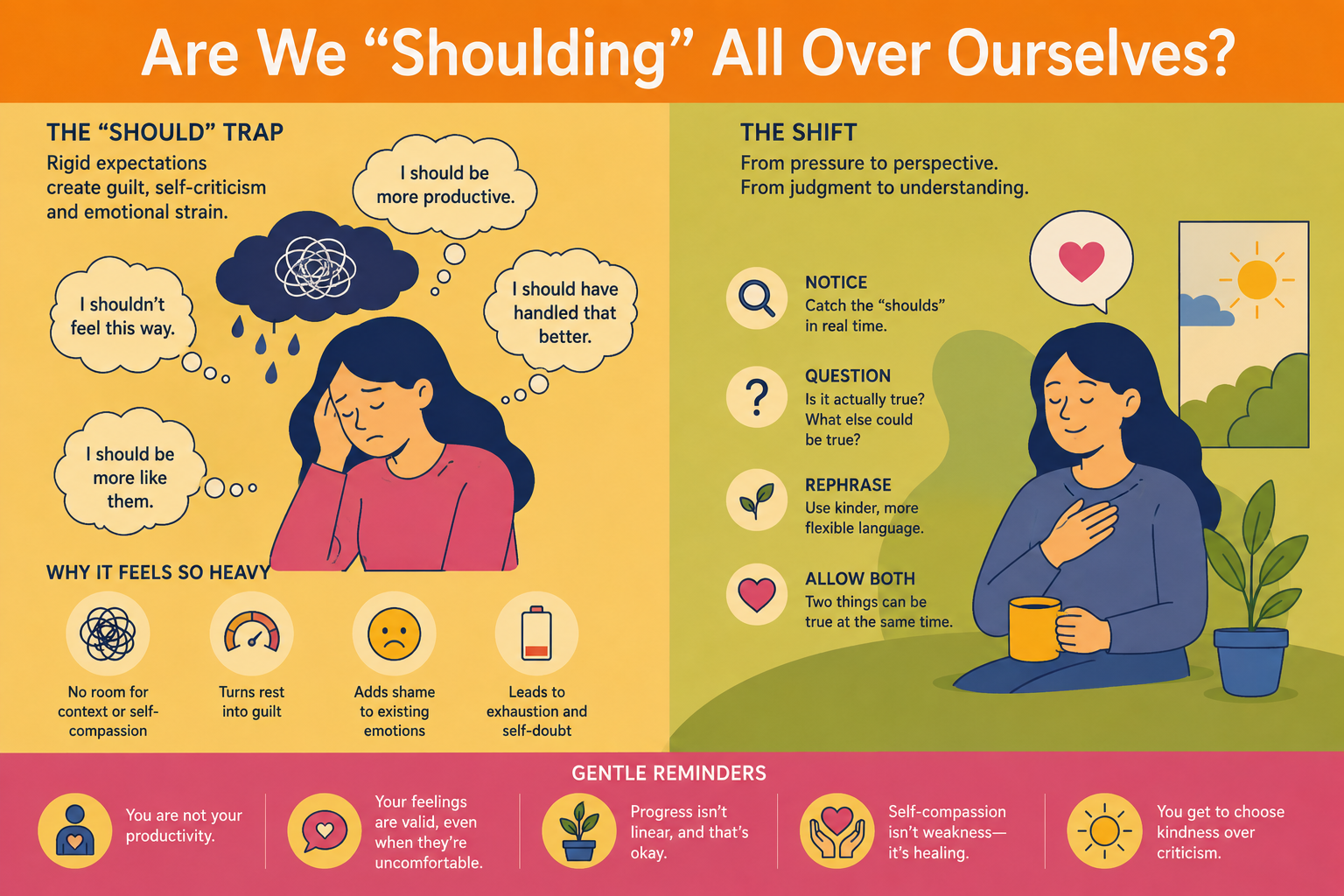
Are We “Shoulding” All Over Ourselves?
Have you ever caught yourself thinking, “I should be more productive,” “I shouldn’t feel this way,” or “I should have handled that better”? These statements often slip in quietly, and generally make it sound like motivation or responsibility. However, over time, they can become a relentless internal pressure system; one that adds guilt, self-criticism, and shame which can sometimes also fuel them to moments that are already difficult. Thus, creating a vicious loop.
This pattern is sometimes called “shoulding” where our thoughts are imbued with rigid expectations about how we ought to think, feel, or behave. While “shoulds” can occasionally guide us, they more often trap us in a cycle of judgment and emotional strain.
What Does “Shoulding” Look Like?
“Shoulding” can show up in subtle and not-so-subtle ways:
- Emotional shoulds: “I shouldn’t feel anxious as I have a good life.” “I should be over this by now.”
- Behavioural shoulds: “I should be working harder than this.”
- Social shoulds: “I should be more like them.”
These thoughts and statements aren’t random, but often reflect internalised expectations usually stitched together from things we’ve learned over time such as family expectations, cultural messages, social media comparisons, even past experiences where we felt judged or not enough. Eventually by unconsciously gravitating towards them, they become automatic, and so, shape how we evaluate ourselves to the point where they can stop sounding like opinions and start feeling like rules.
The tricky part in this, is that they often disguise themselves as common sense, discipline or even morals and values; and instead of encouraging growth, they frequently lead to self-doubt and emotional suppression. So, “Shoulding” doesn’t always announce itself loudly, as sometimes it’s woven into our everyday thinking so tightly that it feels like common sense. It shows up when you’re having a hard day but tell yourself, “Other people have it worse so, I should be grateful.”, or e.g. when you’re exhausted but push on because, “I should be more disciplined.”
Why “Shoulding” Feels So Heavy
The problem with “should” isn’t the word itself, but rather the rigidity that comes with it. One of the reasons is that a “should” doesn’t leave much room for context. It doesn’t ask how you’re feeling, what you’re dealing with, or what you actually need in that moment. Instead, a should ends up declaring that something about you (such as your feelings, your pace, your response) is not okay and needs to bulldozed over to make space for a “corrective” response. And that’s where the weight comes in.
So, keeping the above-mentioned statements in mind:
- When we tell ourselves that we shouldn’t feel anxious, the anxiety doesn’t disappear, but then gets layered with frustration or shame.
- When we think we should be doing more, even our rest can start to feel like failure.
- When we believe we should be better by now, healing starts to feel like a deadline we keep missing.
So, this constant self-correction can eventually get really exhausting and turns your inner voice into an Inner Critic instead of a guide instead.
Where Do These “Shoulds” Come From?
Most “shoulds” aren’t actually yours, at least not originally as they often come from things you’ve absorbed along the way:
- Messages like “be strong,” “don’t complain,” or “always do your best
- Watching others and feeling like you’re falling behind
- Wanting to avoid disappointing people or being judged
- Trying to create control in situations that feel uncertain
None of these are bad intentions. In fact, many of them start as ways to cope or belong which are deeply human, at the same time, when they harden into rules, that’s when they stop helping.
Noticing It as It Happens
One of the simplest (and hardest) steps is catching us “shoulding” ourselves in real time.
You might notice:
- A sentence in your head that includes should, must, or have to
- A sharp, critical tone directed at yourself
- A wave of guilt that seems to come out of nowhere
When you notice this, (can also refer to above examples), pause there for a second. Notice, and see if you can approach it with curiosity. Eventually, you’ll see that these sentence carries heaviness in forms of assumptions, that there’s a “right” way to handle a certain situation, and you’re not meeting it.
After noticing, see if you can ask: “But is that actually true?” As a though experiment, you can try and come up different ways in which a certain situation can be managed or approached (maybe thinking how a different person might).
Loosening the Grip
This isn’t about never having expectations or becoming indifferent but rather about softening the way you relate to yourself. Sometimes, even a small shift in language can make a big difference.
So, instead of saying: “I should go for a run today.”
Try to say: “I’d like to go for a run, but I’m feeling pretty drained, so maybe a short walk would feel better.”
Or instead of: “I shouldn’t feel this way.”
Try: “I don’t love feeling this way, but it makes sense given what’s going on.” (you can try and be specific so that it doesn’t feel like a blanket statement but something you actually can understand and relate to.)
This shift, from pressure to perspective, starts to create space, and this space is where change actually becomes possible.
Letting Two Things Be True
One of the biggest traps “shoulding” sets, is the idea that only one thing can be valid at a time. Some ideas for example are: “Either you’re grateful, or you’re unappreciative/ insolent.” Or “if you are not strong, you will collapse” or “you have to move on, or you’re stuck and a failure.”
However, real life isn’t that clean because you can be grateful for parts of your life and still feel deeply overwhelmed at times, or you can be healing and still have days where it hurts like nothing has changed.
Note: Letting two things be true at once doesn’t make you inconsistent, but rather it makes you human, as these can be the nuances and complexities which make us, “us”.
A Way Forward
At the cost of sounding like a broken record from the past blogs too, the first step here too, can be just noticing and developing awareness of our “shoulds” and then the next is being curious about it than judgemental. Because if you start paying attention, you’ll probably notice just how often and in the varied ways in which your “shoulds” shows up. And that’s okay. The goal isn’t to eliminate it completely, but to begin questioning it.
The next time you catch yourself thinking, “I should…”, try asking:
- Who has mentioned this before and where is this coming from (person, movies, culture, media, etc.)?
- Is this actually helpful right now (does it lean more towards feeling heavy or light)?
- What do I need instead?
Sometimes the answer for “what do I need instead” will still involve responsibility, accountability, and effort, but it will come from a place that feels supportive, not punishing.
In the End
Most of us “should” ourselves because we want to grow, to do well, to feel okay and it’s important to know that there’s nothing wrong with that. At the same time, growth doesn’t come from constantly telling yourself you’re falling short. It, however, does come from being honest about where you are and responding to that with a bit more understanding.
So maybe the next time your mind goes, “I should be better,” you can gently interrupt it with something else: “I’m figuring it out.” And for now, that’s enough.